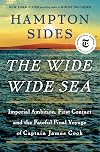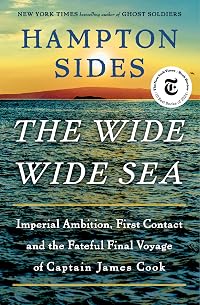
The Wide Wide Sea: Imperial Ambition, First Contact and the Fateful Final Voyage of Captain James Cook
by Hampton Sides
On This Page
Description
"From New York Times bestselling author Hampton Sides, an epic account of the most momentous voyage of the Age of Exploration, which culminated in Captain James Cook's death in Hawaii, and left a complex and controversial legacy still debated to this day. On July 12th, 1776, Captain James Cook, already lionized as the greatest explorer in British history, set off on his third voyage in his ship the HMS Resolution. Two and a half years later, on a beach on the island of Hawaii, Cook was show more killed in a conflict with native Hawaiians. How did Cook, who was unique among captains for his respect for Indigenous peoples and cultures, come to that fatal moment? Hampton Sides' bravura account of Cook's last journey both wrestles with Cook's legacy and provides a thrilling narrative of the titanic efforts and continual danger that characterized exploration in the 1700s. Cook was renowned for his peerless seamanship, his humane leadership, and his dedication to science--the famed naturalist Joseph Banks accompanied him on his first voyage, and Cook has been called one of the most important figures of the Age of Enlightenment. He was also deeply interested in the native people he encountered. In fact, his stated mission was to return a Tahitian man, Mai, who had become the toast of London, to his home islands. On previous expeditions, Cook mapped huge swaths of the Pacific, including the east coast of Australia, and initiated first European contact with numerous peoples. He treated his crew well, and endeavored to learn about the societies he encountered with curiosity and without judgment. Yet something was different on this last voyage. Cook became mercurial, resorting to the lash to enforce discipline, and led his two vessels into danger time and again. Uncharacteristically, he ordered violent retaliation for perceived theft on the part of native peoples. This may have had something to do with his secret orders, which were to chart and claim lands before Britain's imperial rivals could, and to discover the fabled Northwest Passage. Whatever Cook's intentions, his scientific efforts were the sharp edge of the colonial sword, and the ultimate effects of first contact were catastrophic for Indigenous people around the world. The tensions between Cook's overt and covert missions came to a head on the shores of Hawaii. His first landing there was harmonious, but when Cook returned after mapping the coast of the Pacific Northwest and Alaska, his exploitative treatment of the Hawaiians led to the fatal encounter. At once a ferociously-paced story of adventure on the high seas and a searching examination of the complexities and consequences of the Age of Exploration, THE WIDE WIDE SEA is a major work from one of our finest narrative nonfiction writers"-- show lessTags
Recommendations





























Member Reviews
"The Wide, Wide Sea" by Hampton Sides is the story of Captain Cook's final voyage. The mission was to sail the Resolution and the Discovery in search for the Northwest Passage and return native Tahitian Mai to his homeland laden with animals and gifts. King George III hoped to Tahiti into a more "civilized" society through Mai. On the way they would encounter native Tasmanians (who would become extinct within 100 years) and lead a particularly brutal encounter in Moorea. After an initial somewhat peaceful greeting, an act of petty theft convinced Cook to order a fiery decimation of the native village. On one hand, the English believed in private property. Period. But the Polynesians believed a person must be worthy of their possessions, show more or share communally. Clever thievery was an act of skill, not necessarily of maliciousness. This major cultural difference was one that Cook wouldn't acknowledge, and ultimately proved to be his downfall in Hawaii.
I wasn't a fan of how Sides handled Cook's attack on Moorea. Not defensive of his actions specifically, but quick to explain it away as a bout of mental illness. Sides quotes Cook's defenders and suggests that a battle-hungry Mai was partially to blame, but doesn't posit the idea that maybe Cook was acting on personal pride. Sides also made the mistake of wondering why the natives didn't fight back. Fear and cultural destruction are powerful tools and Cook knew how to utilize them effectively. I'm still not convinced that Cook was "unique" in his respect for Indigenous peoples, for his acts of violence prove he really was no different than any other 18th century Royal navyman. His treatment of Mai doesn't make for a fair argument because Mai had been indoctrinated as a beneficial tool for colonialism. However, if you can overlook these flaws, you will learn the finer details of Cook's final voyage in a detailed, accessible and compelling way. I do enjoy Sides' narrative voice very much, I only wish they had been a bit more critical and objective of Cook. Since this book only covers Cook's final voyage, the reader is given minimal insight into Cook's mindset on the previous two. If a reader is already fully familiar with Cook, perhaps some his actions would appear more "out of character." show less
I wasn't a fan of how Sides handled Cook's attack on Moorea. Not defensive of his actions specifically, but quick to explain it away as a bout of mental illness. Sides quotes Cook's defenders and suggests that a battle-hungry Mai was partially to blame, but doesn't posit the idea that maybe Cook was acting on personal pride. Sides also made the mistake of wondering why the natives didn't fight back. Fear and cultural destruction are powerful tools and Cook knew how to utilize them effectively. I'm still not convinced that Cook was "unique" in his respect for Indigenous peoples, for his acts of violence prove he really was no different than any other 18th century Royal navyman. His treatment of Mai doesn't make for a fair argument because Mai had been indoctrinated as a beneficial tool for colonialism. However, if you can overlook these flaws, you will learn the finer details of Cook's final voyage in a detailed, accessible and compelling way. I do enjoy Sides' narrative voice very much, I only wish they had been a bit more critical and objective of Cook. Since this book only covers Cook's final voyage, the reader is given minimal insight into Cook's mindset on the previous two. If a reader is already fully familiar with Cook, perhaps some his actions would appear more "out of character." show less
This fascinating and engaging history of James Cook’s last voyage presents a complicated man. He had extraordinary skills and abilities that had brought great fame and success, and yet fatal errors in judgement toppled the great man to his death.
After two voyages into uncharted waters, surveying and mapping unknown lands and making first contact with human societies across the Pacific, Cook was preparing for a comfortable retirement. But his king had another task for him: a third voyage with the mission of seeking a Northwest Passage. First, he was to return a man to his native homeland in the South Seas. In England, Mai became a celebrity and a dandy, and Cook resettled him with his numerous gifts, including livestock and plants from show more the king who wanted to display British civilization and superiority.
The voyage was filled with challenges. The Resolution’s subpar repairs resulted in leaks. There was the vagaries of the sea and weather to contend with. They met unfamiliar human societies both friendly and hostile. Life was complicated by Cook’s sometimes aberrant behavior and bad judgement.
Making first contact with Hawaii altered Cook’s luck. He arrived as the islanders were celebrating the god Lono, perfectly timed to for Cook to be considered the return of the god, and he was worshipped as Lono. The Resolution required extensive repairs resulting in the men overstayed their welcome, draining the island paradise’s resources. Meantime, the islanders were mad for anything made of iron, resorting to stealing it in their greed.
Cook sailed further than any man before, rounding the coast of Alaska and crossing the Arctic Circle. But he encountered ice instead of a northern shortcut and quickly turned back before the ships became encased in the ice. He returned to Hawaii for repairs and provisioning, but became embroiled in the conflict that ended his life. This visit, the islanders discovered that Cook was no god.
The book presents Cook, the good and the bad, and his legacy, the good and the bad. Cook had a scientific attitude, observing and recording the cultures and people he encountered without judgement. He was careful to protect the islanders from sexual disease, but he also left a ship load of rats behind. Cook’s emphasis on fresh foods resulted in no losses of crew to scurvy, while he was more diligent and brutal in his punishments. His discoveries of new lands gave his country impetitus for colonization to claim the natural resources, while missionaries arrived to enforce Christian beliefs and morality.
It was so interesting to learn about the many cultures Cook encountered, from New Zealand to the Inuit of Alaska.
Thanks to the publisher for a free book. show less
After two voyages into uncharted waters, surveying and mapping unknown lands and making first contact with human societies across the Pacific, Cook was preparing for a comfortable retirement. But his king had another task for him: a third voyage with the mission of seeking a Northwest Passage. First, he was to return a man to his native homeland in the South Seas. In England, Mai became a celebrity and a dandy, and Cook resettled him with his numerous gifts, including livestock and plants from show more the king who wanted to display British civilization and superiority.
The voyage was filled with challenges. The Resolution’s subpar repairs resulted in leaks. There was the vagaries of the sea and weather to contend with. They met unfamiliar human societies both friendly and hostile. Life was complicated by Cook’s sometimes aberrant behavior and bad judgement.
Making first contact with Hawaii altered Cook’s luck. He arrived as the islanders were celebrating the god Lono, perfectly timed to for Cook to be considered the return of the god, and he was worshipped as Lono. The Resolution required extensive repairs resulting in the men overstayed their welcome, draining the island paradise’s resources. Meantime, the islanders were mad for anything made of iron, resorting to stealing it in their greed.
Cook sailed further than any man before, rounding the coast of Alaska and crossing the Arctic Circle. But he encountered ice instead of a northern shortcut and quickly turned back before the ships became encased in the ice. He returned to Hawaii for repairs and provisioning, but became embroiled in the conflict that ended his life. This visit, the islanders discovered that Cook was no god.
The book presents Cook, the good and the bad, and his legacy, the good and the bad. Cook had a scientific attitude, observing and recording the cultures and people he encountered without judgement. He was careful to protect the islanders from sexual disease, but he also left a ship load of rats behind. Cook’s emphasis on fresh foods resulted in no losses of crew to scurvy, while he was more diligent and brutal in his punishments. His discoveries of new lands gave his country impetitus for colonization to claim the natural resources, while missionaries arrived to enforce Christian beliefs and morality.
It was so interesting to learn about the many cultures Cook encountered, from New Zealand to the Inuit of Alaska.
Thanks to the publisher for a free book. show less
To a bibliophilic teenager, the Age of Exploration once thrilled, alive with swashbuckling and romantic adventure. At that time, heroic European explorers were rarely acknowledged to have discovered lands and coastlines long occupied by people of other cultures. No longer are such histories tenable, not in the present era where these discoveries are understood in multiple contexts, including as the forerunners of colonial exploitation, and often the precursors to the collapse of indigenous cultures on a massive scale. Charles Mann describes the process in the Americas in two influential popular books 1491 and 1493, the first an account of the flourishing of Pre-Columbian civilizations, and the second their crumbling in the face of show more imperial theft and cataclysmic infectious disease.
Hampton Sides, an American history writer, aims to tell the story of James Cook from a more nuanced perspective. Captain Cook has played an outsized role as one the last great explorers of the period. He made prolific contributions to the map of the Pacific, and to the study of the natural history of vast regions. But in recent years, people from New Zealand to British Columbia have rejected monuments and geographical names memorializing his career. Sides aspires to include the perspectives of those Cook encountered along the way as he tells the story of the third and final voyage.
Cook enjoyed a singular nautical reputation in 1776, having retired at 46 following the completion of his second voyage. On his first voyage in his ship Endeavor, he circumnavigated the globe, observed from Tahiti the rare transit of Venus across the sun, made first contact with the Maori, and charted hitherto unknown regions of the South Pacific. His collaboration with botanist Joseph Banks yielded a wealth of scientific data. His second voyage expanded his explorations in the Pacific, tested a new marine chronometer which for the first time allowed accurate measurements of latitude, and made the first foray south of the Antarctic Circle.
Cook’s remit from the British Crown for a third voyage had a primary objective: search for the elusive Northwest Passage, a shortcut to Asia and its lucrative wares and markets, but this time from the western side of North America. The details of the Alaskan coast and the waterways to the north and east were still unknown, and Cook’s mapmaking, surveying, and captaincy were much respected. He was well regarded for his maturity, steadiness, tolerance, and judgment. But he assumed a second task as well. A Polynesian man named Mai had arrived in England in 1774 on Cook’s companion ship during the second voyage. A talented individual, he had learned English under the sponsorship of Joseph Banks, absorbed much of English life and culture, and won the affection of many prominent Englishmen. King George III promised Mai would be returned to his people. The King had a broader concept in mind, one in retrospect naive and imprudent. He would send animals, plants, seeds with Cook from the Royal farmlands to Polynesia to establish English-style farms for Mai’s countrymen. Apparently the limitless supply of seafood and fresh fruit the islanders enjoyed made little impression on His Majesty.
Sides narrates Cook’s unprecedented journey: Near disaster in New Zealand; the return of Mai, whose sojourn in England apparently inflated his ego and sabotaged his interactions with his relations; a happy holiday in Hawaii; the search for the Northwest Passage in Alaska. (Spoiler: he didn’t find it.) And evoking Magellan’s fate two centuries earlier, Cook’s violent death during the unhappy return to Hawaii. Cook’s last voyage paints on an immense canvas geographically and culturally, and the cast of characters is similarly diverse: British explorers, Polynesian Islanders, western North Americans, even Siberian indigenous people. Predictably, this mixing yields both exhilaration and tragedy.
What of Sides’ project, to tell the story from multiple points of view? Credit him with trying. The reality is that Cook’s voyage is amply documented, and the sheer volume of that information dwarves what can be known of Polynesian perspectives. The Maori and Polynesians preserved history in oral traditions. There are no records to review. Sides presents what can be inferred from English accounts, and from the events they described. He attends to obvious differences in attitudes toward private property and sexual mores. He uses the case of Mai’s return liberally, elaborating on the British attempts to make sense of the ill will he seemed to generate. There are Maori and Polynesian scholars today whose perspectives Sides presents. Cook’s death itself has been the subject of much analysis over the centuries. Was it a demonstration by angry or anxious Hawaiians that their god Lono was in fact all-powerful, and that Cook was not a god after all? Or as some scholars of Hawaiian culture of the period argue, was he well understood to be mortal all along, and his death the result of hubris and miscalculation?
Cook’s voyage is arguably the last great odyssey of the Age of Exploration. But in another sense, it is the first of a newer age of European science, one grounded less in the Enlightenment astronomy and physics of Galileo and Newton, and more located in the naturalism and dynamism of the Romantic period. Cook precedes the subsequent seekers and colonialists. Could their consequences be reflected in Star Trek’s famous Prime Directive: the principle of noninterference in the development of newly discovered alien cultures? First Contact is an illuminating, thrilling but risky undertaking. Cook is an end and a beginning. His story is instructive and well told here, the limits of broader perspectival inclusion notwithstanding. Alternatively, in our era of polarized points of view, perhaps the story is all the more instructive because of how those limits constrain the fullness of our understanding. show less
Hampton Sides, an American history writer, aims to tell the story of James Cook from a more nuanced perspective. Captain Cook has played an outsized role as one the last great explorers of the period. He made prolific contributions to the map of the Pacific, and to the study of the natural history of vast regions. But in recent years, people from New Zealand to British Columbia have rejected monuments and geographical names memorializing his career. Sides aspires to include the perspectives of those Cook encountered along the way as he tells the story of the third and final voyage.
Cook enjoyed a singular nautical reputation in 1776, having retired at 46 following the completion of his second voyage. On his first voyage in his ship Endeavor, he circumnavigated the globe, observed from Tahiti the rare transit of Venus across the sun, made first contact with the Maori, and charted hitherto unknown regions of the South Pacific. His collaboration with botanist Joseph Banks yielded a wealth of scientific data. His second voyage expanded his explorations in the Pacific, tested a new marine chronometer which for the first time allowed accurate measurements of latitude, and made the first foray south of the Antarctic Circle.
Cook’s remit from the British Crown for a third voyage had a primary objective: search for the elusive Northwest Passage, a shortcut to Asia and its lucrative wares and markets, but this time from the western side of North America. The details of the Alaskan coast and the waterways to the north and east were still unknown, and Cook’s mapmaking, surveying, and captaincy were much respected. He was well regarded for his maturity, steadiness, tolerance, and judgment. But he assumed a second task as well. A Polynesian man named Mai had arrived in England in 1774 on Cook’s companion ship during the second voyage. A talented individual, he had learned English under the sponsorship of Joseph Banks, absorbed much of English life and culture, and won the affection of many prominent Englishmen. King George III promised Mai would be returned to his people. The King had a broader concept in mind, one in retrospect naive and imprudent. He would send animals, plants, seeds with Cook from the Royal farmlands to Polynesia to establish English-style farms for Mai’s countrymen. Apparently the limitless supply of seafood and fresh fruit the islanders enjoyed made little impression on His Majesty.
Sides narrates Cook’s unprecedented journey: Near disaster in New Zealand; the return of Mai, whose sojourn in England apparently inflated his ego and sabotaged his interactions with his relations; a happy holiday in Hawaii; the search for the Northwest Passage in Alaska. (Spoiler: he didn’t find it.) And evoking Magellan’s fate two centuries earlier, Cook’s violent death during the unhappy return to Hawaii. Cook’s last voyage paints on an immense canvas geographically and culturally, and the cast of characters is similarly diverse: British explorers, Polynesian Islanders, western North Americans, even Siberian indigenous people. Predictably, this mixing yields both exhilaration and tragedy.
What of Sides’ project, to tell the story from multiple points of view? Credit him with trying. The reality is that Cook’s voyage is amply documented, and the sheer volume of that information dwarves what can be known of Polynesian perspectives. The Maori and Polynesians preserved history in oral traditions. There are no records to review. Sides presents what can be inferred from English accounts, and from the events they described. He attends to obvious differences in attitudes toward private property and sexual mores. He uses the case of Mai’s return liberally, elaborating on the British attempts to make sense of the ill will he seemed to generate. There are Maori and Polynesian scholars today whose perspectives Sides presents. Cook’s death itself has been the subject of much analysis over the centuries. Was it a demonstration by angry or anxious Hawaiians that their god Lono was in fact all-powerful, and that Cook was not a god after all? Or as some scholars of Hawaiian culture of the period argue, was he well understood to be mortal all along, and his death the result of hubris and miscalculation?
Cook’s voyage is arguably the last great odyssey of the Age of Exploration. But in another sense, it is the first of a newer age of European science, one grounded less in the Enlightenment astronomy and physics of Galileo and Newton, and more located in the naturalism and dynamism of the Romantic period. Cook precedes the subsequent seekers and colonialists. Could their consequences be reflected in Star Trek’s famous Prime Directive: the principle of noninterference in the development of newly discovered alien cultures? First Contact is an illuminating, thrilling but risky undertaking. Cook is an end and a beginning. His story is instructive and well told here, the limits of broader perspectival inclusion notwithstanding. Alternatively, in our era of polarized points of view, perhaps the story is all the more instructive because of how those limits constrain the fullness of our understanding. show less
Finally a readable Captain Cook book written in modern narrative nonfiction form. Hampton Sides is one of the best of this genre. The pacing and proportion it's like a 14 hour movie that never flags. Captain Cook you can't get away from, he is named dropped all over the place, in places and in books. Yet, try to find good books about him and they are either hagiography or so detailed as to loose sight of the forest for the trees. He is a difficult subject because of the evils of colonialism; and Cook left very few written records other than ship logs, he was a reserved character in real life. Sides shows Cook to be a man torn by self-knowledge of despoiling native cultures, but also with no choice because of his mission. These show more contradictions drove Cook a little crazy in the end as he vacillates between benevolent bringer of civilization, and destroyer of worlds. Despite the evils of colonization, it still captures the imagination exploring at a continent-scale for the first time. Cooks third voyage was the longest distance and time wise of any exploratory journey to that time. This is a wonderful book about an amazing story by a remarkable writer. show less
Captain Cook's 3rd voyage is one of the great dramas of exploration and hubris. By 1776, Cook had already made a reputation as one of the finest explorers of his, or any age, combining exceptional skill at navigation and cartography with stern yet fairhanded leadership and surprising sensitivity to cultural norms. He could have accepted a generous retirement as one of the heads of the Greenwich naval hospital, but the lure of the sea was too much.
The ostensible reason for Cook's third journey was to return Omai, a Polynesian to his home. Omai had come to England with another expedition and charmed high society, but his time as a curiosity had reached its end and all were ready to see him home, newly armed with European weapons, to seek show more revenge on the warriors who had killed his father. Cook's secret orders were to search for the fabled Northwest Passage from the western end. Contemporary theory held that ice could only be formed in fresh water, and that sea ice was the outflow from terrestrial rivers. Theoretically, far enough away from shore there would be open water.
The first part of the journey took him through Cape Town, the Kerguelen Islands, New Zealand, and then the society islands, where Cook delivered Omai and a host of animals sent by King George to the Tahitians. This part of the journey showed that something had changed in Cook. While life at sea requires discipline, Cook became for the first time a flogging captain, doling out 60 lashes for relatively minor offenses. Relations between Polynesians and the English was often characterized by theft, as Polynesians had a desperate desire for iron, a more relaxed attitude towards private property, and a tradition of heroic trickster-thieves, but Cook's responses became increasing disproportionate.
At first thieves had half their head shaved, humiliating in the body conscious islands but a mark which would fade after the English departed. At some point, Cook started cutting off the ears of native thieves. On Moorea, after the theft of a goat, Cook's crew (and Omai) embarked on a rampage of destruction until the animal was returned.
After departing the Society Islands and heading north, Cook made the major discover of the voyage, finding the Hawaiian islands. Though smack in the middle of the route taken by the Manila galleon for over a century, Europeans had somehow missed the islands. Cook landed on Kauai for a peaceful encounter before skipping the rest of the chain to head north. The exploration of the Pacific Northwest and the Alaskan coast again displayed Cook's skills, as he turned Bering's vague and misleading maps into precise fixtures of landmarks, made peaceful trades with local tribes, and skillfully navigated treacherous waters and ice. The Northwest Passage was blocked by the arctic icecap, an example of negative discovery, and Cook set sail south to winter in some place more hospitable.
This is where the story gets truly weird. Cook arrived at the big island of Hawai'i and choose to circle the island counter-clockwise. By an immense coincidence, this occurred at the same time as the festival of the god Lono, who was prophecied to return after circle the island counter-clockwise and who's holy symbols included a shield adorned with crosses and white streamers which resembled the sails of a ship. The Hawaiians took Cook to be the return of their god.
Or at least some people argue they did. We can't really reconstruct the attitudes of people who lived centuries ago when we have incomplete oral histories. Cook's journals for this period are missing, either never written or destroyed at some later point, though he was a conscientious diarist. Sides come down with those who believe that Cook was sincerely treated as some sort of divine figure, an opinion I agree with. Hawaiians weren't naive, but they were a profoundly spiritual people who's belief systems were flexible enough to extend to something like incarnation.
The extended stay of Cook and his crew wore out any friendly feelings between the two cultures, and when Cook departed in February, all were happy to move on. Except the Resolution's foremast broke, and Cook returned for repairs. The season of Lono was over, and the god was supposed to be gone. It was now the season of war.
When one of the ship's cutters was stolen, Cook attempted to take the King of Hawaiʻi, Kalaniʻōpuʻu, captive. Massively outnumbered, Cook refused to back down, and he had an untested faith in the psychological power of musketry to scatter the natives. According to Sides, Cook fired the first shop, killing a Hawaiian warrior. He and his men were then attacked from all sides and overwhelmed.
This is a fantastic history, showing some of the wonder of the era, and the tragedy of man eventually destroyed by his own mistakes and hubris. show less
The ostensible reason for Cook's third journey was to return Omai, a Polynesian to his home. Omai had come to England with another expedition and charmed high society, but his time as a curiosity had reached its end and all were ready to see him home, newly armed with European weapons, to seek show more revenge on the warriors who had killed his father. Cook's secret orders were to search for the fabled Northwest Passage from the western end. Contemporary theory held that ice could only be formed in fresh water, and that sea ice was the outflow from terrestrial rivers. Theoretically, far enough away from shore there would be open water.
The first part of the journey took him through Cape Town, the Kerguelen Islands, New Zealand, and then the society islands, where Cook delivered Omai and a host of animals sent by King George to the Tahitians. This part of the journey showed that something had changed in Cook. While life at sea requires discipline, Cook became for the first time a flogging captain, doling out 60 lashes for relatively minor offenses. Relations between Polynesians and the English was often characterized by theft, as Polynesians had a desperate desire for iron, a more relaxed attitude towards private property, and a tradition of heroic trickster-thieves, but Cook's responses became increasing disproportionate.
At first thieves had half their head shaved, humiliating in the body conscious islands but a mark which would fade after the English departed. At some point, Cook started cutting off the ears of native thieves. On Moorea, after the theft of a goat, Cook's crew (and Omai) embarked on a rampage of destruction until the animal was returned.
After departing the Society Islands and heading north, Cook made the major discover of the voyage, finding the Hawaiian islands. Though smack in the middle of the route taken by the Manila galleon for over a century, Europeans had somehow missed the islands. Cook landed on Kauai for a peaceful encounter before skipping the rest of the chain to head north. The exploration of the Pacific Northwest and the Alaskan coast again displayed Cook's skills, as he turned Bering's vague and misleading maps into precise fixtures of landmarks, made peaceful trades with local tribes, and skillfully navigated treacherous waters and ice. The Northwest Passage was blocked by the arctic icecap, an example of negative discovery, and Cook set sail south to winter in some place more hospitable.
This is where the story gets truly weird. Cook arrived at the big island of Hawai'i and choose to circle the island counter-clockwise. By an immense coincidence, this occurred at the same time as the festival of the god Lono, who was prophecied to return after circle the island counter-clockwise and who's holy symbols included a shield adorned with crosses and white streamers which resembled the sails of a ship. The Hawaiians took Cook to be the return of their god.
Or at least some people argue they did. We can't really reconstruct the attitudes of people who lived centuries ago when we have incomplete oral histories. Cook's journals for this period are missing, either never written or destroyed at some later point, though he was a conscientious diarist. Sides come down with those who believe that Cook was sincerely treated as some sort of divine figure, an opinion I agree with. Hawaiians weren't naive, but they were a profoundly spiritual people who's belief systems were flexible enough to extend to something like incarnation.
The extended stay of Cook and his crew wore out any friendly feelings between the two cultures, and when Cook departed in February, all were happy to move on. Except the Resolution's foremast broke, and Cook returned for repairs. The season of Lono was over, and the god was supposed to be gone. It was now the season of war.
When one of the ship's cutters was stolen, Cook attempted to take the King of Hawaiʻi, Kalaniʻōpuʻu, captive. Massively outnumbered, Cook refused to back down, and he had an untested faith in the psychological power of musketry to scatter the natives. According to Sides, Cook fired the first shop, killing a Hawaiian warrior. He and his men were then attacked from all sides and overwhelmed.
This is a fantastic history, showing some of the wonder of the era, and the tragedy of man eventually destroyed by his own mistakes and hubris. show less
Of course, I had heard of Captain James Cook, one of the greatest explorers of all time but I had never read anything specifically about him. Well, leave it to Hampton Sides, one of my favorite nonfiction authors, to set me straight. In July 1776, Cook embarked on his final journey. His mission was to map out as much of the Pacific, as he could. From New Zealand to Alaska and back. Two and a half years later, after sailing thousands and thousands of miles, he ends up being killed on a Hawaiian island, by the natives there. This is a fantastic tale of the Age of Exploration, with both it’s triumphs and it’s fateful consequences, crafted by a master storyteller. Highly recommended.
In The Wide, Wide Sea, Hampton Sides tries to present a factual and unbiased account of Captain James Cook’s third and ultimately fatal voyage. Using as many first-hand accounts as possible — including oral histories from the indigenous people — Sides does an admirable job of not deifying or demonizing Cook, but trying to ascertain his true actions and motives. Sometimes heavily documented texts can get boring, but Sides keeps things moving, and the actual voyage is too fascinating to ever become dull. I really enjoyed this book, and recommend it to readers of nonfiction who like sea voyages, exploration, and history.
Members
- Recently Added By
Lists

History
37 works; 1 member

Books recommended by Barack Obama
295 works; 28 members

Barack Obama's Summer Reading List 2024
14 works; 2 members

Top Five Books of 2024
795 works; 264 members

Books Read in 2025
4,128 works; 98 members
Top Five Books of 2025
954 works; 303 members
Author Information

Hampton Sides, contributing editor of "Outside" & editor of "The Wild File," is also the author of "Ghost Soldiers". He lives in Santa Fe, New Mexico. (Publisher Provided) Hampton Sides received a BA in history from Yale University. He is editor-at-large for Outside Magazine and has also written for National Geographic, The New Yorker, Esquire, show more Preservation, and Men's Journal. His magazine work has been nominated twice for National Magazine Awards for feature writing. He is the author of several books including Ghost Soldiers, Blood and Thunder, Hellhound on His Trail, and In the Kingdom of Ice. (Bowker Author Biography) show less
All Editions
Some Editions
Awards and Honors
Awards
Distinctions
Common Knowledge
- Canonical title*
- Sur la Vaste, Vaste Mer : Le Dernier Voyage du Capitaine Cook
- Original publication date
- 2024
- People/Characters
- Captain James Cook, RN, FRS
- Important places
- Hawaiian Islands; Tahiti, French Polynesia; New Zealand; Alaska
- Important events
- Captain Cook's third voyage (1776-1780)
- Epigraph
- Alone, alone, all, all alone,
Alone on a wide wide sea!
And never a saint took pity on
My soul in agony.
- Samuel Taylor Coleridge, The Time of the Ancient Mariner - Dedication
- for ANNE ALMIGHTY
with all my love - First words
- (Prologue) Kauai, the Hawaiian Islands, January 1778
On the night the ships appeared, some fishermen were out on the ocean, working by torchlight.
It was the start of a very important year - 1776 - and James Cook had become a very important figure, a celebrity, a champion, a hero. - Last words
- (Click to show. Warning: May contain spoilers.)Protesters had dribbled and splotched the monument's substantial plinth, Jackson Pollock style, with copious amounts of blood red paint, and just above Cook's name someone had written, in bold letters: YOU ARE ON NATIVE LAND.
(Click to show. Warning: May contain spoilers.)(Epilogue) Then, at last, he would glide into Kealakekua Bay - reuniting with his people, at his exalted place. His eternal home. - Blurbers
- Preston, Douglas; Alexander, Caroline; Hattendorf, John B.; Fedarko, Kevin; Thornton, Cliff; Vaillant, John (show all 8); Heller, Peter; King, Dean
- Original language
- English US
*Some information comes from Common Knowledge in other languages. Click "Edit" for more information.
Classifications
- Genres
- History, Travel, Nonfiction, General Nonfiction, Biography & Memoir
- DDC/MDS
- 910.92 — History & geography Geography & travel modified standard subdivisions of Geography and travel Explorers & Travelers Geographers, travellers, explorers regardless of country of origin
- LCC
- G246 .C7 .S53 — Geography, Anthropology and Recreation Geography (General) History of discoveries, explorations, and travel
- BISAC
Statistics
- Members
- 911
- Popularity
- 29,563
- Reviews
- 26
- Rating
- (4.38)
- Languages
- English, French, Spanish
- Media
- Paper, Audiobook, Ebook
- ISBNs
- 14
- ASINs
- 6