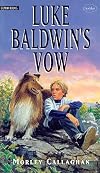
Luke Baldwins Vow
by Morley Callaghan
On This Page
Description
A story of a boy and his dog and their adventures, which will appeal to the many children who are dog lovers. It is also a sensitive story of love and loss, and of making a new life for oneself. Luke is not yet 12 when his father dies of a heart attack, leaving him an orphan. Small for his age and something of a loner, he moves from the city to the country to live with his aunt and uncle. He is naturally homesick and grieving the loss of his father. His well-meaning and kindly aunt and uncle show more do their best for him; but his only real friend and comfort becomes Dan, the farm's elderly, one-eyed collie. Practical Uncle Henry considers Dan useless now that he is too old to be a watch-dog and decides that Dan should be "put down." Luke, whose sense of dignity and loyalty transcend the practical, frantically tries to save Dan's life, providing for heart-racing suspense as he makes his stand against the expedient world of adults. show lessTags
Recommendations














Member Reviews
Considering Morley Callaghan's children's novel, THE VOW (1948), was written over 65 years ago, it holds up well and the lessons it teaches are, I think, still valid.
So why am I reading this obscure children's book from Canada? Well, a few years back I read and very much enjoyed Callaghan's memoir, THAT SUMMER IN PARIS (1963), about his expatriate year in the 1920s and his friendships with Hemingway, Fitzgerald, Stein and others, and, since I was a boyhood fan of dog books by Terhune, O'Brien, Curwood and Kjelgaard, I though I would try a Canadian dog book.
And I am glad I did, although THE VOW is probably much more of the realist school than the romantic adventures those other dog book writers wrote. Briefly, eleven year-old orphan, show more Luke Baldwin, is forced to grow up a little faster when he comes to live with his burly and very practical-minded Uncle Henry, a successful small town sawyer, who is nothing at all like Luke's late father, who was a physician. Henry is determined to cure Luke of his 'dreaminess' and make a man out of him. Luke takes comfort in the companionship of their dog, Dan, an aging one-eyed collie who is nearing the end of his usefulness around the house and sawmill. A city boy, Luke also must learn to fit in and assert himself among a new crowd of rough country boys.
Yes, it is a fairly straightforward and simple story. The crux of it, however, is very different from the soft-filtered Victorian tones of Terhune's Sunnybank collie books. Because Uncle Henry determines that it's time to 'get rid' of old Dan, despite the bond between the dog and boy. How Luke responds to this situation is indeed moving and, at the same time, pretty realistic. And, lest you get the wrong idea, Uncle Henry is NOT painted as a villain. He is simply a businessman who evaluates things carefully, and when he decides something - a dog, for example - has outlived its usefulness, well, then it has to go. And I could relate. Perhaps because I was a child of the forties and fifties, back when dogs were pretty disposable and easily replaced, and I can remember my father once had to shoot our dog - a collie, in fact - who had killed some of our neighbor's chickens. And, while my three older brothers and I were certainly upset and saddened by this turn of events, we did not hate our dad. It was simply the way of the world, and we learned. None of this sounds very politically correct now, I know, in an era when chickens might be found in an animal shelter - CHICKENS! - but that's just the way it was. Pets and animals were possessions, to be used or disposed of as owners saw fit.
So I can see how THE VOW served a purpose and taught a lesson in its time. It's also a pretty damn good story, about family, about boys, and most importantly, about a boy and his dog. I will highly recommend it for middle school children, but I would recommend parents read it too, so they can talk about it with the young readers, can explain how things once were with people and pets - and sometimes still are.
P.S. Both this book and the memoir I mentioned, are now available in handsome reprints from Exile Editions, a press founded and run by Morley Callaghan's son.
- Tim Bazzett, author of the memoir, BOOKLOVER show less
So why am I reading this obscure children's book from Canada? Well, a few years back I read and very much enjoyed Callaghan's memoir, THAT SUMMER IN PARIS (1963), about his expatriate year in the 1920s and his friendships with Hemingway, Fitzgerald, Stein and others, and, since I was a boyhood fan of dog books by Terhune, O'Brien, Curwood and Kjelgaard, I though I would try a Canadian dog book.
And I am glad I did, although THE VOW is probably much more of the realist school than the romantic adventures those other dog book writers wrote. Briefly, eleven year-old orphan, show more Luke Baldwin, is forced to grow up a little faster when he comes to live with his burly and very practical-minded Uncle Henry, a successful small town sawyer, who is nothing at all like Luke's late father, who was a physician. Henry is determined to cure Luke of his 'dreaminess' and make a man out of him. Luke takes comfort in the companionship of their dog, Dan, an aging one-eyed collie who is nearing the end of his usefulness around the house and sawmill. A city boy, Luke also must learn to fit in and assert himself among a new crowd of rough country boys.
Yes, it is a fairly straightforward and simple story. The crux of it, however, is very different from the soft-filtered Victorian tones of Terhune's Sunnybank collie books. Because Uncle Henry determines that it's time to 'get rid' of old Dan, despite the bond between the dog and boy. How Luke responds to this situation is indeed moving and, at the same time, pretty realistic. And, lest you get the wrong idea, Uncle Henry is NOT painted as a villain. He is simply a businessman who evaluates things carefully, and when he decides something - a dog, for example - has outlived its usefulness, well, then it has to go. And I could relate. Perhaps because I was a child of the forties and fifties, back when dogs were pretty disposable and easily replaced, and I can remember my father once had to shoot our dog - a collie, in fact - who had killed some of our neighbor's chickens. And, while my three older brothers and I were certainly upset and saddened by this turn of events, we did not hate our dad. It was simply the way of the world, and we learned. None of this sounds very politically correct now, I know, in an era when chickens might be found in an animal shelter - CHICKENS! - but that's just the way it was. Pets and animals were possessions, to be used or disposed of as owners saw fit.
So I can see how THE VOW served a purpose and taught a lesson in its time. It's also a pretty damn good story, about family, about boys, and most importantly, about a boy and his dog. I will highly recommend it for middle school children, but I would recommend parents read it too, so they can talk about it with the young readers, can explain how things once were with people and pets - and sometimes still are.
P.S. Both this book and the memoir I mentioned, are now available in handsome reprints from Exile Editions, a press founded and run by Morley Callaghan's son.
- Tim Bazzett, author of the memoir, BOOKLOVER show less
Ratings
Members
- Recently Added By
Lists

The Best of Canadian Literature
235 works; 33 members

Rough collies -- children's/young adult fiction
155 works; 1 member

Dogs -- children's/young adult fiction
1,317 works; 9 members
Author Information

77+ Works 1,251 Members
Morley Callaghan 1903-1990 Morley Callaghan was born on February 22, 1903 in Toronto, Canada. A master of the short story and author of several excellent novels, Callaghan has long been a writer of international reputation. He educated at St. Michael's College, University of Toronto, and Osgoode Hall Law school. Working as a reporter for the show more Toronto Daily Star, he met Ernest Hemingway who was also working with the newspaper. In 1929, the same year as his first volume of short stories, Native Argosy, was published, Callaghan traveled to Paris, where he became reacquainted with Hemingway and met James Joyce and F. Scott Fitzgerald. That Summer in Paris (1963) contains Callaghan's memoirs of his experiences with these famous expatriates. Morley Callaghan is renowned for the clarity and economy of his prose. While Callaghan's work appears forthright and uncomplicated, each of the novels focuses on a character who faces a crisis. How this turning point is handled determines the direction the character's life will take. Callaghan, who was a devout Catholic, saw himself as a moralist as well as one who gave "shape and form to human experience." Callaghan was awarded the Royal Society of Canada's Lorne Pierce Medal in 1960. In 1982 he was made a Companion of the Order of Canada. Callaghan's works include The Loved and the Lost (which won the Governor General's Award in 1951), The Many Colored robe, A Time for Judas, Our Lady of the Snows, and A Wild Old man Down the Road. He died at the age of 87 and was interred at Mount Hope Catholic Cemetery in Ontario. (Bowker Author Biography) show less
Work Relationships
Classifications
- Genres
- Fiction and Literature, Children's Books, Kids, Tween
- DDC/MDS
- 813.01083629772 — Literature & rhetoric American literature in English American fiction in English By type Short fiction
- LCC
- PZ7 .E72556 .C355 — Language and Literature Fiction and juvenile belles lettres Fiction and juvenile belles lettres Juvenile belles lettres
- BISAC
Statistics
- Members
- 73
- Popularity
- 431,490
- Reviews
- 1
- Rating
- (3.50)
- Languages
- English, Lithuanian
- Media
- Paper, Ebook
- ISBNs
- 10
- ASINs
- 3