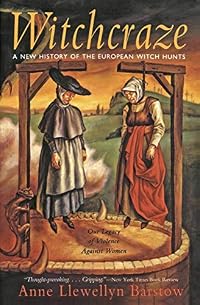
Witchcraze
by Anne L. Barstow
On This Page
Description
"In the sixteenth century, a rise in sexual violence in European society was exacerbated by pressure from church and state to change basic sexual customs...As the centuries since have shown escalating levels both of violence, general and sexual, and of state control, the witchcraze can be considered a portent, even a model, of some aspects of what modern Europe would be like." Over three centuries, approximately one hundred thousand persons, most of whom were women, were put to death under show more the guise of "witch hunts", particularly in Reformation Europe. The shocking annihilation of women from all walks of life is explored in this brilliant, authoritative feminist history Anne Llwellyn Barstow. Barstow exposes an unrecognized holocaust -- the "ethnic cleansing" of independent women in Reformation Europe -- and examines the residual attitudes that continue to influence our culture. Barstow argues that it is only with eyes sensitive to gender issues that we can discern what really happened in the persecution and murder of these women. Her sweeping chronicle examines the scapegoating of women from the ills of society, investigates how their subjugation to sexual violence and death sent a message of control to all women, and compares this persecution of women with the enslavement and slaughter of African slaves and Native Americans. Ultimately Barstow traces the current backlash against women to its gynophobic torture-filled origins. In the process, she leaves an indelible mark on our growing understanding of the legacy of violence against women around the world. show lessTags
Recommendations









Member Reviews
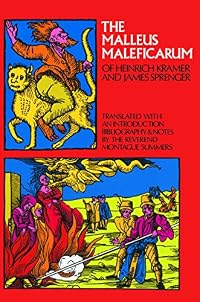
For a fairly slim volume this tackles a huge subject: the 16th and 17th century witch hunts which preoccupied the religious and civic authorities across Europe. The author puts forward various suggestions as to why this burgeoned into such a holocaust after many centuries of low level persecution of witches, and certainly has a point in linking it to the adoption of the theories in Malleus Maleficarum and similar witch hunting manuals that women were supposedly more lustful, more open to persuasion by the devil and that witchcraft was a pact with Satan, in effect making it a replacement for the heresy which had been viciously persecuted on the continent previously. This point is made by contrasting the much lower level persecution in show more countries such as England, where witchcraft was looked on as a crime to be punished according to the level of harm done to others and where the ideas about the devil's pact, witches sabbat (meeting) and other elements were only introduced late on from the continent. The legalised use of extreme tortures in European countries ensured that persecutions became widespread, as victims named further victims in a spiral of torture and judicial murder, in contrast with England where torture was illegal, the legal system was not inquisitorial, and witchcraft outbreaks were generally small scale as a direct result.
The book roams around very widely in its ambition to cover not only the countries with well-known witchcraft persecutions, but others including Russia. Its underlying theme is that of seeing the witchcraft persecutions as a war on women. Women certainly were greatly disadvantaged, in a period where employment laws were pushing women into more marginal, poorly paid work, where the continent was riven by religious conflict and wars, and where certain officials in both church and state viewed women as more potentially evil than men due to their perceived moral weakness. Certainly a large element of 'blame the victim' went on. The descriptions of appalling torture in this book are also harrowing.
Ultimately, I'm not sure how much use this is as a real guide to the development of the hunts, as opposed to a whistle stop tour with some anecdotes of sad victims. The cruel and even sadistic treatment inflicted on the victims was deplorable, but I wasn't sure if I really learned anything from this book that I didn't already know from others. Although this was published in the 1990s, I'm pretty sure there were others written around the same time which drew the same inferences about gender bias in the numbers of victims of the persecutions, despite the claims in the book to be unique in this. So I would rate this at 3 stars. show less
The book roams around very widely in its ambition to cover not only the countries with well-known witchcraft persecutions, but others including Russia. Its underlying theme is that of seeing the witchcraft persecutions as a war on women. Women certainly were greatly disadvantaged, in a period where employment laws were pushing women into more marginal, poorly paid work, where the continent was riven by religious conflict and wars, and where certain officials in both church and state viewed women as more potentially evil than men due to their perceived moral weakness. Certainly a large element of 'blame the victim' went on. The descriptions of appalling torture in this book are also harrowing.
Ultimately, I'm not sure how much use this is as a real guide to the development of the hunts, as opposed to a whistle stop tour with some anecdotes of sad victims. The cruel and even sadistic treatment inflicted on the victims was deplorable, but I wasn't sure if I really learned anything from this book that I didn't already know from others. Although this was published in the 1990s, I'm pretty sure there were others written around the same time which drew the same inferences about gender bias in the numbers of victims of the persecutions, despite the claims in the book to be unique in this. So I would rate this at 3 stars. show less
Argues that the witch hunts of the past were essentially a pogrom against women, in which independent women were blamed for the problems of the times
Now superceded, but important in its day - needs to be considered in the history of the history of the trials... as it were.
barstow has her own agenda and rants on about it to the point of obscuring the actual situation in europe. not recommended.
I had a misprinted copy, so I missed a good portion of the book. Sad face.
Ratings
Members
- Recently Added By
Lists

Witch Hunts
30 works; 7 members
Author Information
7 Works 537 Members
Common Knowledge
- Canonical title
- Witchcraze
- Original publication date
- 1994
- People/Characters
- Reginald Scot; Walpurgia Hausmanin; Marguerite Carlier; John Metcalf of Leeds; Anne Dixon; Neele Ellers (show all 17); Jochum Bos; Old Demdyke; Old Chattox; Anne Redfearne; Alison Device; Jennet Preston; Alice Nutter; Alice Kyteler; Anna Pedersdotter Absalon; Catherine Jolie; Anne Pappenheimer
- Important events
- Witch Trials (1450 | 1750); Reformation (1517 | 1648)
- Dedication
- For those who did not survive
- First words
- Joan Petersen, a healer, "was searched again in a most unnatural and barbarous manner by four women" supplied by her accusers, who found "a teat of flesh in her secret parts more than other women usually had."
- Last words
- (Click to show. Warning: May contain spoilers.)And no one has yet said, "They will never dare to happen again."
Classifications
- Genres
- History, Nonfiction, Religion & Spirituality, General Nonfiction, Sexuality and Gender Studies
- DDC/MDS
- 133.43094 — Philosophy and Psychology Parapsychology & occultism Specific topics in parapsychology and occultism Demonology and witchcraft Magic and witchcraft Standard subdivisions History, geographic treatment, biography Europe
- LCC
- BF1584 .E9 .B27 — Philosophy, Psychology and Religion Psychology Occult sciences Witchcraft
- BISAC
Statistics
- Members
- 507
- Popularity
- 59,036
- Reviews
- 5
- Rating
- (3.53)
- Languages
- English, Portuguese
- Media
- Paper
- ISBNs
- 2
- ASINs
- 4