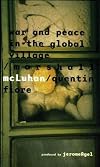
War and Peace in the Global Village
by Marshall McLuhan
On This Page
Description
Initiallly published in 1968, this text is regarded as a revolutionary work for its depiction of a planet made ever smaller by new technologies. A mosaic of pointed insights and probes, this text predicts a world without centres or boundaries. It illustrates how the electronic information travelling around the globe at the speed of light has eroded the rules of the linnear, literate world. No longer can there be fixed positions or goals.Tags
Recommendations
























Member Reviews
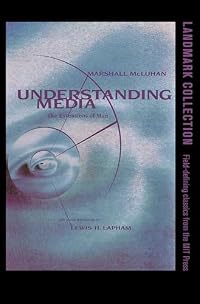
I picked this book up, along with Understanding Media (also by McLuhan) at a random book sale. I loved Understanding Media so I thought I would enjoy this one too. Instead, I barely understood it and thought it was wrong when I did understand it. I never really figured out what the authors' point was. There were interesting fragments of ideas, but there was something of a fundamental disconect between my understanding and what was on the page. That said, the book really has a great rhythm to it. I almost feel like I would have understood it better if I had listened to it. Perhaps that was the point.
Fascinating read, highly relevant to today and the current 'war on terrorism'. Explains that Joyce was the first man to discover how technology change affected culture, and uses Finnegan's Wake as the sort of leitmotif around which the book is structured.
Rated: F
Ratings
Members
- Recently Added By
Author Information

60+ Works 8,713 Members
A poetry professor turned media theorist---or media guru, as some in the press called him at the time---Marshall McLuhan startled television watchers during the 1960's with the notion that the medium they were enthralled by was doing more than transmitting messages---it was the message: Its rapid-fire format, mixing programs and advertisements, show more conveyed as much as---or more than---any single broadcast element. McLuhan grew up in the prairie country of the Canadian West and studied English at the University of Manitoba and Cambridge University. As television entered a period of huge growth during the 1950's, McLuhan, then a college professor, became interested in advertising. He thought of it as something to be taken seriously as a new culture form, beyond its obvious capability of selling products. That interest led to his increasing speculation about what media did to audiences. In his unpredictable modern poetry classes at the University of Toronto, he spoke more and more of media. The students he taught were the television generation, the first to grow up with the medium. Many were fascinated by McLuhan's provocative observations that a medium of communication radically alters the experience being communicated. A society, he said, is shaped more by the style than by the content of its media. Thus, the linear, sequential style of printing established a linear, sequential style of thinking, in which one thing is considered after another in orderly fashion: it shaped a culture in which (objective) reason predominated and experience was isolated, compartmentalized, and repeatable. In contrast, the low-density images of television, composed of a mosaic of light and dark dots, established a style of response in which it is necessary to unconsciously reconfigure the dots immediately in order to derive meaning from them. It has shaped a culture in which (subjective) emotion predominates and experience is holistic and unrepeatable. Since television (and the other electronic media) transcends space and time, the world is becoming a global village---a community in which distance and isolation are overcome. McLuhan was crisp and assured in his pronouncements and impatient with those who failed to grasp their import. McLuhan's most famous saying, "the medium is the message," was explicated in the first chapter of his most successful book, "Understanding Media," published in 1966 and still in print. It sold very well for a rather abstruse book and brought McLuhan widespread attention in intellectual circles. The media industry responded by seeking his advice and enthusiastically disseminating his ideas in magazines and on television. These ideas caused people to perceive their environment, particularly their media environment, in radically new ways. It was an unsettling experience for some, liberating for others. Though McLuhan produced some useful insights, he was given to wild generalizations and flagrant exaggerations. Some thought him a charlatan, and he always felt himself an outcast at the university, at least partly because of his disdain for print culture and opposition to academic conventions. He never seemed quite as energetic after an operation in 1967 to remove a huge brain tumor, but he continued to work and teach until he suffered a stroke in 1979. He died a year later. Though today his writings are not discussed as much by the general public, his thesis is still considered valid and his ideas have become widely accepted. (Bowker Author Biography) show less
Series
Belongs to Publisher Series
Bantam Books (P4339)
Common Knowledge
- Epigraph
- Globes make my head spin. By the time I locate the place, they've changed the boundaries.
Lead, kindly fowl! They always did: ask the ages. What bird has done yesterday man may do next year, be it fly, be it moult, be it hatch, be it agreement in the nest. FW 112 - First words
- The frequent marginal quotes from Finnegans Wake serve a variety of functions.
- Last words
- (Click to show. Warning: May contain spoilers.)Our technologies, or self-amputations, and the environments or habitats which they create must now become that matrix of that macrocosmic connubial bliss derided by the evolutionist.
Classifications
- Genres
- Nonfiction, Sociology, General Nonfiction, Philosophy, Technology
- DDC/MDS
- 190 — Philosophy & psychology Modern western philosophy Modern western and other noneastern philosophy
- LCC
- CB478 .M24 — Auxiliary Sciences of History History of Civilization History of Civilization Relation to special topics Technology
- BISAC
Statistics
- Members
- 434
- Popularity
- 70,573
- Reviews
- 3
- Rating
- (3.09)
- Languages
- English, French, German, Spanish
- Media
- Paper
- ISBNs
- 11
- ASINs
- 7