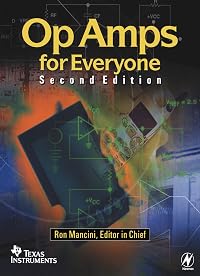
Op Amps for Everyone
by Bruce Carter
On This Page
Description
Op Amps for Everyone, Fifth Edition, will help you design circuits that are reliable, have low power consumption, and can be implemented in as small a size as possible at the lowest possible cost. It bridges the gap between the theoretical and practical by giving pragmatic solutions using components that are available in the real world from distributors. The book does not just give a design with a transfer function; instead, it provides design tools based on transfer function, getting you to show more a working circuit so you can make the right decision on which op amp is best for the job at hand. With this book you will learn: single op amp designs that get the most out of every amplifier; which specifications are of most importance to your design, enabling you to narrow down the list of amplifiers to those few that are most suitable; strategies for making simple tweaks to the design ?changes that are often apparent once a prototype has been constructed; how to design for hostile environments ?extreme temperatures, high levels of shock, vibration, and radiation ?by knowing which circuit parameters are likely to degrade and how to counteract that degradation. Features real world op amp selection guides Teaches which op amp is best for the job Includes design circuits with real world component values Contains guidelines for developing the entire signal chain, from specification for the transducer to power supply and data converter Includes new coverage of negative regulation techniques and op amp stability, negative regulation techniques, extended electronics theory and troubleshooting show lessTags
Recommendations








Member Reviews
Beware: The guide on how to calculate noise of op-amp amplifiers is full of errors, which resulted in great confusion as I tried to learn this topic and my calculations disagreed depending on which instructions I followed.
First big mistake: They combine the noise of the resistors with the output noise of the op-amp:
Instead, they should be combining the noise of the resistors with the input noise of the op-amp, and then multiplying this by the (noise) gain to get the output noise.
Second big mistake: They sum the noise of parallel resistors together. Instead, they should be calculating the equivalent resistance seen by the source, and then using that. For instance, they combine a 10 MΩ resistor and a 100 kΩ resistor as if they were in show more series (10.1 MΩ → 57.1 μV), but they should be combining them as if they are in parallel (99 kΩ → 5.6 μV).
And no, that equation doesn't match the text describing it, either. There are a number of other miscalculation/typo errors in this section, making it useless for learning how to calculate noise.
There are other fundamental errors, too: In another part of the book, they claim that "unity gain stable" means that an inverting amplifier with gain less than unity is unstable, so you have to attenuate first and then amplify:
This is wrong, but it's still being echoed around the internet, confusing n00bs. There is nothing unstable about making Rg greater than Rf. The truth is that "unity gain stable" applies to the noise gain, not the inverting signal gain. Noise gain of this circuit can never drop below unity. Their proposed solution increases both parts count and noise for no reason:
(And that equation is wrong, too. It should be m = (Rf * Ratten)/(Rin*(Rin 2*Ratten)).)
So yeah, don't trust anything you read in this book until you've double-checked it. show less
First big mistake: They combine the noise of the resistors with the output noise of the op-amp:
Instead, they should be combining the noise of the resistors with the input noise of the op-amp, and then multiplying this by the (noise) gain to get the output noise.
Second big mistake: They sum the noise of parallel resistors together. Instead, they should be calculating the equivalent resistance seen by the source, and then using that. For instance, they combine a 10 MΩ resistor and a 100 kΩ resistor as if they were in show more series (10.1 MΩ → 57.1 μV), but they should be combining them as if they are in parallel (99 kΩ → 5.6 μV).
And no, that equation doesn't match the text describing it, either. There are a number of other miscalculation/typo errors in this section, making it useless for learning how to calculate noise.
There are other fundamental errors, too: In another part of the book, they claim that "unity gain stable" means that an inverting amplifier with gain less than unity is unstable, so you have to attenuate first and then amplify:
This is the most often misdesigned circuit of all the cases. Many inexperienced designers create an unstable stage by attempting to extrapolate an inverting gain stage to the attenuation case by making RG greater than RF. The easiest fix for this problem is to use a voltage divider followed by a unity gain buffer, as described in Section 5.2. If inverting gain is absolutely required, then a similar solution can be implemented by adding a voltage divider to the input of an inverting gain stage.
This is wrong, but it's still being echoed around the internet, confusing n00bs. There is nothing unstable about making Rg greater than Rf. The truth is that "unity gain stable" applies to the noise gain, not the inverting signal gain. Noise gain of this circuit can never drop below unity. Their proposed solution increases both parts count and noise for no reason:
(And that equation is wrong, too. It should be m = (Rf * Ratten)/(Rin*(Rin 2*Ratten)).)
So yeah, don't trust anything you read in this book until you've double-checked it. show less
Members
- Recently Added By
Author Information
19+ Works 185 Members
Classifications
- Genres
- Nonfiction, Technology
- DDC/MDS
- 621.395 — Applied science & technology Engineering Applied physics Electronics & Computers Computer engineering Circuitry
- LCC
- TK7871.58 .O6 .O623 — Technology Electrical engineering. Electronics. Nuclear engineering Electrical engineering. Electronics. Nuclear Electronics
- BISAC
Statistics
- Members
- 22
- Popularity
- 1,195,554
- Reviews
- 1
- Rating
- (1.00)
- Languages
- English
- Media
- Paper, Ebook
- ISBNs
- 10
- ASINs
- 1