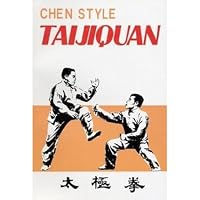
Chen Style Taijiquan
by Feng Zhiqiang
On This Page
Description
"A comprehensive, illustrated study of Taijiquan in the style of the Chen Family. If you're a beginner, this book will offer a great foundaton."Tags
Member Reviews
First published in 1984, this book is a very thorough primer on Chen-style Taijiquan (t'ai chi chuan), the original form of taiji. (All others--including Yang style, the world's most popular form of taiji--were derived from Chen style.) It is divided into four major sections: an essay on the history of taiji; a lengthy, two-part sequence of illustrations of the "attack-defense art" of Chen style (showing the movements of attacker and defender, respectively); and illustrations of the Chen-style short form, which contains thirty-eight movements.
While Chen style is (like Yang style) practiced for its health benefits, it was conceived as a martial art and is distinguished even today by forceful movements not seen in the generally slower, show more more meditative Yang style. When reviewing any book of this type, it's always important to note that one cannot learn a martial art from a book. "What, then, is the point of martial arts books?" the reader might ask, and reasonably so. In their introduction to the attack-defense art section, Feng Zhiqiang and Feng Dabiao have the answer: "The contents of this book are not about teaching you how to exercise the Chen-style Taijiquan, but about studying how to use the Chen-style Taijiquan for attacking and defending" (italics mine). In other words, some prior familiarity with the art is necessary in order for the book to be useful. If you've practiced Yang style or one of the other variations, then you will know in a general sense what taiji looks and feels like...and will understand at least some of the principles outlined in this book. It's a worthwhile study guide for people who, like myself, are interested in Chen style but have not yet encountered a Chen-style teacher. The illustrations consist entirely of photographs, which are smallish but clear.
One thing that I found especially interesting is Gu Liuzin's description of the circumstances under which taiji was created in the 1660s. It's a little-discussed point, but the fact is that Chen Wangting developed the art during a time of great hardship, when China had fallen to hostile invaders. Many men would have succumbed to despair (and probably did), but Chen was determined to salvage something from the experience: "After the downfall of the Ming Dynasty, Chen Wangting, influenced by Taoism, withdrew from society and lived in solitude. This can be seen from the second half of the poem he wrote not long before his death: 'Recalling past years, how bravely I fought to wipe out enemy troops, and what risks I went through! All the favors bestowed on me are now in vain! (...) Life consists in creating actions of boxing when feeling depressed, doing field work when the season comes, and spending the leisure time teaching disciples and children so that they can be worthy members of the society.'" show less
While Chen style is (like Yang style) practiced for its health benefits, it was conceived as a martial art and is distinguished even today by forceful movements not seen in the generally slower, show more more meditative Yang style. When reviewing any book of this type, it's always important to note that one cannot learn a martial art from a book. "What, then, is the point of martial arts books?" the reader might ask, and reasonably so. In their introduction to the attack-defense art section, Feng Zhiqiang and Feng Dabiao have the answer: "The contents of this book are not about teaching you how to exercise the Chen-style Taijiquan, but about studying how to use the Chen-style Taijiquan for attacking and defending" (italics mine). In other words, some prior familiarity with the art is necessary in order for the book to be useful. If you've practiced Yang style or one of the other variations, then you will know in a general sense what taiji looks and feels like...and will understand at least some of the principles outlined in this book. It's a worthwhile study guide for people who, like myself, are interested in Chen style but have not yet encountered a Chen-style teacher. The illustrations consist entirely of photographs, which are smallish but clear.
One thing that I found especially interesting is Gu Liuzin's description of the circumstances under which taiji was created in the 1660s. It's a little-discussed point, but the fact is that Chen Wangting developed the art during a time of great hardship, when China had fallen to hostile invaders. Many men would have succumbed to despair (and probably did), but Chen was determined to salvage something from the experience: "After the downfall of the Ming Dynasty, Chen Wangting, influenced by Taoism, withdrew from society and lived in solitude. This can be seen from the second half of the poem he wrote not long before his death: 'Recalling past years, how bravely I fought to wipe out enemy troops, and what risks I went through! All the favors bestowed on me are now in vain! (...) Life consists in creating actions of boxing when feeling depressed, doing field work when the season comes, and spending the leisure time teaching disciples and children so that they can be worthy members of the society.'" show less
Members
- Recently Added By
Author Information
3 Works 21 Members
Classifications
- Genres
- Nonfiction, Sports and Leisure
- DDC/MDS
- 613.7148 — Applied Science & Technology Medicine & health Personal health and Fitness Physical fitness Exercise and sport
- LCC
- GV504 .F70 — Geography, Anthropology and Recreation Recreation. Leisure Recreation. Leisure Physical education and training Gymnastics. Gymnastic exercises
Statistics
- Members
- 17
- Popularity
- 1,445,658
- Reviews
- 1
- Rating
- (3.50)
- Languages
- English
- Media
- Paper
- ISBNs
- 2