On This Page
Description
Well-known songs, including "Itsy Bitsy Spider" and "Farmer in the Dell," are presented with new words and titles, such as "Tiny Baby Brother" and "I'm in My Room and Bored."Tags
Recommendations









Member Reviews
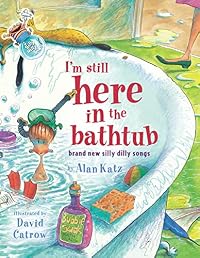
I greatly enjoyed reading Alan Katz's "I'm Still Here in the Bathtub." I particularly liked that all of the "silly dilly songs" were set to the tune of well-known children's songs, like "Skip to my Lou" and "Itsy Bitsy Spider." Because I knew these tunes well, I had no trouble singing (in my head) along with the text of the book. All of the songs, or poems, are written from a child's perspective and discuss topics familiar to many if not most children. Topics of the songs include disliking vegetables, losing items around the house, enduring family gatherings with older relatives, and eating the terrible food served at summer camp. I found these songs to be very relatable because I remember tackling many of these issues in my own show more childhood. I found it very easy to connect my own childhood experiences to the songs featuring topics like struggling with sibling rivalry and getting in trouble for making a mess, which made the book even more enjoyable to read. I enjoyed the book's bright, colorful illustrations. I liked that these pictures were often humorous, like the picture accompanying "He's Got the Whole Beach in his Pants," where an entire beach's worth of sand and sand toys is falling out of a baby's diaper and filling a living room. Many of the pictures are bold and exaggerated, like the picture for the song "Aunt Bea Says." Almost two whole pages are filled with a picture of an older woman's puckered lips reaching out to "kiss" the reader. While there was no clear plot to the book, I think that a common thread tying together each of the songs is that they each take unpleasant situations that children often experience and turn them into humorous, "silly dilly songs" that leave the reader smiling. I would say the "big idea" of the book, then, is that while these common childhood experiences are unpleasant, it helps to make light of them and laugh instead of getting upset. I would give this book five stars. show less
I loved the book I’m still here in the bathtub brand new silly dilly songs by Alan Katz and Illustrated by David Catrow. I gave it 4 stars because it is just plain fun! I read a few to my students, and they were rolling on the floor. My own children love it too. Each poem is to a tune we all know very well. For example, the poem titled I-T-C-H-Y is read to the tune of “Bingo”. The poem Tiny Baby Brother is read to the tune of “Itsy Bitsy Spider”. It is truly a fun read!
For this reading log I read I’m Still Here in the Bathtub, by Alan Katz. I absolutely loved this collection of poetry for several reasons. The message of this series is to provide humorous stories that are entertaining for children which is all portrayed through poetry.
Firstly, this text is extremely descriptive, which provides entertainment to the reader and definitely creates an interest in reading. There is not one poem in this entire book that is not descriptive. One poem entitled Tiny Baby Brother, talks about the narrator’s baby brother who seems a little crazy. It describes his craziness very well,
“He smashed our mother’s car phone,
Smeared paint throughout the den
That’s why I’m singing this song from inside his show more playpen!”
The illustrations also go hand in hand with the descriptive words, and show the baby brother and the narrator, his older brother, inside of the playpen. It is very bright and vibrant and adds a lot to the poems.
Additionally, the rhyming patterns in each poem are usually different, but are all great at helping the text flow well. In the poem I Always Lose, one stanza says,
“Parka, shoe, backpack, and hat
Lunch box, tuba, where’s Ron at?
They’re all gone… oops, so’s the cat
Gotta go, Dad is calling!”
Each stanza follows the same 1,1,1,2 pattern, and makes it easy to read. It also keeps a clear pace for the reader to follow.
Furthermore, another feature that is very unique to these poems, is that they are all written to the tune of children’s songs. You can still read and enjoy them without knowing the song, but it adds another element of creativity I really enjoyed. The previous poems mentioned, Tiny Baby Brother, was to the tune of “Itsy Bitsy Spider”, and I Always Lose is to the tune of “Skip to My Lou”. My favorite poem in this book is called The Meals at My Camp, and is to the tune of “Wheels on the Bus”. One stanza says,
“The lunches at my camp
Prepared by Joan
Didn’t know
Cheese had bones
Her specialty is tuna ice-cream cones
Each day at camp!”
This adds a level of extremely humorous tones, and along with the funny content, makes this book of poetry some of my favorite I’ve ever read. show less
Firstly, this text is extremely descriptive, which provides entertainment to the reader and definitely creates an interest in reading. There is not one poem in this entire book that is not descriptive. One poem entitled Tiny Baby Brother, talks about the narrator’s baby brother who seems a little crazy. It describes his craziness very well,
“He smashed our mother’s car phone,
Smeared paint throughout the den
That’s why I’m singing this song from inside his show more playpen!”
The illustrations also go hand in hand with the descriptive words, and show the baby brother and the narrator, his older brother, inside of the playpen. It is very bright and vibrant and adds a lot to the poems.
Additionally, the rhyming patterns in each poem are usually different, but are all great at helping the text flow well. In the poem I Always Lose, one stanza says,
“Parka, shoe, backpack, and hat
Lunch box, tuba, where’s Ron at?
They’re all gone… oops, so’s the cat
Gotta go, Dad is calling!”
Each stanza follows the same 1,1,1,2 pattern, and makes it easy to read. It also keeps a clear pace for the reader to follow.
Furthermore, another feature that is very unique to these poems, is that they are all written to the tune of children’s songs. You can still read and enjoy them without knowing the song, but it adds another element of creativity I really enjoyed. The previous poems mentioned, Tiny Baby Brother, was to the tune of “Itsy Bitsy Spider”, and I Always Lose is to the tune of “Skip to My Lou”. My favorite poem in this book is called The Meals at My Camp, and is to the tune of “Wheels on the Bus”. One stanza says,
“The lunches at my camp
Prepared by Joan
Didn’t know
Cheese had bones
Her specialty is tuna ice-cream cones
Each day at camp!”
This adds a level of extremely humorous tones, and along with the funny content, makes this book of poetry some of my favorite I’ve ever read. show less
I really enjoyed this book for three reasons. I loved that each of the poems can be read to the tune of different children’s songs and nursery rhymes. This establishes the rhythm of the poem and makes the poems more interactive. Also, I think that the content of the poems is relatable for children and adults. I remember wanting to stay in the bathtub all night, or refusing to eat my vegetables and it makes the poems more interesting as I can relate them to my own personal experiences. I think the big idea of the book is to make relatable experiences like staying in the bathtub silly and interactive for the listener and reader to enjoy as they sing along. Lastly, I thought the illustrations were interested because they were exaggerated show more in size and facial features. They also matched the content of the poem, like the boy feeding his brussel sprouts to the dog. The illustrations made the content of the poems easier to visualize and connect to. show less
The poem "No medication" from this book is one that I chose given it’s deeper meaning and detailed artwork. The main reason I like this poem is the illustrations that go along with it are detailed and comical. They add emotion and a silly visual image that readers can get lost in. Another reason I enjoyed it is because the meaning is deeper than it first appears. Although the poem is silly and discusses a boy refusing to take medicine, I enjoyed this poem because there is also an underlying message.
The overall message is that everything has a consequence, this is seen when the boy realizes he will be ‘getting a taste of his own medicine” after he threw his medicine out of the window.
The overall message is that everything has a consequence, this is seen when the boy realizes he will be ‘getting a taste of his own medicine” after he threw his medicine out of the window.
Jaylen White
EDUC 417.002
I’m Still Here in the Bathtub
This poetry book was awesome for two reasons! The first was that every poem was written to a nursery rhyme or well-known tune. For example one of the poems was written to the tune/tone of “take me out to the ball game” this was very beneficial for me because it gave me a voice and tempo to read it to. This also made it fun and interesting to read and find myself flipping the pages simply to see what songs were involved with the poems and how they would flow. The second thing I loved about this book were the illustrations and how they told/summarized the poems. Along with singing and reading along with the poems they had fantastic visuals that went along with them and really show more helped with telling the story or simply illustrating that poem. I would definitely keep this book in my classrooms especially for the older children that would know most of the songs in the book. show less
EDUC 417.002
I’m Still Here in the Bathtub
This poetry book was awesome for two reasons! The first was that every poem was written to a nursery rhyme or well-known tune. For example one of the poems was written to the tune/tone of “take me out to the ball game” this was very beneficial for me because it gave me a voice and tempo to read it to. This also made it fun and interesting to read and find myself flipping the pages simply to see what songs were involved with the poems and how they would flow. The second thing I loved about this book were the illustrations and how they told/summarized the poems. Along with singing and reading along with the poems they had fantastic visuals that went along with them and really show more helped with telling the story or simply illustrating that poem. I would definitely keep this book in my classrooms especially for the older children that would know most of the songs in the book. show less
This is such a fun, silly book of poetry with the main idea that old classic songs and nursery rhymes can be rewritten to be silly and fun for children. I liked this book! I liked it because at the beginning of each new poem or rhyme, it specifies to which tune the rhyme is to be sung. This makes the poem even more fun to read, and even more fun to remember because you can put the words to a melody. I also like this book because of the illustrations. I like that the illustrations used a lot of colors and used a lot of exaggerated pictures that a child with a large imagination might think of. By having illustrations like this, it further adds to the silliness and child-likeness of the poems and songs.
Members
- Recently Added By
Author Information

64+ Works 6,210 Members
Alan Katz is the author of numerous highly acclaimed children's books, including Take Me Out of the Bathtub and Other Silly Dilly Songs, Don't Say That Word! OOPS!, and The Day the Mustache Took Over and its sequel, The Day the Mustache Came Back. Alan is also a six-time Emmy-nominated writer for TV and has created comic books, trading card sets, show more web videos, animated series, and hundreds of other special projects for kids and parents. He lives with his family in Fairfield County, Connecticut. show less
All Editions
Awards and Honors
Awards
Series

Classifications
- Genres
- Poetry, Picture Books, Children's Books
- DDC/MDS
- 782.421640268 — Arts & recreation Music Vocal music [formerly: Dramatic music and production of musical drama] Secular forms of vocal music Songs General principles and musical forms Traditions of secular songs {genres} Western popular songs Miscellany [formerly Songs composed for Children ?] Texts; treatises on music scores and recordings Librettos, lyrics, poems, screenplays, texts of Western popular songs
- LCC
- PZ8.3 .K1275 .I — Language and Literature Fiction and juvenile belles lettres Fiction and juvenile belles lettres Juvenile belles lettres
- BISAC
Statistics
- Members
- 1,544
- Popularity
- 14,742
- Reviews
- 18
- Rating
- (4.13)
- Languages
- English, Spanish
- Media
- Paper
- ISBNs
- 6
- ASINs
- 5