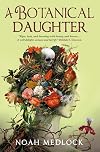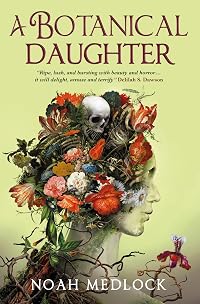
A Botanical Daughter
by Noah Medlock
On This Page
Description
It is an unusual thing, to live in a botanical garden. But Simon and Gregor are an unusual pair of gentlemen. Hidden away in their glass sanctuary from the disapproving tattle of Victorian London, they are free to follow their own interests without interference. For Simon, this means long hours in the dark basement workshop, working his taxidermical art. Gregor's business is exotic plants-lucrative, but harmless enough. Until his latest acquisition, a strange fungus which shows signs of show more intellect beyond any plant he's seen, inspires him to attempt a masterwork: true intelligent life from plant matter. Driven by the glory he'll earn from the Royal Horticultural Society for such an achievement, Gregor ignores the flaws in his plan: that intelligence cannot be controlled; that plants cannot be reasoned with; and that the only way his plant-beast will flourish is if he uses a recently deceased corpse for the substrate. The experiment-or Chloe, as she is named-outstrips even Gregor's expectations, entangling their strange household. But as Gregor's experiment flourishes, he wilts under the cost of keeping it hidden from jealous eyes. The mycelium grows apace in this sultry greenhouse. But who is cultivating whom? show lessTags
Recommendations
Member Reviews
Until this book, I didn't know that I needed a mix of Frankenstein and Little Shop of Horrors in my life, but this wonderfully queer, cozy horror novel sucked me in and made me fall in love with it from the beginning. Medlock's characters are so real, and developed with such nuance, you feel as if you're stepping into their true world somewhere in the past. Add in Medlock's incredible talent for blending details of botany and science into his narrative so seamlessly, and worldbuilding that bridges the fantastic and the familiar in the best ways, and you have a book that is magical in the most wonderful sense. The story also kept me guessing, and one scene in particular dropped my jaw open in surprise like no book ever has before it. But show more in the end, I was left so wonderfully thrilled with this book, I'll read anything else Medlock brings to life.
Absolutely recommended. show less
Absolutely recommended. show less
What a debut novel of pure imagination, a dash of decadence, a little sauciness mixed with some electrifying horror creates the truly unforgettable Botanical Daughter. Simon and Gregory, more than just friends, live in the surreal botanical environment that is Grimfern, a vast greenhouse of living plants. Simon occupies the basement with his taxidermy workstation, and Gregory the upper level of this glass sanctuary. Gregory dreams of success at the Royal Horticultural Society and his experiments have led him to believe that there could be intelligent life within plants. Within his haven a lone orchid appears to have a fungal guardian shielding the fragrant petals from direct sunlight…..” A shallow glass bowl about a foot in diameter show more contained an inch of soil and a seething mass of sinews. These tendrils caressed and cocooned a gorgeous orchid”.....As part of his vision and to ensure a successful outcome of this most outlandish of experiments, Gregory needs a human corpse to act as a “substrate” thus incubating the orchid and fungus and combining their intelligence……Gregory will then be recognised as a true genius by the RHS merging plant life and human brilliance.
There is certainly a nod to Frankenstein in the revealing of this tale, but I thought the storytelling and the use of language was exceptional and highly entertaining. The cast of characters from the unfortunate Julian Mallory the current President of RHS ( whose position Gregory aspires to) and the delightfully named Rosalinda Smeralda-Bland…”a sumptuous woman of continental extraction” all add to the readability and the delightful sequence of events as they unfold. Those readers who crave a little spilling of blood will not be disappointed and the final scenes create a perfect conclusion to an amazing story. An exceptional debut novel and one that I enjoyed very much. show less
There is certainly a nod to Frankenstein in the revealing of this tale, but I thought the storytelling and the use of language was exceptional and highly entertaining. The cast of characters from the unfortunate Julian Mallory the current President of RHS ( whose position Gregory aspires to) and the delightfully named Rosalinda Smeralda-Bland…”a sumptuous woman of continental extraction” all add to the readability and the delightful sequence of events as they unfold. Those readers who crave a little spilling of blood will not be disappointed and the final scenes create a perfect conclusion to an amazing story. An exceptional debut novel and one that I enjoyed very much. show less
Happy pride to these two Victorian gays, their weird fungal daughter, and her girlfriend.
This is the first book I’ve read so far this year that wasn’t written over 100 years ago and I really enjoyed it. I don’t engage with as much explicitly queer media as I should, so this was a nice change of pace from being delusional about Arthurian knights being queer. I adore Simon and he’s a good model as to what I picture myself being in the future for better or for worse. I will say, the one thing I did not like about this book is how often and drastically Simon and Gregor’s feeling towards Chloe change. Idk it just feels really sudden sometimes and I found it to be slightly annoying but it’s not that big of an issue. Overall I show more really enjoyed the book and I’ll definitely reread it and force as many people as I can to read it. A botanical daughter deserves to be more popular. show less
This is the first book I’ve read so far this year that wasn’t written over 100 years ago and I really enjoyed it. I don’t engage with as much explicitly queer media as I should, so this was a nice change of pace from being delusional about Arthurian knights being queer. I adore Simon and he’s a good model as to what I picture myself being in the future for better or for worse. I will say, the one thing I did not like about this book is how often and drastically Simon and Gregor’s feeling towards Chloe change. Idk it just feels really sudden sometimes and I found it to be slightly annoying but it’s not that big of an issue. Overall I show more really enjoyed the book and I’ll definitely reread it and force as many people as I can to read it. A botanical daughter deserves to be more popular. show less
Disclaimer: I have never read FRANKENSTEIN. I tried once and couldn't bear it. So keep that in mind as I complain below -- perhaps reading that would have alleviated some of my woes.
[On Goodreads, I have an animated GIF of Alicia Silverstone as Cher from CLUELESS side-swiping a car and saying "Oh, should I write them a note?"]
Second disclaimer, after I finished writing this monstrosity of a review: I'm not a horrible person, I swear! I generally hate doing anything that may cause unpleasantness in a person, and I know that the author has a Goodreads (and he's Goodlooking, too, so I'm extra-screwing myself here), so let me soften the upcoming blows by saying that the fact that I finished the novel means the author is talented. I'm not show more shy about quitting a book if I find nothing redeemable in it, so there's hope! And now, without further ado...
I love the idea here. I just finished my first foray into horrorticulture, DON'T LET THE FOREST IN, which blew me away, so I was excited to read this one. It started off slow, and I wasn't sure it was actually horror. Then it got a bit gory, then it got more gory, then it got most gory, but I'm still not convinced. It's a problem, I think, of execution.
First, let's talk about the narration, the writing itself. The author can string words together well, and he clearly has ample knowledge of both the time and place he's writing (Victorian London) and the subject he's covering (plants). In fact, I think he's trying too hard to sound well-educated and couched in the times. He's very fond of using flowery language ("dark orbs," someone mentions in another review) where simple language will do. Normally I wouldn't criticize such a decision -- that's style, and every author has their own, and that's fine! -- but here, it felt fabricated and overwrought. I'd be interested to see if his next book uses the same language, especially if it's not set in the past.
The narrator, too, is an odd beast. It's an omniscient point-of-view, bouncing quickly between the minds of various characters, both human and plant (and perhaps animal, I think, at one point), but it is far from objective. It is aware that it is narrating a story and is not afraid to let you know that it knows that you know that it knows. Again, it feels almost like the author is trying too hard here, this time to mimic the sardonic narration of an Austen novel here -- but Austen wrote social comedies, not horror. Having a narrator that cracks jokes one minute and then describes a scene of grisly murder is very jarring, particularly when there's nothing in the actual action or plot that lightens the horror. (Horror comedies usually work by being self-aware, at least to a degree -- there's a certain levity there that ameliorates the otherwise jarring juxtaposition.)
Moving on now to the story and the characters. As I said, I love the idea but I just never fully bought it. The author keeps insisting that everything that happens is the result of pure science -- no magic, no machines, nothing divine or demonic or otherwordly -- and I'm sorry, but there's nothing in this story to really make me believe that. The botanist, Gregor Sandys (not to be confused with Gregor Mendel of pea notoriety), is called a genius by virtually everyone in the story multiple times, but the actual science that occurs feels like something out of a Looney Tunes cartoon: Gregor and his taxidermist lover, Simon, throw various plants, musical instruments, minerals and metals and woods onto a cadaver, sew it all up, et voilà, une fille! But it's not magic, it's science! As I said, I never bought it, so I stayed at too far a remove to get fully invested into the story.
And these characters are simply not likeable. Most of them are one-dimensional props to push the story along, and the ones who aren't are about as two-dimensional as a piece of paper. But again, this is horror, so I wasn't expecting to fall in love with anyone or to see any illuminating insight into the conundrum that is being alive, that's fine. But I demand at least consistency in characterization, at least a modicum of belief in the actions and arcs that they go through, and you don't have that here. One minute Gregor is a scientist with a new experiment and the next that experiment has somehow become his daughter, but by the next page he says she's ungodly and wants to kill her, and on the next he's building a bunker to keep her safe. Simon, too, has some sort of weird epiphany like the Grinch on Mt. Krumpet whose heart grew three sizes that day, and it's just baffling, absolutely baffling!, why. Jennifer/Jenny -- the narrator can't seem to decide which to use for the girl -- is the only character who verges on consistency, but she's literally just a foil for the plant-daughter and has no real purpose in the narrative. (And while we're on names, why, oh why, does the author insist on using SMALL CAPS for the plant-daughter's name? Every time I saw CHLOE in the text a little part of me died.) You may think me extreme, but I've been known to skip must-reads if I'm aware a character dies in it, so it's really not a good sign when I'm hoping the entire casts bites the dust.
Two more thoughts, but I'm putting them behind spoiler-warnings.
SPOILERS TO FOLLOW
I mentioned earlier that I just read DON'T LET THE FOREST IN, which may or may not be about a gay boy's descent into grief-fueled, homicidal insanity. That book handles a descent into madness expertly -- you don't realize what's happening until it's already happened. This book, on the other hand, feels like it's going the cray-cray route, but there's no justification for it. This goes back to that consistency thing I mentioned earlier. Why are these characters losing their shit? None of it felt authentic. These are characters I don't like doing things that make no sense, either in the "real world" as we understand it or the book world as it's been drawn for us by the author.
I'm also not one to go all woke on your ass, butI found it "interesting" that this is an (ostensibly) male, (presumably) gay author writing a story about two gay men who choose to create a female child from the body of a dead girl killed because she's a lesbian. (And the only sex seen in the book is between the corpse-based plant-girl and the lesbian.) It didn't help that there are only three women in this entire book, not including horses and plants: one never shows up on screen but is painted in a pretty brutal light, and the other two are lesbians who end up (or start out, in one case) dead, specifically because of their sexuality. I wonder the ramifications if Gregor and Simon had created a son instead of a daughter, or if Gregor and Simon (or Jennifer and Constance) had been a heterosexual couple instead. Would I have been any less unnerved? I don't know. This is a relatively unbaked thought, I know, but I had it, and so I gave it to you. You're welcome.
Ultimately, I wonder what the "moral" of the story is. Gregor and Simon get a happy ending, and I'm just not sure what that means or if I can really like a book that allows that to happen. Can you? show less
[On Goodreads, I have an animated GIF of Alicia Silverstone as Cher from CLUELESS side-swiping a car and saying "Oh, should I write them a note?"]
Second disclaimer, after I finished writing this monstrosity of a review: I'm not a horrible person, I swear! I generally hate doing anything that may cause unpleasantness in a person, and I know that the author has a Goodreads (and he's Goodlooking, too, so I'm extra-screwing myself here), so let me soften the upcoming blows by saying that the fact that I finished the novel means the author is talented. I'm not show more shy about quitting a book if I find nothing redeemable in it, so there's hope! And now, without further ado...
I love the idea here. I just finished my first foray into horrorticulture, DON'T LET THE FOREST IN, which blew me away, so I was excited to read this one. It started off slow, and I wasn't sure it was actually horror. Then it got a bit gory, then it got more gory, then it got most gory, but I'm still not convinced. It's a problem, I think, of execution.
First, let's talk about the narration, the writing itself. The author can string words together well, and he clearly has ample knowledge of both the time and place he's writing (Victorian London) and the subject he's covering (plants). In fact, I think he's trying too hard to sound well-educated and couched in the times. He's very fond of using flowery language ("dark orbs," someone mentions in another review) where simple language will do. Normally I wouldn't criticize such a decision -- that's style, and every author has their own, and that's fine! -- but here, it felt fabricated and overwrought. I'd be interested to see if his next book uses the same language, especially if it's not set in the past.
The narrator, too, is an odd beast. It's an omniscient point-of-view, bouncing quickly between the minds of various characters, both human and plant (and perhaps animal, I think, at one point), but it is far from objective. It is aware that it is narrating a story and is not afraid to let you know that it knows that you know that it knows. Again, it feels almost like the author is trying too hard here, this time to mimic the sardonic narration of an Austen novel here -- but Austen wrote social comedies, not horror. Having a narrator that cracks jokes one minute and then describes a scene of grisly murder is very jarring, particularly when there's nothing in the actual action or plot that lightens the horror. (Horror comedies usually work by being self-aware, at least to a degree -- there's a certain levity there that ameliorates the otherwise jarring juxtaposition.)
Moving on now to the story and the characters. As I said, I love the idea but I just never fully bought it. The author keeps insisting that everything that happens is the result of pure science -- no magic, no machines, nothing divine or demonic or otherwordly -- and I'm sorry, but there's nothing in this story to really make me believe that. The botanist, Gregor Sandys (not to be confused with Gregor Mendel of pea notoriety), is called a genius by virtually everyone in the story multiple times, but the actual science that occurs feels like something out of a Looney Tunes cartoon: Gregor and his taxidermist lover, Simon, throw various plants, musical instruments, minerals and metals and woods onto a cadaver, sew it all up, et voilà, une fille! But it's not magic, it's science! As I said, I never bought it, so I stayed at too far a remove to get fully invested into the story.
And these characters are simply not likeable. Most of them are one-dimensional props to push the story along, and the ones who aren't are about as two-dimensional as a piece of paper. But again, this is horror, so I wasn't expecting to fall in love with anyone or to see any illuminating insight into the conundrum that is being alive, that's fine. But I demand at least consistency in characterization, at least a modicum of belief in the actions and arcs that they go through, and you don't have that here. One minute Gregor is a scientist with a new experiment and the next that experiment has somehow become his daughter, but by the next page he says she's ungodly and wants to kill her, and on the next he's building a bunker to keep her safe. Simon, too, has some sort of weird epiphany like the Grinch on Mt. Krumpet whose heart grew three sizes that day, and it's just baffling, absolutely baffling!, why. Jennifer/Jenny -- the narrator can't seem to decide which to use for the girl -- is the only character who verges on consistency, but she's literally just a foil for the plant-daughter and has no real purpose in the narrative. (And while we're on names, why, oh why, does the author insist on using SMALL CAPS for the plant-daughter's name? Every time I saw CHLOE in the text a little part of me died.) You may think me extreme, but I've been known to skip must-reads if I'm aware a character dies in it, so it's really not a good sign when I'm hoping the entire casts bites the dust.
Two more thoughts, but I'm putting them behind spoiler-warnings.
SPOILERS TO FOLLOW
I mentioned earlier that I just read DON'T LET THE FOREST IN, which may or may not be about
I'm also not one to go all woke on your ass, but
Ultimately, I wonder what the "moral" of the story is. Gregor and Simon get a happy ending, and I'm just not sure what that means or if I can really like a book that allows that to happen. Can you? show less
Kind of hate Gregory but my love for the other 3 characters kept this book at 4 stars for me.
Two gay dads and their gay adopted daughters plus murderous flora.
Gave gothic plants with lotsa queer love.
But it lacked emotional depth for me and I found it dragged a bit.
Gave gothic plants with lotsa queer love.
But it lacked emotional depth for me and I found it dragged a bit.
Well-written, unique premise, vivid characters and setting. A favorite of 2024.
Members
- Recently Added By
Lists

LGBTQIA Horror
172 works; 7 members

Books Read in 2024
4,727 works; 128 members
Author Information

1 Work 350 Members
Common Knowledge
- Original publication date
- 2024-03-19
- People/Characters
- Gregor Sandys; Simon Rievaulx; Chloe; Jennifer "Jenny" Finch; Constance Haggerston; John Finch (show all 10); Julian Mallory; Rosalinda Smeralda-Bland; Constance's Father; Will Taylor
- Important places
- Grimfern Estate; Buckinghamshire, England, UK
Classifications
Statistics
- Members
- 351
- Popularity
- 90,960
- Reviews
- 9
- Rating
- (3.81)
- Languages
- English
- Media
- Paper, Audiobook, Ebook
- ISBNs
- 3
- ASINs
- 3