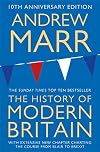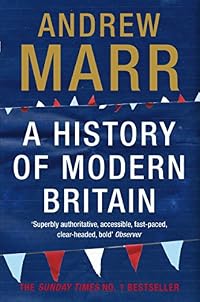
A History of Modern Britain
by Andrew Marr
On This Page
Description
A History of Modern Britain confronts head-on the victory of shopping over politics. It tells the story of how the great political visions of New Jerusalem or a second Elizabethan Age, rival idealisms, came to be defeated by a culture of consumerism, celebrity and self-gratification. In each decade, political leaders think they know what they are doing, but find themselves confounded. Every time, the British people turn out to be stroppier and harder to herd than predicted.Throughout, show more Britain is a country on the edge - first of invasion, then of bankruptcy, then on the vulnerable front line of the Cold War and later in the forefront of the great opening up of capital and migration now reshaping the world. This history follows all the political and economic stories, but deals too with comedy, cars, the war against homosexuals, Sixties anarchists, oil-men and punks, Margaret Thatcher's wonderful good luck, political lies and the true heroes of British theatre. show lessTags
Recommendations





Member Reviews
Bought 12 Sep 2008
This was absolutely brilliant and will be in my top 10 of the year, all books as well as non-fic. Approachable and understandable, covering British history and politics 1945-2007, a time I've never studied and didn't really have a grasp of. I was OK on just post-war stuff but the 60s were a mystery, and the 70s and 80s I remember but obviously didn't have the context. Marr is strictly non-partisan and presents all the leaders' successes and failures clearly. His writing style is confident and slightly informal, and he does show his opinions at times.
I realise how much I hark back in my politics and methods to the pre-60s society - careful, prudent, socialist, which I find interesting. Marr's central premise is that we show more have turned from a political into a shopping society, and that the cult of possessions and celebrity, forged in the 1960s, is partly what got us into the mess we're in now (I said partly, don't all spring at me!). But also he ends on an optimistic note - we have got through recessions, post-war poverty, the nuclear threat etc etc and can get through this one too.
Fascinating stuff and I'm really glad I read it. show less
This was absolutely brilliant and will be in my top 10 of the year, all books as well as non-fic. Approachable and understandable, covering British history and politics 1945-2007, a time I've never studied and didn't really have a grasp of. I was OK on just post-war stuff but the 60s were a mystery, and the 70s and 80s I remember but obviously didn't have the context. Marr is strictly non-partisan and presents all the leaders' successes and failures clearly. His writing style is confident and slightly informal, and he does show his opinions at times.
I realise how much I hark back in my politics and methods to the pre-60s society - careful, prudent, socialist, which I find interesting. Marr's central premise is that we show more have turned from a political into a shopping society, and that the cult of possessions and celebrity, forged in the 1960s, is partly what got us into the mess we're in now (I said partly, don't all spring at me!). But also he ends on an optimistic note - we have got through recessions, post-war poverty, the nuclear threat etc etc and can get through this one too.
Fascinating stuff and I'm really glad I read it. show less
Should be titled A Political History of Modern Britain, as that is what it is, but within that constraint, this is very good. It is interesting to see how many big issues and crises that were so important at the time now seem so inconsequential (which may hearten Gordon Brown). It is also interesting (but not surprising) to see how little politicians could influence the course of events, and of how successive policies were derailed by outbreaks of reality (which may not hearten Gordon Brown). Well-told, many amusing and interesting vignettes.
A birthday gift from my brother which I only read because he would ask me if I had every time I saw him. My reluctance had nothing to do with Marr whom I consider to be one of the best British political commentators around but with the subject matter. If there is one bit of history I know about, it's British political history pot-war.
I'm glad my brother pestered me. This is a very good book, with sound analysis and quite a few anecdotes and facts I was not previously aware of. My favourite concerned George Brown, deputy leader of the Labour Party throughout the 1960s and at one point Foreign Secretary and at all points addicted to the bottle. At a diplomatic reception in Peru, he repeatedly requested a dance from a tall, elegant show more individual clothed in scarlet. After the final rejection, he demanded to know the reason why - "There are three reasons, I will not dance with you. First, you are disgustingly drunk. Second, the band is not playing a Waltz but the Peruvian national anthem. Third, I am not a lady but the Cardinal-Archbishop of Lima".
Probably because the publisher demanded it, about a third of the book is non-political. Marr is less sure footed here. The choice of subjects is a bit unbalanced too - there's a lot on fashion and music but very little on sport or literature. There are still insights here and Marr shows his excellent taste in putting forward Ray Davies as the best songwriter of the sixties, not excluding Lennon-McCartney.
As far as politics is concerned, Marr writes objectively and well (although there are a lot of irritating typos). He is particularly good on the post-war austerity period and on the Thatcher revolution but less so on the 1950s, particularly Churchill's second Government. The most interesting part for me was the section on the 1974-1979 Labour Government, long excoriated as one of the worst in our history. Marr goes some way to rehabilitating Callaghan, Healy and co. and includes the astonishing (to me at least) revelation that the desperate loan squeezed from the IMF, who required huge public spending cuts, was entirely unnecessary and required only because the Treasury had severely underestimated revenues. Had the mandarins got it right, it is very likely Labour woudl have been re-elected in 1978/9 and Margaret Thatcher would be remembered as the first female leader of a major party rather than the first woman to become Prime Minister.
Marr writes as a journalist and the book lacks a central thesis, but probably doesn't need one. The closest he gets is to note how lucky we are to have lived in an age of such prosperity - no one could have guessed as much in the bleak years immediately after the end of the war. show less
I'm glad my brother pestered me. This is a very good book, with sound analysis and quite a few anecdotes and facts I was not previously aware of. My favourite concerned George Brown, deputy leader of the Labour Party throughout the 1960s and at one point Foreign Secretary and at all points addicted to the bottle. At a diplomatic reception in Peru, he repeatedly requested a dance from a tall, elegant show more individual clothed in scarlet. After the final rejection, he demanded to know the reason why - "There are three reasons, I will not dance with you. First, you are disgustingly drunk. Second, the band is not playing a Waltz but the Peruvian national anthem. Third, I am not a lady but the Cardinal-Archbishop of Lima".
Probably because the publisher demanded it, about a third of the book is non-political. Marr is less sure footed here. The choice of subjects is a bit unbalanced too - there's a lot on fashion and music but very little on sport or literature. There are still insights here and Marr shows his excellent taste in putting forward Ray Davies as the best songwriter of the sixties, not excluding Lennon-McCartney.
As far as politics is concerned, Marr writes objectively and well (although there are a lot of irritating typos). He is particularly good on the post-war austerity period and on the Thatcher revolution but less so on the 1950s, particularly Churchill's second Government. The most interesting part for me was the section on the 1974-1979 Labour Government, long excoriated as one of the worst in our history. Marr goes some way to rehabilitating Callaghan, Healy and co. and includes the astonishing (to me at least) revelation that the desperate loan squeezed from the IMF, who required huge public spending cuts, was entirely unnecessary and required only because the Treasury had severely underestimated revenues. Had the mandarins got it right, it is very likely Labour woudl have been re-elected in 1978/9 and Margaret Thatcher would be remembered as the first female leader of a major party rather than the first woman to become Prime Minister.
Marr writes as a journalist and the book lacks a central thesis, but probably doesn't need one. The closest he gets is to note how lucky we are to have lived in an age of such prosperity - no one could have guessed as much in the bleak years immediately after the end of the war. show less
This book proved to be a surprisingly readable history of post-1945 Britain. While the book itself focused more strongly upon politics than social history, there were still rather good sections devoted to what set, say, the population of Britain in the 50s apart from the population in Britain today.
While at times the book was a bit verbose and dry, for the most part [a:Andrew Marr|190087|Andrew Marr|http://www.goodreads.com/assets/nophoto/nophoto-U-50x66.jpg] kept the tone remarkably accessible, and extensively quoted primary sources. The wry British humor is out in force when describing certain politicians, and a few times I had to do a double-take when coming upon some unexpected wit.
This was precisely the book I was looking for in show more terms of historical content. I would recommend this to anyone looking for an overview of British history, though not necessarily for lighter reading. I would also recommend that anyone wishing to read it get it in hard cover or paperback format as opposed to an e-book, it would be far more easily readable and referenced in physical form. show less
While at times the book was a bit verbose and dry, for the most part [a:Andrew Marr|190087|Andrew Marr|http://www.goodreads.com/assets/nophoto/nophoto-U-50x66.jpg] kept the tone remarkably accessible, and extensively quoted primary sources. The wry British humor is out in force when describing certain politicians, and a few times I had to do a double-take when coming upon some unexpected wit.
This was precisely the book I was looking for in show more terms of historical content. I would recommend this to anyone looking for an overview of British history, though not necessarily for lighter reading. I would also recommend that anyone wishing to read it get it in hard cover or paperback format as opposed to an e-book, it would be far more easily readable and referenced in physical form. show less
This is an excellent read about recent UK history - if you like history but don't like it too heavy.
Mr Marr points out that as a small overpopulated island with major energy requirements our history is one of energy shocks.
An excellent perspective on the past 50 years.
Mr Marr points out that as a small overpopulated island with major energy requirements our history is one of energy shocks.
An excellent perspective on the past 50 years.
Thoroughly readable and illuminating account of the politics and culture from the 2nd WW to now. It seems as though Britain has always lurched from one economic crisis to another.
Excellent - witty, extremely accessible, vivid. Covers British political and economic history primarily but also includes wide-ranging social change.
Members
- Recently Added By
Lists

Top Five Books of 2013
1,562 works; 715 members
Author Information

20+ Works 2,641 Members
Andrew Marr, a bestselling author and award-winning journalist, hosts The Andrew Marr Show on BBC. His best-known book, A History of Modern Britain, was accompanied by a BBC television series that won one of British television's most prestigious prizes. He and his wife live in London with their three children.
Some Editions
Awards and Honors
Work Relationships
Is contained in
Common Knowledge
- Original publication date
- 2007
- People/Characters
- Clement Attlee; Aneurin Bevan; Ernest Bevin; Winston Churchill; Stafford Cripps; Hugh Dalton (show all 9); John Maynard Keynes; Herbert Morrison; Margaret Thatcher
- Important places
- United Kingdom
- Related movies
- Andrew Marr's History of Modern Britain (2007 | IMDb)
- First words
- Prologue
The play starts on the afternoon of 28 May 1940, at a meeting of the war cabinet in the Prime Minister's office in the old House of Commons. - Last words
- (Click to show. Warning: May contain spoilers.)In global terms, to be born British remains a wonderful stroke of luck.
Classifications
- Genres
- History, Nonfiction, General Nonfiction
- DDC/MDS
- 941.085 — History & geography History of Europe British Isles Historical periods of British Isles 1837- Period of Victoria and House of Windsor 1945-1999
- LCC
- DA566 .M28 — History of Europe, Asia, Africa and Oceania Great Britain History of Great Britain England History By period Modern, 1485- 20th century
- BISAC
Statistics
- Members
- 871
- Popularity
- 30,984
- Reviews
- 9
- Rating
- (3.92)
- Languages
- English
- Media
- Paper, Audiobook, Ebook
- ISBNs
- 17
- ASINs
- 8