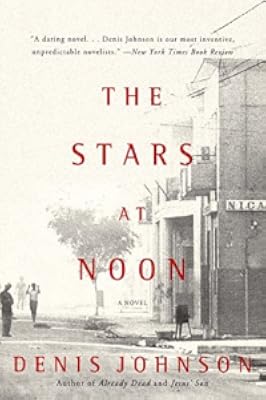
The Stars at Noon
by Denis Johnson
On This Page
Description
A literary thriller and love story set during the Nicaraguan revolution, from the National Book Award winner and two-time Pulitzer Prize finalist. Now the basis for a major motion picture Set in Nicaragua in 1984, The Stars at Noon is a story of passion, fear, and betrayal told in the voice of an American woman whose mission in Central America is as shadowy as her surroundings. Is she a reporter for an American magazine, as she sometimes claims, or a contact person for the anti-war group show more Eyes of Peace? And who is the rough English businessman she begins an affair with? The two foreigners become entangled in sinister plots and ever-widening webs of corruption, until a desperate attempt to escape the country brings their relationship to a crisis point. With his customary narrative brilliance, award-winning writer Denis Johnson brings a hellish landscape of moral ambiguity vividly to life. show lessTags
Recommendations





































Member Reviews
A highly cynical woman is trying to survive in 1984 Managua during a revolution when she meets an Englishman, an oil company man who’s in a bit of trouble. “You are a North American female prostitute-drifter with a press card,‘ he said, ‘which has been revoked.”
They try to stay together, for their own reasons, maybe love is involved. “I’m not beautiful but I keep my back straight and my hands still.”
They decide to escape to Costa Rica. She might be in some trouble herself – currency smuggling. A shady American – but everyone is shady – claiming to be a rival oil man, seems to be tracking them, with a specific interest in the Englishman. He wants her to sign something to get herself out of trouble, with bad news for show more her companion. “Two Americans, two stupid Americans. Nobody will ever understand what that’s like.” The trouble ramps up as they approach the border.
There’s hopelessness, resignation and betrayal in every word show less
They try to stay together, for their own reasons, maybe love is involved. “I’m not beautiful but I keep my back straight and my hands still.”
They decide to escape to Costa Rica. She might be in some trouble herself – currency smuggling. A shady American – but everyone is shady – claiming to be a rival oil man, seems to be tracking them, with a specific interest in the Englishman. He wants her to sign something to get herself out of trouble, with bad news for show more her companion. “Two Americans, two stupid Americans. Nobody will ever understand what that’s like.” The trouble ramps up as they approach the border.
There’s hopelessness, resignation and betrayal in every word show less
Is she or isn’t she a prostitute? Maybe she’s a spy. She says she’s a reporter. Who is this unnamed unreliable narrator of Denis Johnson’s The Stars at Noon?
Well, if you’re an American woman in Nicaragua in 1984, travelling on your own, probably you don’t want to reveal too much about yourself. Many rules just don’t apply under a national State of Emergency.
Initially a sub-tenente had allowed her to use her questionable press card and paid her motel bills in exchange for favours. He was now having second thoughts about anyone seizing that card and finding his name on it, so took it back.
Time to look for a new protector, but in that business, the trend is downward rather than upward, and personal safety becomes more and show more more precarious. Then chance threw up an Englishman, supposedly working for an oil company. It seemed however, that his allegiance was questioned by both Contras and Sandinistas. It was time for both of them to leave the country. As happens so often in these situations, there was a lot of hurry up and wait, terror and boredom, hope and desperation, as they tried to make good on their escape.
[The Stars at Noon] has some good ideas behind it. The whole debacle in Nicaragua is definitely a rich source for novels and non fiction. However, for me it didn’t have the intensity someone like Robert Stone could have given it, or the scalpel focussed writing of Joan Didion, or even the narrative ability of Philip Caputo.
This was a disappointment, as Denis Johnson is one of my favourite authors. It’s his third novel, and apparently was not that well received at the time. He had originally been going to write an essay piece, but was unsure whether it would be taken up by anyone, so decided on fiction instead. It was a rough time personally for Johnson, who had initially impressed critics, and would do so again later, but this is not the book for that. Had it been my first Johnson, I’m not sure I would have continued reading him. However, it does have its supporters, especially more recently.
I feel I’ve been hard on it, but probably only because my expectations were so unreasonable, so I’ll end with the………………. from which the book gets its title:
….what we are looking for
In each other
Is each other,
The stars at noon,
While the light worships its blind god. W S Merwin show less
Well, if you’re an American woman in Nicaragua in 1984, travelling on your own, probably you don’t want to reveal too much about yourself. Many rules just don’t apply under a national State of Emergency.
Initially a sub-tenente had allowed her to use her questionable press card and paid her motel bills in exchange for favours. He was now having second thoughts about anyone seizing that card and finding his name on it, so took it back.
Time to look for a new protector, but in that business, the trend is downward rather than upward, and personal safety becomes more and show more more precarious. Then chance threw up an Englishman, supposedly working for an oil company. It seemed however, that his allegiance was questioned by both Contras and Sandinistas. It was time for both of them to leave the country. As happens so often in these situations, there was a lot of hurry up and wait, terror and boredom, hope and desperation, as they tried to make good on their escape.
[The Stars at Noon] has some good ideas behind it. The whole debacle in Nicaragua is definitely a rich source for novels and non fiction. However, for me it didn’t have the intensity someone like Robert Stone could have given it, or the scalpel focussed writing of Joan Didion, or even the narrative ability of Philip Caputo.
This was a disappointment, as Denis Johnson is one of my favourite authors. It’s his third novel, and apparently was not that well received at the time. He had originally been going to write an essay piece, but was unsure whether it would be taken up by anyone, so decided on fiction instead. It was a rough time personally for Johnson, who had initially impressed critics, and would do so again later, but this is not the book for that. Had it been my first Johnson, I’m not sure I would have continued reading him. However, it does have its supporters, especially more recently.
I feel I’ve been hard on it, but probably only because my expectations were so unreasonable, so I’ll end with the………………. from which the book gets its title:
….what we are looking for
In each other
Is each other,
The stars at noon,
While the light worships its blind god. W S Merwin show less
This was not one of Johnson's strongest novels. I believe it was his third. Published in 1986 it contains the voice of an American female trying to get out of Nicaragua during the revolution in 1984. The first part of the novel (the first 20 or 30 pages) contained some very moving, beautiful, interesting, and magical sentences. However theses types of sentences were less frequently found throughout the rest of the book.
I liked the ending - very fitting.
Example sentences found in the first part:
"You have the kind of good manners that eventually get you killed."
"I wanted to know the exact dimensions of Hell." (When asked why she was there.)
"'Are you for sale?' 'I am press.' 'We're all press.' 'Then we're all for sale.'"
"We can't show more remember our sins here. We don't know who we used to be."
"Making love with him was like passing through a patch of fog."
"I could walk through hours like doorways in the middle of the night."
Beautiful. show less
I liked the ending - very fitting.
Example sentences found in the first part:
"You have the kind of good manners that eventually get you killed."
"I wanted to know the exact dimensions of Hell." (When asked why she was there.)
"'Are you for sale?' 'I am press.' 'We're all press.' 'Then we're all for sale.'"
"We can't show more remember our sins here. We don't know who we used to be."
"Making love with him was like passing through a patch of fog."
"I could walk through hours like doorways in the middle of the night."
Beautiful. show less
The Stars at Noon appears to be one of DJ's least read works, and that is a shame. DJ is a very masculine writer, so his use of a female voice takes some getting used to. But once I settled in, I found this tale of the political and moral confusion of a female American journalist and an English executive in Sandinista-era Nicaragua extremely compelling. There is a strong resemblance to Graham Greene's spy stories, but with a harsher edge.
It is 1984 in Nicaragua under the government of the Sandinistas. The story is told through the voice of an American woman who might, or might not, be a reporter or a contact person for an NGO, but she keeps herself solvent prostituting herself to foreigners, largely in the InterContinental hotel, but also giving her favours to a couple of government officials who have influence over her life and documents. She (we never learn her name), in trouble herself with the withdrawal of protection from her government friends, befriends an Englishman (whom she first beds for $50) who is on the run from shady forces involving the secret police of Costa Rica and the CIA for information he had passed, to Nicaragua, concerning potential oil fields. show more The intrigue deepens and the two of them set out to drive south to the border to try to cross over into Costa Rica to escape, with the CIA and CR secret police dogging their heels.
This is not nearly as sophisticated, complex, polished or ambitious as Johnson’s Tree of Smoke, but some themes from the latter are apparent, e.g. the sheer unreliability and unpredictability of social and institutional bodies, organizations, connections (“…everybody sells everybody out down here. They can’t afford not to; it’s basic, that’s the situation. If you hang to even one little tiny scruple it’ll be the death of you, I promise. This is Hell, it’s Hell, how many times do you have to be told?”); the closed, clandestine agenda of secret organizations imposing their own rules and own reality; the utter fragility of life that can be snatched on a whim; the failure of social organizations.
Not bad, but time much better spent on Tree of Smoke. show less
This is not nearly as sophisticated, complex, polished or ambitious as Johnson’s Tree of Smoke, but some themes from the latter are apparent, e.g. the sheer unreliability and unpredictability of social and institutional bodies, organizations, connections (“…everybody sells everybody out down here. They can’t afford not to; it’s basic, that’s the situation. If you hang to even one little tiny scruple it’ll be the death of you, I promise. This is Hell, it’s Hell, how many times do you have to be told?”); the closed, clandestine agenda of secret organizations imposing their own rules and own reality; the utter fragility of life that can be snatched on a whim; the failure of social organizations.
Not bad, but time much better spent on Tree of Smoke. show less
The Stars at Noon is a novel of mystery and suspense set during the Nicaraguan Revolution and story of journalist Miss Johnson who is covering a story from inside the ground report , she was underestimated by her colleagues even though they have hired because she is brave enough to be on ground and report and write and articles for what she see around her in the place. Set in Nicaragua in 1984, The story of passion, fear, and betrayal told in the voice of an American woman whose mission in Central America is as shadowy as her surroundings. Is she a reporter for an American magazine, as she sometimes claims, or a contact person for Eyes for Peace And who is the rough English businessman with whom she becomes involved As the two show more foreigners become entangled in increasingly sinister plots, Denis Johnson masterfully dramatizes a powerful vision of spiritual bereavement and corruption.
The life of both protagonist is a mystery when costa rica cops and other agencies move a motion towards the british businessman , life of American journalist also come under the radar and danger of the getting killed. But end show that both were separated and only Journalist was shown that she survived show less
The life of both protagonist is a mystery when costa rica cops and other agencies move a motion towards the british businessman , life of American journalist also come under the radar and danger of the getting killed. But end show that both were separated and only Journalist was shown that she survived show less
Ratings
Members
- Recently Added By
Author Information

36+ Works 14,426 Members
Denis Johnson was born in Munich, Germany on July 1, 1949. He received a bachelor's degree and a master's degree from the University of Iowa. He published his first book of poetry, The Man Among the Seals, at the age of 19. However, addictions to alcohol and drugs derailed him and he was in a psychiatric ward at the age of 21. He was sober by the show more early 1980s. Along with writing several volumes of poetry, Johnson wrote short stories for The New Yorker, Atlantic Monthly, Esquire, Paris Review, and Best American Short Stories. His novels included Angels, Jesus' Son, Resuscitation of a Hanged Man, Already Dead, Nobody Move, Train Dreams, and The Laughing Monsters. He won the National Book Award in 2007 for Tree of Smoke. He also received the Award for Literature from the American Academy of Arts, the Robert Frost Award, and the Library of Congress Prize for American Fiction. He died of liver cancer on May 24, 2017 at the age of 67. (Bowker Author Biography) show less
Some Editions
Common Knowledge
- Original publication date
- 1986
Classifications
Statistics
- Members
- 276
- Popularity
- 116,894
- Reviews
- 6
- Rating
- (3.47)
- Languages
- English, French
- Media
- Paper, Audiobook
- ISBNs
- 7
- ASINs
- 3