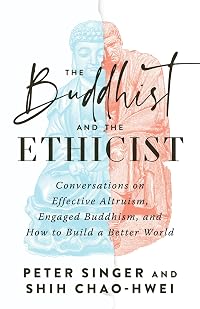
The Buddhist and the Ethicist: Conversations on Effective Altruism, Engaged Buddhism, and How to Build a Better World
by Peter Singer
On This Page
Description
"This eye-opening read spans the foundations of ethics and key Buddhist concepts. Professor Peter Singer is a world-renowned moral philosopher and preeminent voice in bioethics whose writings have helped shape the animal rights and effective altruism movements. Venerable Shih Chao-Hwei of Taiwan is a Buddhist monastic and social activist who's been a key figure in the Buddhist gender equality movement. This unlikely duo came together in conversation at a meditation retreat center in 2016 and show more continued discussions in writing. They shed light on the intersection of philosophy, religion, and day-to-day life"-- show lessTags
Recommendations













Member Reviews
Further evidence for how religion poisons debate in ethics
You might not think a utilitarian philosopher from the United States and a Buddhist nun from Asia would hit it off, finding common ground on issues ranging from animal liberation to effective altruism. But that’s apparently exactly what happened, and is the origin of this book.
The book itself consists of a series of dialogues between utilitarian philosopher Peter Singer and Buddhist nun Shih Chao-Hwei, as they discuss weighty moral issues such as gender equality, sexuality, abortion, animal rights, euthanasia, suicide, the death penalty, and more.
What’s surprising, right off the bat, is how Buddhism—which is constantly touted as being the most “rational” or show more “secular” religion—turns out, based on Chao-Hwei’s commentary, to be saddled with some of the same problems as the monotheistic religions. Buddhists, apparently, have to deal with rampant sexism that is codified in the earliest Buddhist texts, where female monks have a lower status than their male counterparts and are typically forced to walk behind them.
Buddhism also has its fair share of wild metaphysical claims; for example, Chao-Hwei struggles to explain “karma” to Singer without mentioning “future lives,” as if this is somehow self-evident if only one meditates long enough. It turns out that belief in reincarnation is required to believe in karma, and belief in karma is a core aspect of traditional Buddhism.
We also learn that Chao-Hwei’s praiseworthy and progressive views—including support for same-sex marriage and gender equality—do NOT represent orthodox views within the Buddhist community (at least according to Chao-Hwei and her self-reported negative pushback she received from other Buddhists). Unfortunately, you get the sense that Buddhism is also hampered by outdated moral systems and misogynistic thinking, as is every other religion that relies on “sacred texts.” Also, as with other religions, Chao-Hwei is shown to be morally upstanding precisely to the degree to which she goes against the orthodox views of the religion.
But one of the biggest problems with Buddhism is found within the chapter on sexuality. Singer rightfully challenges Chao-Hwei on the idea of being “liberated from sex,” as if sex is some kind of evil that needs to be banished. As Singer wrote:
“If you become like the man who, as you said, is not aroused by the woman flirting with him, then you will not suffer from sexual desire anymore, but you will also lose out on the pleasure and excitement of fulfilling sexual desire….So once again, the question is whether when we eliminate suffering, we are not eliminating sources of joy and happiness as well.”
Buddhists are intent on eliminating all suffering, but since suffering is defined as any type of craving, Buddhists are forced to try to eliminate all cravings. But if you eliminate all cravings, then yes, while you avoid suffering—and may even attain complete tranquility—you achieve this at the expense of positive enjoyment and fulfillment. This is a price that is probably not worth paying; I, for one, will take the ups-and-downs of life over the boredom of passionless meditation any day.
Additionally, as Singer points out, if two consenting adults want to have sex, then there’s probably no harm in it; but with Buddhism, since sexual anticipation counts as a craving, sex has to be viewed, like with every other religion, as a “sin” to be extinguished. No thank you.
But it gets even worse, especially when you get to the chapter on abortion.
Now, I should first say that I won’t pretend that the abortion debate is simple, and that there are not difficult issues, gray areas, and subtle distinctions. But here’s what I do know; the idea that the aborted embryo could possibly be a reincarnated buddha should NOT be one of the reasons to forgo an abortion, which Chao-Hwei spends a good amount of time defending. And her more powerful point—that aborting the embryo deprives it of future experiences—gets lost in the lunacy of reincarnation and karma. Again, religion clouds the debate and shifts the focus to factors that are almost certainly false and irrelevant to actual human happiness, possibly leading to disastrous results, all in the name of “faith.”
In fact, Chao-Hwei explicitly says that faith trumps science, as when she wrote, in the context of the debate on abortion:
“It may now seem to you that there is a difference between a scientific understanding of the world and the Buddhist scriptures, and I am choosing to embrace the latter.”
This is not to say that utilitarianism doesn’t have its problems; without being tempered by some version of the Golden Rule, you can use utilitarianism to justify horrendous acts, like killing an innocent human being at random to save many others. But at least with utilitarianism you can debate moral issues directly—based on costs and benefits and factoring in real human suffering and happiness—without having to deal with false and outdated ideas concerning reality and human nature from ancient texts, which seeks to only muddy the waters in terms of making reasonable decisions.
So, what is the ultimate purpose of this book? To show that, if you try hard enough, and ignore enough of the details, Buddhist ethics looks a lot like utilitarianism and is ultimately good for the world? To me, after reading the book—and despite Chao-Hwei’s very likable and agreeable character—it shows the opposite; namely, that Buddhism is straddled with questionable claims and, like every other religion, uses those claims to suggest things that are either inconsistent with human nature or that act to repress natural urges and decrease human happiness.
After all, you could fairly ask any Buddhist the following question: If the desire to go good in the world and engage in altruistic acts is just another “craving” that could ultimately lead to suffering, then shouldn’t this be avoided? If Nirvana is achieved through individual meditation, and Nirvana is the highest good, then isn’t engagement with the world, including altruistic acts, simply distractions from this ultimate purpose?
Buddhism, taken in its purest form, seems to suggest a life of solitary meditation, not engagement with the world. Isn’t this, after all, the reason why the Buddha abandoned his family and his position to seek “enlightenment?” These are questions that Singer repeatedly asks and, at least to my mind, that Chao-Hwei fails to adequately address. But it’s not her fault; there are no satisfactory answers because Buddhism, like every other dogma, will, in some sense, inevitably contradict itself.
And while utilitarianism is not perfect, it at least allows one to address moral concerns from a rational perspective, which makes it more likely that decisions will be made that enhance well-being and happiness rather than the opposite, which is the inevitable result of being constrained by dogma or universal rules that admit of no exceptions.
I will admit that Buddhism appears to be the least problematic of the world religions, as it’s less of stretch to support, for example, same-sex marriage as a Buddhist than it would be for a Christian. But apparently there is still a formidable barrier to progressive thinking within Buddhism, as demonstrated by the criticism Chao-Hwei has received for something as innocuous as suggesting that female monks shouldn’t have to stand behind the men in a lunch line.
And if acting ethically requires that you stray from the traditional teachings of the religion, doesn’t that suggest that maybe you ought to abandon that religion, or take only the good parts from it, or, at the very least, admit that morality comes from outside the religion, not from within it. Otherwise, how can you defend deviating from its traditional, core teachings?
So the ultimate lesson we can learn from the book is probably one that was not intended—that Buddhism is a religion, and that religious thought, based inevitably on outdated texts and rigid thinking, poisons otherwise rational discourse from otherwise decent and intelligent people. And unless you’re sympathetic to religion in some way, I don’t anticipate that you’ll find these discussions very appealing, or enlightening. show less
You might not think a utilitarian philosopher from the United States and a Buddhist nun from Asia would hit it off, finding common ground on issues ranging from animal liberation to effective altruism. But that’s apparently exactly what happened, and is the origin of this book.
The book itself consists of a series of dialogues between utilitarian philosopher Peter Singer and Buddhist nun Shih Chao-Hwei, as they discuss weighty moral issues such as gender equality, sexuality, abortion, animal rights, euthanasia, suicide, the death penalty, and more.
What’s surprising, right off the bat, is how Buddhism—which is constantly touted as being the most “rational” or show more “secular” religion—turns out, based on Chao-Hwei’s commentary, to be saddled with some of the same problems as the monotheistic religions. Buddhists, apparently, have to deal with rampant sexism that is codified in the earliest Buddhist texts, where female monks have a lower status than their male counterparts and are typically forced to walk behind them.
Buddhism also has its fair share of wild metaphysical claims; for example, Chao-Hwei struggles to explain “karma” to Singer without mentioning “future lives,” as if this is somehow self-evident if only one meditates long enough. It turns out that belief in reincarnation is required to believe in karma, and belief in karma is a core aspect of traditional Buddhism.
We also learn that Chao-Hwei’s praiseworthy and progressive views—including support for same-sex marriage and gender equality—do NOT represent orthodox views within the Buddhist community (at least according to Chao-Hwei and her self-reported negative pushback she received from other Buddhists). Unfortunately, you get the sense that Buddhism is also hampered by outdated moral systems and misogynistic thinking, as is every other religion that relies on “sacred texts.” Also, as with other religions, Chao-Hwei is shown to be morally upstanding precisely to the degree to which she goes against the orthodox views of the religion.
But one of the biggest problems with Buddhism is found within the chapter on sexuality. Singer rightfully challenges Chao-Hwei on the idea of being “liberated from sex,” as if sex is some kind of evil that needs to be banished. As Singer wrote:
“If you become like the man who, as you said, is not aroused by the woman flirting with him, then you will not suffer from sexual desire anymore, but you will also lose out on the pleasure and excitement of fulfilling sexual desire….So once again, the question is whether when we eliminate suffering, we are not eliminating sources of joy and happiness as well.”
Buddhists are intent on eliminating all suffering, but since suffering is defined as any type of craving, Buddhists are forced to try to eliminate all cravings. But if you eliminate all cravings, then yes, while you avoid suffering—and may even attain complete tranquility—you achieve this at the expense of positive enjoyment and fulfillment. This is a price that is probably not worth paying; I, for one, will take the ups-and-downs of life over the boredom of passionless meditation any day.
Additionally, as Singer points out, if two consenting adults want to have sex, then there’s probably no harm in it; but with Buddhism, since sexual anticipation counts as a craving, sex has to be viewed, like with every other religion, as a “sin” to be extinguished. No thank you.
But it gets even worse, especially when you get to the chapter on abortion.
Now, I should first say that I won’t pretend that the abortion debate is simple, and that there are not difficult issues, gray areas, and subtle distinctions. But here’s what I do know; the idea that the aborted embryo could possibly be a reincarnated buddha should NOT be one of the reasons to forgo an abortion, which Chao-Hwei spends a good amount of time defending. And her more powerful point—that aborting the embryo deprives it of future experiences—gets lost in the lunacy of reincarnation and karma. Again, religion clouds the debate and shifts the focus to factors that are almost certainly false and irrelevant to actual human happiness, possibly leading to disastrous results, all in the name of “faith.”
In fact, Chao-Hwei explicitly says that faith trumps science, as when she wrote, in the context of the debate on abortion:
“It may now seem to you that there is a difference between a scientific understanding of the world and the Buddhist scriptures, and I am choosing to embrace the latter.”
This is not to say that utilitarianism doesn’t have its problems; without being tempered by some version of the Golden Rule, you can use utilitarianism to justify horrendous acts, like killing an innocent human being at random to save many others. But at least with utilitarianism you can debate moral issues directly—based on costs and benefits and factoring in real human suffering and happiness—without having to deal with false and outdated ideas concerning reality and human nature from ancient texts, which seeks to only muddy the waters in terms of making reasonable decisions.
So, what is the ultimate purpose of this book? To show that, if you try hard enough, and ignore enough of the details, Buddhist ethics looks a lot like utilitarianism and is ultimately good for the world? To me, after reading the book—and despite Chao-Hwei’s very likable and agreeable character—it shows the opposite; namely, that Buddhism is straddled with questionable claims and, like every other religion, uses those claims to suggest things that are either inconsistent with human nature or that act to repress natural urges and decrease human happiness.
After all, you could fairly ask any Buddhist the following question: If the desire to go good in the world and engage in altruistic acts is just another “craving” that could ultimately lead to suffering, then shouldn’t this be avoided? If Nirvana is achieved through individual meditation, and Nirvana is the highest good, then isn’t engagement with the world, including altruistic acts, simply distractions from this ultimate purpose?
Buddhism, taken in its purest form, seems to suggest a life of solitary meditation, not engagement with the world. Isn’t this, after all, the reason why the Buddha abandoned his family and his position to seek “enlightenment?” These are questions that Singer repeatedly asks and, at least to my mind, that Chao-Hwei fails to adequately address. But it’s not her fault; there are no satisfactory answers because Buddhism, like every other dogma, will, in some sense, inevitably contradict itself.
And while utilitarianism is not perfect, it at least allows one to address moral concerns from a rational perspective, which makes it more likely that decisions will be made that enhance well-being and happiness rather than the opposite, which is the inevitable result of being constrained by dogma or universal rules that admit of no exceptions.
I will admit that Buddhism appears to be the least problematic of the world religions, as it’s less of stretch to support, for example, same-sex marriage as a Buddhist than it would be for a Christian. But apparently there is still a formidable barrier to progressive thinking within Buddhism, as demonstrated by the criticism Chao-Hwei has received for something as innocuous as suggesting that female monks shouldn’t have to stand behind the men in a lunch line.
And if acting ethically requires that you stray from the traditional teachings of the religion, doesn’t that suggest that maybe you ought to abandon that religion, or take only the good parts from it, or, at the very least, admit that morality comes from outside the religion, not from within it. Otherwise, how can you defend deviating from its traditional, core teachings?
So the ultimate lesson we can learn from the book is probably one that was not intended—that Buddhism is a religion, and that religious thought, based inevitably on outdated texts and rigid thinking, poisons otherwise rational discourse from otherwise decent and intelligent people. And unless you’re sympathetic to religion in some way, I don’t anticipate that you’ll find these discussions very appealing, or enlightening. show less
Ratings
Members
- Recently Added By
Lists

Check Library
178 works; 1 member
Author Information

45+ Works 10,667 Members
Classifications
Statistics
- Members
- 33
- Popularity
- 860,443
- Reviews
- 1
- Rating
- (3.50)
- Languages
- English
- Media
- Paper, Ebook
- ISBNs
- 4
- ASINs
- 1