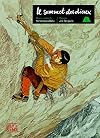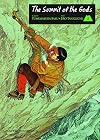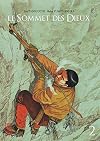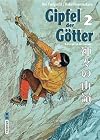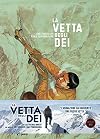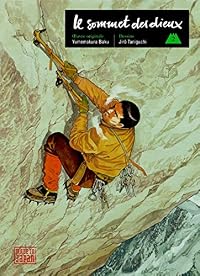
The Summit of the Gods, Volume 2
by Jirô Taniguchi (Illustrator), Baku Yumemakura (Author)
The Summit of the Gods (2)
On This Page
Description
"'Because it's there.' George Herbert Leigh Mallory is said to have given this in reply to the question 'Why do you want to climb Mt. Everest?' On his third expedition in June 1924, Mallory and his climbing partner, Andrew Irvine, disappeared on the North-East ridge during their ascent, having been sighted only a few hundred metres from the summit. In 1993, in a small Nepalese store, Makoto Fukamachi, photographer for a Japanese expedition to conquer Mt Everest, stumbles across an old camera show more -- a Vest Pocket Autographic Kodak Special. Could it be Mallory's camera? Did it hold the secret of whether Mallory and Irvine made it to the summit?"--Publisher's web site. show lessTags
Recommendations













































Member Reviews
The second volume of The Summit of the Gods, a five volume manga series written by Baku Yumemakura and illustrated by Jiro Taniguchi, was originally released in Japan in 2001. The English-language release of The Summit of the Gods, Volume 2 was published by Fanfare/Ponent Mon in early 2010. The series is based on Yumemakura's 1997 award-winning novel The Summit of the Gods and has won several awards itself, including a Japan Media Arts Excellence Award in 2001 and an Angoulême Prize for Artwork in 2005. I will admit right now that I love Yumemakura and Taniguchi's The Summit of the Gods. The manga is easily my favorite work that Taniguchi has collaborated on. The series has gorgeous artwork, characters that are larger than life but who show more remain human in their imperfections, and an engaging story.
After returning to Japan from Nepal, journalist Makoto Fukamachi has been doggedly pursuing the enigma of the man he believes he met there--a legendary Japanese mountain climber named Jouji Habu. Initially, Fukamachi was interested in a camera he is convinced is in Habu's possession. It may very well be the same camera that George Mallory brought with him on his assault on Everest in 1924. If true, Habu has his hands on an important piece of mountaineering history. But as Fukamachi's investigation proceeds he becomes more and more interested in Habu himself and what drives the man as a climber. While Fukamachi's personal life is unraveling he throws himself into his research, tracking down anyone who might know anything about Habu and his current whereabouts.
While I personally find Fukamachi's persistent research to be interesting as he slowly pieces together disparate clues and leads, what I really love about The Summit of the Gods, Volume 2 are the stories that he uncovers. As unlikeable as Habu can be, and with as many enemies as he has made, his accomplishments as a mountain climber are unquestionably phenomenal. Fukamachi delves into many of Habu's feats: his disastrous and yet astonishing foray climbing the Grandes Jorasses as well as his notorious participation in a group summit assault on Everest and several unfortunate incidents relating to it. But as amazing as Habu's achievements are as a climber, it's Taniguchi's stunning artwork that makes them a reality for the reader. From the largest mountain vistas to the smallest crack in ice or rock, Taniguchi's attention to detail is superb. The pacing and timing of his panels make the climbs both exhilarating and terrifying.
Nature and the mountains can be glorious, but they can also be extraordinarily dangerous. Taniguchi's artwork expertly conveys this. Both the figurative and literal gravity of the situations that the climbers face can almost be felt reading The Summit of the Gods. When something goes wrong, even the smallest something, the repercussions can be devastating. And at times the events that unfold are entirely outside of human control. Saying that a climber fell--such a small and simple word--is easy enough. But the enormity of the human drama and the story surrounding that fall, what happened to cause it, and what happens as a result of it, is intensely engrossing. It is clear that the characters in The Summit of the Gods are effected deeply; the impacts can be seen in their changing relationships to each other, to climbing, and to the mountains themselves. The Summit of the Gods is an incredible work.
Experiments in Manga show less
After returning to Japan from Nepal, journalist Makoto Fukamachi has been doggedly pursuing the enigma of the man he believes he met there--a legendary Japanese mountain climber named Jouji Habu. Initially, Fukamachi was interested in a camera he is convinced is in Habu's possession. It may very well be the same camera that George Mallory brought with him on his assault on Everest in 1924. If true, Habu has his hands on an important piece of mountaineering history. But as Fukamachi's investigation proceeds he becomes more and more interested in Habu himself and what drives the man as a climber. While Fukamachi's personal life is unraveling he throws himself into his research, tracking down anyone who might know anything about Habu and his current whereabouts.
While I personally find Fukamachi's persistent research to be interesting as he slowly pieces together disparate clues and leads, what I really love about The Summit of the Gods, Volume 2 are the stories that he uncovers. As unlikeable as Habu can be, and with as many enemies as he has made, his accomplishments as a mountain climber are unquestionably phenomenal. Fukamachi delves into many of Habu's feats: his disastrous and yet astonishing foray climbing the Grandes Jorasses as well as his notorious participation in a group summit assault on Everest and several unfortunate incidents relating to it. But as amazing as Habu's achievements are as a climber, it's Taniguchi's stunning artwork that makes them a reality for the reader. From the largest mountain vistas to the smallest crack in ice or rock, Taniguchi's attention to detail is superb. The pacing and timing of his panels make the climbs both exhilarating and terrifying.
Nature and the mountains can be glorious, but they can also be extraordinarily dangerous. Taniguchi's artwork expertly conveys this. Both the figurative and literal gravity of the situations that the climbers face can almost be felt reading The Summit of the Gods. When something goes wrong, even the smallest something, the repercussions can be devastating. And at times the events that unfold are entirely outside of human control. Saying that a climber fell--such a small and simple word--is easy enough. But the enormity of the human drama and the story surrounding that fall, what happened to cause it, and what happens as a result of it, is intensely engrossing. It is clear that the characters in The Summit of the Gods are effected deeply; the impacts can be seen in their changing relationships to each other, to climbing, and to the mountains themselves. The Summit of the Gods is an incredible work.
Experiments in Manga show less
The mountain climbing adventure stays tense and thrilling as photojournalist Makoto Fukamachi learns about the rivalry between the enigmatic and blunt Jouji Habu and his polar opposite, mountaineering superstar Tsuneo Hase. This volume covers first a miraculous recovery following a high-altitude accident and then a fatal avalanche. The action serves to offset the fact that little progress that is made on the overarching mystery involving the disappearance of Mallory and Irvine.
And really, no matter how good the story, they could just strip out all the words and I'd be happy to just view Taniguchi's pictures of little men on big rocks.
And really, no matter how good the story, they could just strip out all the words and I'd be happy to just view Taniguchi's pictures of little men on big rocks.
E' in solitaria che l'ascensione rivela la sua vera essenza. - HASE - (p. 216)
C'era un solo posto come quello in tutto il mondo... sfiorato dall'immensita' del cielo.
Il tetto del mondo... (p. 331)
La montagna in inverno non ha poi molri colori. Quelli predominanti sono solamente tre. Il primo e' il bianco della neve che copre tutto. L'azzurro del cielo sereno nelle belle giornate. Infine, il verde degli alberi...Alla montagna non serve altro. (p. 346)
C'era un solo posto come quello in tutto il mondo... sfiorato dall'immensita' del cielo.
Il tetto del mondo... (p. 331)
La montagna in inverno non ha poi molri colori. Quelli predominanti sono solamente tre. Il primo e' il bianco della neve che copre tutto. L'azzurro del cielo sereno nelle belle giornate. Infine, il verde degli alberi...Alla montagna non serve altro. (p. 346)
Ratings
Members
- Recently Added By
Author Information

Jiro Taniguchi was born in Tottori, Japan on August 14, 1947. The manga artist had his first cartoon published in 1970. His works included The Times of Botchan, A Distant Neighbourhood, and The Walking Man. In 2011, the French government awarded him the Knight of the Order of Arts and Letters. He died on February 11, 2017 at the age of 69. (Bowker show more Author Biography) show less
Awards and Honors
Awards
Series

Common Knowledge
- Canonical title
- The Summit of the Gods, Volume 2
- Original title
- 神々の山嶺 (2) (2); Kamigami no Itadaki (2) (2)
- People/Characters
- Makoto Fukamachi; Jouji "Bikha Sanp" Habu; Osamu Mizuno; Ryoko Kishi; Kayoko Segawa; Noriaki Kakura (show all 22); Miyagawa; Tsuneo Hase; Koichiro Ito; Ryoichi Waga; Toshi Ishiwata; Masayoshi Kawakita; Manabu Morita; Shusuke Kitahama; Hisaya Iwahara; Reinhold Messner; Naomi Uemura; Kasumi Kitazawa; Ang Tshering; Charles Granville Bruce; George Mallory; Andrew Irvine
- Important places
- Grandes Jorasses, Mont Blanc massif; Japan; Shinjuku, Tokyo, Japan; Mount Everest / Sagarmatha; K2; Nanga Parbat (show all 10); Kathmandu, Nepal; Mount Tanigawa, Japan; Mount Kisokoma, Japan; Himalayas
- Important events
- Disappearance of Mallory and Irvine 1924
- First words
- The Grandes Jorasses is in the north eastern part of the Mont Blanc range.
- Last words
- (Click to show. Warning: May contain spoilers.)In 1924 Mallory and Irvine vanished on Everest's north-east ridge leaving behind them the mystery of who was first to reach its summit.
There was a camera that could provide the solution.
"Far higher in the sky than imagination had dared to suggest, the white summit of Everest appeared."
George Mallory - Blurbers
- Kevin, Brian
- Original language
- Japanese
Classifications
Statistics
- Members
- 136
- Popularity
- 239,294
- Reviews
- 3
- Rating
- (4.29)
- Languages
- 6 — English, French, German, Italian, Japanese, Spanish
- Media
- Paper, Ebook
- ISBNs
- 8
- ASINs
- 1