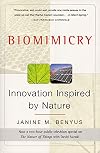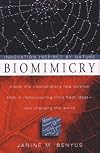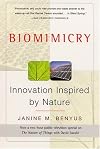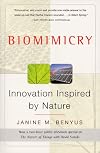
Biomimicry: Innovation Inspired by Nature
by Janine M. Benyus
On This Page
Description
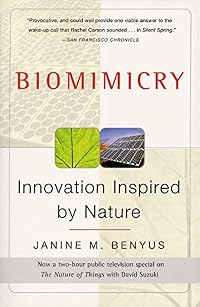
This ""valuable and entertaining"" (New York Times Book Review) book explores how scientists are adapting nature's best ideas to solve tough 21st century problems. Biomimicry is rapidly transforming life on earth. Biomimics study nature's most successful ideas over the past 3.5 million years, and adapt them for human use. The results are revolutionizing how materials are invented and how we compute, heal ourselves, repair the environment, and feed the world. Janine Benyus takes readers into show more the lab and in the field with maverick thinkers as they: discover miracle drugs by watching what chimps eat when they're sick; learn how to create by watching spiders weave fibers; harness energy by examining how a leaf converts sunlight into fuel in trillionths of a second; and many more examples. Composed of stories of vision and invention, personalities and pipe dreams, Biomimicry is must reading for anyone interested in the shape of our future. show lessTags
Recommendations







Member Reviews
Biomimicry is such an interesting field with many cool innovations. This book was unfortunately not quite as exciting. I think it is a bit too anecdotal at times (like the chapter on farming was here is one place where they looked at natural systems and they did this. Here is another. And another. And yet another!) A lot of what this book talks about is technically more biomimicry adjacent - biomimicry is learning from and adapting things found in nature to improve human technology while a lot of this was things like considering the climate when choosing what to plant. Don't get me wrong, these concepts are important, I was just a little confused when a book about biomimicry started off with something that isn't biomimicry.
If you are show more interested in biomimicry I wouldn't tell you to not pick this book up, but be aware that it is quite old and simultaneously very broad and way too specific. I suspect that there are more recently published books that do a better job of talking about the topic. show less
If you are show more interested in biomimicry I wouldn't tell you to not pick this book up, but be aware that it is quite old and simultaneously very broad and way too specific. I suspect that there are more recently published books that do a better job of talking about the topic. show less
Although this book was written in the 1990’s, its clarion call for innovation based on what natures tells us about systems and sustainability couldn’t be more timely or more relevant.
Since then we have lost 20 critical years preparing for the inevitability of climate change.
Much of the science described here has no doubt been overtaken by recent developments. CRISPR for sure has altered the landscape in bioengineering.
Still, the imperatives for design in our brave new world remain the same:
Does it run on sunlight?
Does it reward cooperation?
Does it bank on diversity?
What could be more elementary?
Kate Raworth in her more recent book “Donut Economics: Seven Ways to Think Like a 21st-Century Economist” makes the salient point that show more our economies and innovation are pointing us in the wrong direction.
We are likely competing ourselves to extinction.
As I am now reading Elizabeth Kolbert’s book, “Under a White Sky: The Nature of the Future,” I am learning that even biomimicry can lead to bigtime mistakes.
The introduction of some species of Asian carp to help clean dirty ponds in N. America has turned into an environmental nightmare.
Just one example of which, unfortunately, there are plenty more (Gulp!). show less
Since then we have lost 20 critical years preparing for the inevitability of climate change.
Much of the science described here has no doubt been overtaken by recent developments. CRISPR for sure has altered the landscape in bioengineering.
Still, the imperatives for design in our brave new world remain the same:
Does it run on sunlight?
Does it reward cooperation?
Does it bank on diversity?
What could be more elementary?
Kate Raworth in her more recent book “Donut Economics: Seven Ways to Think Like a 21st-Century Economist” makes the salient point that show more our economies and innovation are pointing us in the wrong direction.
We are likely competing ourselves to extinction.
As I am now reading Elizabeth Kolbert’s book, “Under a White Sky: The Nature of the Future,” I am learning that even biomimicry can lead to bigtime mistakes.
The introduction of some species of Asian carp to help clean dirty ponds in N. America has turned into an environmental nightmare.
Just one example of which, unfortunately, there are plenty more (Gulp!). show less
If you love building but worry about the impact of the work on our planet, Biomimicry can fill you with hope for the future. Benyus is criticized for not getting all the technical details right as she covers a wide range of scientific subjects armed only with a Master's degree. Buit even those who try to take her down admit that Benyus is making an important subject more accessible to lay readers. By imitating nature (biomimicing), she reports, we can convert our production processes -- including design and construction of buildings -- so that they merge with rather than poison and disrupt the organic cycle. For example, she describes research on building coatings whose pigments are modeled on the chloroplasts in plants and that would show more produce the power for a building the coatings are applied to. show less
Explores scientific and technological advances that attempt to mimic the designs and processes of nature in order to help humans live in harmony with the natural world instead of dominating it.
Fantastic book - a must read if you're into sustainability and the environment. Beautifully written. I've posted an ordinary mind map kind of summary here:http://dl.getdropbox.com/u/137325/Shelfari/Books - Biomimicry.pdf
Intriguing.
Interesting.
Members
- Recently Added By
Author Information

13+ Works 1,253 Members
Common Knowledge
- First words
- It's not ordinary for a bare-chested man wearing jaguar teeth and owl feathers to grace the pages of the New Yorker, but these are not ordinary times.
- Last words
- (Click to show. Warning: May contain spoilers.)It's the way home, and I'm as eager as the geese to go.
Classifications
Statistics
- Members
- 799
- Popularity
- 34,918
- Reviews
- 14
- Rating
- (3.80)
- Languages
- English, French, Portuguese, Spanish
- Media
- Paper, Audiobook, Ebook
- ISBNs
- 10
- ASINs
- 5