On This Page
Description
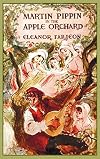
A clever wandering minstrel rescues an imprisoned young lady when she charms the seven man-hating damsels guarding her by telling them stories, one by one.Tags
Recommendations


















Member Reviews
I’m glad I’ve reached the age when I can lie on the banks of the Murray River (the one in Sussex that only children can find, not the one in Australia) and let myself enjoy a fairy tale, particularly one that is as well-written as this.
This is a whimsical collection of tales within a tale, the first six of increasing complexity. They are set within a larger story about a wandering minstrel who undertakes to help a lovesick youth. It is all about the power of romantic love.
There are, of course, deeper meanings, should one care to look, beginning with the setting, an apple orchard, an Eden with no snake. While Martin’s quest requires that he beguile the six sworn man-haters guarding the object of the youth’s affection — herself show more equally lovesick — the girls in turn beguile him.
Add in an unexpected twist at the end (although I should have seen it coming), and it was an enjoyable read. Until now, all I’ve known of Eleanor Farjeon is the song “Morning Has Broken.” I look forward to reading more from her. show less
This is a whimsical collection of tales within a tale, the first six of increasing complexity. They are set within a larger story about a wandering minstrel who undertakes to help a lovesick youth. It is all about the power of romantic love.
There are, of course, deeper meanings, should one care to look, beginning with the setting, an apple orchard, an Eden with no snake. While Martin’s quest requires that he beguile the six sworn man-haters guarding the object of the youth’s affection — herself show more equally lovesick — the girls in turn beguile him.
Add in an unexpected twist at the end (although I should have seen it coming), and it was an enjoyable read. Until now, all I’ve known of Eleanor Farjeon is the song “Morning Has Broken.” I look forward to reading more from her. show less
Eleanor Farjeon sure could write. This series of 6 romantic fairy tales, framed by yet another romantic story, was really impressive. Each story focused on romantic love, as told by a minstrel to an audience of milkmaids. But I found myself confused - this is usually called a children's book, and it definitely isn't. Its intended audience is clearly young adult and adult. Perhaps the confusion is because in 1922 there was no "young adult" category. Or maybe it was caused by her publishers hunting for an audience, and the only modern audience for fairy tales is children. The book really deserves 4 or 5 stars, but I have never much liked romances. I get impatient with everyone's foolish behavior.
This is available for e-readers on Project Gutenberg. I recommend it. I loved [b:Martin Pippin in the Daisy Field|1595947|Martin Pippin in the Daisy Field (Puffin Books)|Eleanor Farjeon|http://www.goodreads.com/images/nocover-60x80.jpg|1957173] better, but perhaps only because I read that when I was little. This is the first time I've read this one. I'd love to own the pair - and I almost never collect or re-read books.
Oh for the days when one middling-prosperous farmer had six milkmaids and an apple orchard with about a dozen varieties. When making daisy-chains and blowing dandelion clocks could while away an entire afternoon. When each set of prongs of each year of a male deer had it's own name, as did the deer itself (not a stag show more until the fifth year). When so many stories could come from the meadows, rivers, and woods of Sussex that the wider world need seldom be mentioned.
The conceit framing the story, that Martin has to tell six original love-stories over six evenings, works well. We get to know the maids, and their story(s), and that of their mistress, as well as the six tales.
The book is a bit precious. Some might glance at it and scoff 'purple prose' or 'twee.' But if you can spend a long afternoon curled up in an apple orchard, or in a cozy chair with some hot tea, some bread, and some apples, do immerse yourself in this world and come out charmed and refreshed.
Um, not exactly a children's book. I think most under 12s would be bored by it, and confused by all the allusions to historical culture.
I think it's smart enough, and wise enough for adults, even those who don't generally read fairy tales. How better, for example, to express the story of Schrodinger's Cat than the bit about a girl reluctant to open to the door to an unexpected knock: Before we know a thing it is a thousand things. Only one thing would be there when she lifted the bar. But as she stood with her hand upon, it a host of presences stood on the other side. A knight in armor, a king in his gold crown... a woman to be her friend; her mother... a child...."
I like the endings, in which we see some mischiefs, some insights, that aren't as pat and HEA as the milkmaids have been clamoring for. The modern psychologists and neuroscientists I've been reading would approve of more of this 'fantasy' than one might think, I'm sure." show less
Oh for the days when one middling-prosperous farmer had six milkmaids and an apple orchard with about a dozen varieties. When making daisy-chains and blowing dandelion clocks could while away an entire afternoon. When each set of prongs of each year of a male deer had it's own name, as did the deer itself (not a stag show more until the fifth year). When so many stories could come from the meadows, rivers, and woods of Sussex that the wider world need seldom be mentioned.
The conceit framing the story, that Martin has to tell six original love-stories over six evenings, works well. We get to know the maids, and their story(s), and that of their mistress, as well as the six tales.
The book is a bit precious. Some might glance at it and scoff 'purple prose' or 'twee.' But if you can spend a long afternoon curled up in an apple orchard, or in a cozy chair with some hot tea, some bread, and some apples, do immerse yourself in this world and come out charmed and refreshed.
Um, not exactly a children's book. I think most under 12s would be bored by it, and confused by all the allusions to historical culture.
I think it's smart enough, and wise enough for adults, even those who don't generally read fairy tales. How better, for example, to express the story of Schrodinger's Cat than the bit about a girl reluctant to open to the door to an unexpected knock: Before we know a thing it is a thousand things. Only one thing would be there when she lifted the bar. But as she stood with her hand upon, it a host of presences stood on the other side. A knight in armor, a king in his gold crown... a woman to be her friend; her mother... a child...."
I like the endings, in which we see some mischiefs, some insights, that aren't as pat and HEA as the milkmaids have been clamoring for. The modern psychologists and neuroscientists I've been reading would approve of more of this 'fantasy' than one might think, I'm sure." show less
Let me take you back in time some 40-odd years. I’m a young teenager, and I’ve just read Tolkien, and C S Lewis, and Mervyn Peake. I want to read more stuff like that. But I can’t. There’s nothing out there.
This may seem incredible to you young things, used to being able to wander into Forbidden Planet on a whim, and to dedicated science fiction/fantasy sections in every branch of Waterstones. But back in them there days, science fiction was pretty thin on the ground, and fantasy even harder to come by, with the result that I ended up scratching around for whatever I could find and reading all sorts of odd things.
This is one of those things. My local library had a copy, and I took it out any number of times. Eleanor Farjeon is show more almost forgotten now (and, indeed, was then), other than as the writer of 'Morning Has Broken'; she wrote short, magical stories, in much the same vein as Joan Aiken and Jane Yolen – though Aiken’s are spikier, and Yolen’s more fantastic. Farjeon’s are whimsical; maybe a little more mannered and twee than I realised as a child, set in a bucolic idyll of a historical England that never existed, but sweet for all that.
The framing story is this: Martin Pippin is on his travels when he meets a young farmhand stricken by grief because the girl he loves is being kept from him, locked in her father’s well house, surrounded by an apple orchard, and guarded by six man-hating milkmaids. (How anyone manages to go to the lavatory is a question never answered.) Martin undertakes to release her, and accordingly inveigles himself into the orchard and worms his way into the good graces of the girls by singing them songs and telling them stories. Only the youngest milkmaid, Joscelyn, is hard to overcome …
Long out of print; this is a print on demand edition, and is riddled with flaws (the blurb on the back is for a different book; the songs are laid out with no line breaks), but it doesn’t matter. I’m glad to have a copy. show less
This may seem incredible to you young things, used to being able to wander into Forbidden Planet on a whim, and to dedicated science fiction/fantasy sections in every branch of Waterstones. But back in them there days, science fiction was pretty thin on the ground, and fantasy even harder to come by, with the result that I ended up scratching around for whatever I could find and reading all sorts of odd things.
This is one of those things. My local library had a copy, and I took it out any number of times. Eleanor Farjeon is show more almost forgotten now (and, indeed, was then), other than as the writer of 'Morning Has Broken'; she wrote short, magical stories, in much the same vein as Joan Aiken and Jane Yolen – though Aiken’s are spikier, and Yolen’s more fantastic. Farjeon’s are whimsical; maybe a little more mannered and twee than I realised as a child, set in a bucolic idyll of a historical England that never existed, but sweet for all that.
The framing story is this: Martin Pippin is on his travels when he meets a young farmhand stricken by grief because the girl he loves is being kept from him, locked in her father’s well house, surrounded by an apple orchard, and guarded by six man-hating milkmaids. (How anyone manages to go to the lavatory is a question never answered.) Martin undertakes to release her, and accordingly inveigles himself into the orchard and worms his way into the good graces of the girls by singing them songs and telling them stories. Only the youngest milkmaid, Joscelyn, is hard to overcome …
Long out of print; this is a print on demand edition, and is riddled with flaws (the blurb on the back is for a different book; the songs are laid out with no line breaks), but it doesn’t matter. I’m glad to have a copy. show less
I first read this book many years ago when I was the same age as the youngest milkmaid. I read it again and again, passing through the age of each milkmaid, and have continued to read it over and over as the years have past - I could now be young Joselyn's grandmother, but it keeps the magic alive - and the sweet romance and whimsy are just as lovely. Every time I return to it I am transported. This is my favourite book.
Read this long ago but still remember it (and the author) fondly. Wanted to read more of her books but had trouble finding them in the library
8th printing - DJ has issues but VG overall
Members
- Recently Added By
Author Information

114+ Works 2,873 Members
Series

Common Knowledge
- Original publication date
- 1921
- People/Characters
- Martin Pippin
Classifications
Statistics
- Members
- 119
- Popularity
- 272,868
- Reviews
- 7
- Rating
- (4.36)
- Languages
- English
- Media
- Paper, Ebook
- ISBNs
- 24
- ASINs
- 14