
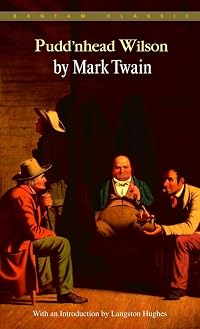
Pudd'nhead Wilson
by Mark Twain 
On This Page
Description
American humorist and literary master Mark Twain takes on tough issues like slavery, race, and the ugliness that can lurk beneath the surface of rural life in this novel. An interwoven tale of three families whose fates are thrown together in the aftermath of a murder, The Tragedy of Pudd'nhead Wilson is one of Twain's more serious works, although it is told with the same love of quirky misfits and wonderful observations that enliven books like The Adventures of Tom Sawyer and Adventures of show more Huckleberry Finn.. show less
Tags
Recommendations

















Member Reviews
The best and most affecting story I've read from Twain so far. Starting out i thought it would just be a prince and the pauper story set in the pre civil war south, but twain creates something great for his story. Tom Driscoll is a weak iago and Chambers the poor othello. Twain's statements on the absurdities of racial ideologies of the time (as well as the practice of slavery as a whole) are witty and acid tongued. Twain speaks as part historian part misanthrope not apologizing for the time or the institution but somehow giving it the tinge of acceptability due mostly to people and their continued errs while ruthlessly mocking it and the people who endorse it as well as those who suffer from it, black and white. For a quick read show more there's a fantastic amount of depth and meaning to be found in its reflections on both americas past and peoples eternal flaws and mores. show less
This is a really great way to take in this manifold tale: a full cast presenting it like a play; as lively theater. Of course, if you are one of the ones that find the n-word in Huckleberry Finn marking it as worthy of banning, you really won't like this wide-eyed look at passing octoroons and a switched at birth slave/master pair. The exploration of character motivation, comedy capers and interweaving plots make this Tragedy the 19th Century equivalent of a Tarantino screenplay. The end is a delightful afterword by Twain explaining his original story idea and how it transmogrified. The fingerprint forensics theme is, I think, very forward-looking.
It was not intentional that I read "Pudd'nhead Wilson" during Black History Month. Nonetheless, it was a perfect choice for its focus on race, especially in its central plot of switching a black baby (being only a thirty-second mixed-race) with a white one and all the subsequent issues springing from that event. It was the worst choice to have read out loud to my wife since the dialogue was so saturated with racial slurs--especially in its chief employ of the dreaded N-word. A white dude narrating to his white wife black dialect some other white dude wrote in the darker, later period of his career. For all her head-turning at each N-bomb, I had to stop at one point to say, "You know, you're going to get a sore neck." It was awkward to show more say the least. It was exploitative to say the most.
I had a friend recently say that Twain was just being honest, even though he'd never read the book. And I'd get that if it were part of the natural tapestry of the greater narrative. But for its first half, the dialogue is so absolutely clogged with racial epithets that it actually seemed to throw off the story instead of lend it realism; a bent toward obsession versus faithful narration. And I think this speaks to Twain's tendency to radicalism in his later writing, which I greatly appreciate and one reason for which I have an affinity for his writing. However, overuse is overuse.
The point of literature, fiction in particular, I believe, is to suspend disbelief--to willingly immerse yourself into the created world. If you've done that, then you've achieved something outside yourself. Whether in novels or movies or relating an incident to a friend, if you've lost the audience in rant or artifice, then you've lost it all. And all literature is artifice. Dialogue is a very particular artifice within that artifice. It's all faked. (If you don't believe me, record a conversation of any length and faithfully transcribe every word, pause, misstep, burp, overlap and twang and you'll find it's damn near unreadable. You don't have to read Alexander Block's poetry to realize this.) So, whenever the sheet is pulled back and you notice that artifice for what it is--namely, cold naked fakery--you've blown it, gone too far, led the reader down an alley with a flashlight bereft of batteries. For me, Twain did this in "Pudd'nhead Wilson".
When I was a young man, I went through an exploitation movie phase: sexploitation, blaxploitation, Nazisploitation, nunsploitation, Giallo films, you name it. Maybe to right the balance of all the foreign and Hollywood films I'd seen up until then. In any case, sometimes a film would go one beat too far and momentarily lose me. But that's the point of exploitation in art--it's supposed to shock you outside of ordinary narration. But even when that went too far, I couldn't help but exclaim: "Jesus Christ, enough already." "Fight for Your Life" was one such example. A racist criminal breaks into the home of a black minister and his family, takes them hostage, throws out every racist barb he can stick, threats and violence, until the minister unleashes unholy Hell upon the redneck bigot. It was hard to watch--not so much for its physical brutality as much as the pervasiveness of its brutal language. Twain didn't go that far, but it felt closer to this than what he'd written in "Adventures of Huckleberry Finn" where the racism and language were a natural part of the story--part of its flow--not merely an insertion to get a rise (or faithfully record the era, whatever that means). Kind of like when Quentin Tarantino played the Australian miner in "Django Unchained" three-quarters of the way in. I mean, he couldn't get some other actor to play the role and give his mouth an N-bomb break?
Not to say that I didn't enjoy "Pudd'nhead Wilson" at times. On the contrary, parts of it were whimsical and delightful (especially the scenes with the much underused title character). But there was a lot of wincing to be had. Next Black History Month I'll be sure to select a book written by an author who isn't white. Sometimes, we know how to fuck up a perfectly good story all too well. show less
I had a friend recently say that Twain was just being honest, even though he'd never read the book. And I'd get that if it were part of the natural tapestry of the greater narrative. But for its first half, the dialogue is so absolutely clogged with racial epithets that it actually seemed to throw off the story instead of lend it realism; a bent toward obsession versus faithful narration. And I think this speaks to Twain's tendency to radicalism in his later writing, which I greatly appreciate and one reason for which I have an affinity for his writing. However, overuse is overuse.
The point of literature, fiction in particular, I believe, is to suspend disbelief--to willingly immerse yourself into the created world. If you've done that, then you've achieved something outside yourself. Whether in novels or movies or relating an incident to a friend, if you've lost the audience in rant or artifice, then you've lost it all. And all literature is artifice. Dialogue is a very particular artifice within that artifice. It's all faked. (If you don't believe me, record a conversation of any length and faithfully transcribe every word, pause, misstep, burp, overlap and twang and you'll find it's damn near unreadable. You don't have to read Alexander Block's poetry to realize this.) So, whenever the sheet is pulled back and you notice that artifice for what it is--namely, cold naked fakery--you've blown it, gone too far, led the reader down an alley with a flashlight bereft of batteries. For me, Twain did this in "Pudd'nhead Wilson".
When I was a young man, I went through an exploitation movie phase: sexploitation, blaxploitation, Nazisploitation, nunsploitation, Giallo films, you name it. Maybe to right the balance of all the foreign and Hollywood films I'd seen up until then. In any case, sometimes a film would go one beat too far and momentarily lose me. But that's the point of exploitation in art--it's supposed to shock you outside of ordinary narration. But even when that went too far, I couldn't help but exclaim: "Jesus Christ, enough already." "Fight for Your Life" was one such example. A racist criminal breaks into the home of a black minister and his family, takes them hostage, throws out every racist barb he can stick, threats and violence, until the minister unleashes unholy Hell upon the redneck bigot. It was hard to watch--not so much for its physical brutality as much as the pervasiveness of its brutal language. Twain didn't go that far, but it felt closer to this than what he'd written in "Adventures of Huckleberry Finn" where the racism and language were a natural part of the story--part of its flow--not merely an insertion to get a rise (or faithfully record the era, whatever that means). Kind of like when Quentin Tarantino played the Australian miner in "Django Unchained" three-quarters of the way in. I mean, he couldn't get some other actor to play the role and give his mouth an N-bomb break?
Not to say that I didn't enjoy "Pudd'nhead Wilson" at times. On the contrary, parts of it were whimsical and delightful (especially the scenes with the much underused title character). But there was a lot of wincing to be had. Next Black History Month I'll be sure to select a book written by an author who isn't white. Sometimes, we know how to fuck up a perfectly good story all too well. show less
Nobody quite combines comedy and tragedy like Mark Twain. His ability to mock the most unfortunate of situations makes even the most scathing of social commentaries enjoyable reading. Puddn'head Wilson is a perfect example of this with its discussion of race and privilege in the South.
Twain accomplishes two goals with this particular work. When discussing the reversed identities, he hits right at the heart of racial prejudice. Tom’s treatment of Chambers, and eventually his mother, is absolutely appalling, especially as the reader understands the true situation. His sense of entitlement because he is “white” is as disgusting to modern readers as it is telling of the difference in mindset between the 1850s and today.
What is show more fascinating is Twain’s use of the beginnings of forensic evidence in murder trials. The polite interest that turns into overt mocking that then switches to apt fascination is spot on in society’s acceptance of any new scientific methodology. While presenting this new, objective methodology, Twain also continues his biting commentary on the subjectivity of a jury that is hampered by close-mindedness and social stigmas. The crowd’s reaction when they understand that a “white” man of privilege could commit such a horrible crime is humorous in true Twain fashion while simultaneously horrifying at their ignorance.
Puddn'head Wilson is a fascinating look at a society long past. In fact, modern readers can appreciate Twain’s message more than his contemporaries could because we have the benefit of hundreds of years of ingrained social messaging about the equality of races. It begs the question of what Twain’s contemporaries thought about this social commentary. Would they have appreciated what Twain was mocking? No matter what era in which this novel is being read, Puddn'head Wilson provides plenty of fodder for discussion and contemplation, as befits a true classic. show less
Twain accomplishes two goals with this particular work. When discussing the reversed identities, he hits right at the heart of racial prejudice. Tom’s treatment of Chambers, and eventually his mother, is absolutely appalling, especially as the reader understands the true situation. His sense of entitlement because he is “white” is as disgusting to modern readers as it is telling of the difference in mindset between the 1850s and today.
What is show more fascinating is Twain’s use of the beginnings of forensic evidence in murder trials. The polite interest that turns into overt mocking that then switches to apt fascination is spot on in society’s acceptance of any new scientific methodology. While presenting this new, objective methodology, Twain also continues his biting commentary on the subjectivity of a jury that is hampered by close-mindedness and social stigmas. The crowd’s reaction when they understand that a “white” man of privilege could commit such a horrible crime is humorous in true Twain fashion while simultaneously horrifying at their ignorance.
Puddn'head Wilson is a fascinating look at a society long past. In fact, modern readers can appreciate Twain’s message more than his contemporaries could because we have the benefit of hundreds of years of ingrained social messaging about the equality of races. It begs the question of what Twain’s contemporaries thought about this social commentary. Would they have appreciated what Twain was mocking? No matter what era in which this novel is being read, Puddn'head Wilson provides plenty of fodder for discussion and contemplation, as befits a true classic. show less
Wow, This is one of these stories that starts off on a lighter and more comedic note, but holy shit, things go downhill after a certain point, but then, this was a book meant to be a commentary on various ills, including slavery, with a cruel yet somehow appropriate ending.
Two babies are switched in their infancy. One is pure white blood and heir to an estate. The other is 1/16 black, and a slave, although he looks as white as any. The slave child's mother switches the infants, to guarantee that her own son is never "sold down the river" but will instead inherit an estate.
The character of the two boys becomes clear as they grow older, and the imposter child (now educated and dignified) is clearly the one lacking in empathy and moral integrity. When that young man commits a heinous murder, it is up to "Pudd'nhead Wilson," a local eccentric who has always wanted to be a lawyer, to find the murderer.
The upsetting aspect of this book was that Twain seems to be suggesting that Roxy (the 1/8 negro mother) and show more Tom (the 1/16 negro boy) were as awful as they were because of their black heritage. Far from being an indictment of the "one drop" rule - this story seems to encourage that idea. Roxy and Tom are the clear villains of the story, and they are both considered black, because they have trace degrees of "black blood" in them. The underlying theme of the book seemed racist to me, and therefore not something I would recommend. show less
The character of the two boys becomes clear as they grow older, and the imposter child (now educated and dignified) is clearly the one lacking in empathy and moral integrity. When that young man commits a heinous murder, it is up to "Pudd'nhead Wilson," a local eccentric who has always wanted to be a lawyer, to find the murderer.
The upsetting aspect of this book was that Twain seems to be suggesting that Roxy (the 1/8 negro mother) and show more Tom (the 1/16 negro boy) were as awful as they were because of their black heritage. Far from being an indictment of the "one drop" rule - this story seems to encourage that idea. Roxy and Tom are the clear villains of the story, and they are both considered black, because they have trace degrees of "black blood" in them. The underlying theme of the book seemed racist to me, and therefore not something I would recommend. show less
I've never read this entire book before but have vague memories of references to it in discussions of other Twain novels or of general turn of the century literature. The one discussion I remember most vividly was a discussion of "courtroom drama" literature and how this particular book helped set up that format and in particular helped set up the presentation of evidence, especially the concept of using fingerprints to help solve crimes.
Apart from the vague discussions about theme, I went into this novel fresh and really enjoyed it. I've always loved Twain's writing. Huckleberry Finn is one of my favorite all time books. In Pudd'nhead Wilson there is a lot of similar tone, setting, dialog and feel that made Huck Finn seem so real.
This show more book is set in a Missouri town (Dawson's Landing) in the early 1800s and (although I'm not an expert on the 19th century South), it felt very authentic. Once again, Twain captures great elements of dialog and mannerism and does a great job of creating vivid environments and characters.
The story is intriguing and feels at times like a Shakespearean "mistaken identity" play writ large. In the first few pages we're introduced to the townsfolk and shortly after introduction we watch a slave do the ol' switcher with two babies…her 'black' baby (1/32 black, and thus very easily confused as 'white') and her master's white baby. We stick with the worried mother Roxy for a few months and then fast forward through the childhood and adolescent lives of the switched boys. The story picks up with them in their early 20s and really kicks into overdrive as two twins arrive from Italy, vices of the switched "black" boy come to light, and murder is committed in the town. The story ends with the title character, Pudd'nhead, working to solve the crime and act as defense lawyer for the accused.
There are many themes present throughout this book. They are all presented in Twain's subtle, ironic, humorous tones. Moreso even than in some of his other books, Twain keeps the various "morales" very subtly in the background. He never seems to overtly or explicitly condemn anyone for any of their crimes, prejudices or vices. Instead, he presents a variety of situations ranging from tragic to humorous to ridiculous and lets the reader make his/her own judgment call.
So even though Roxy commits a crime in switching her black baby for her master's white baby, Twain never condemns her. He never makes any commentary on what he presents as the absolutely ridiculous practice that even a drop of "black blood" can make a person "black" and thus a slave, no matter how "white" that person really is. He doesn't even really speak out against slavery (even in the subtle way he did in Huck Finn or Tom Sawyer) though he does make is somewhat evident that he's not a fan just through the way the various interactions take place.
The closest he comes to condemnation is through Roxy's dialog later in the book as she talks with her son and reveals his true heritage to him. Through Roxy, he condemns "Tom's" behavior…his despicable treatment of blacks, his many vices, his horrific act of selling "down the river" and more and more.
Pudd'nhead acts almost as a counterpoint to Roxy's scathing comments. He seems sometimes to be the voice of reason or at least of calm, pensive thinking. Through his logical reasoning and his instinctive insight, we have a character who, although thought by his peers to be a dunce, is actually quite bright and has great wit and wisdom.
As the full title (The TRAGEDY of Pudd'nhead Wilson) suggests, this book doesn't have a 'happy' ending per se. In the end, all the crimes are resolved and the innocent parties are restored to their freedom while the guilty parties are punished. However, the tragedy seems to be in how "matter of fact" the state of affairs is presented. After the trial is complete, the wrap up is somewhat disheartening. The white boy ('Chambers') who lived his life as black is now caught between worlds, not fitting into any place. The boy's uncle (Judge Driscoll) is dead and his estate now belongs to an out of place nephew newly restored to 'whiteness.' Roxy's punishment is almost a reward. And 'Tom', who should receive one major punishment is instead set "free" in terms of 'justice' but left a "slave" because of the value of a black man.
This book is a very thoughtful and intriguing piece. It had in its underlying tone, much of the humor and irony that I really love about Twain's work. I really like the characters and the general story. I loved the presentation of the work and had a lot of fun reading this book. If I had to choose only one Twain, I'd still choose Huck, but this is another one that I'd recommend reading if you have any interest in Mark Twain, 19th century south, slavery, or American Literature in general. It's a great read.
****
4.5 out of 5 stars show less
Apart from the vague discussions about theme, I went into this novel fresh and really enjoyed it. I've always loved Twain's writing. Huckleberry Finn is one of my favorite all time books. In Pudd'nhead Wilson there is a lot of similar tone, setting, dialog and feel that made Huck Finn seem so real.
This show more book is set in a Missouri town (Dawson's Landing) in the early 1800s and (although I'm not an expert on the 19th century South), it felt very authentic. Once again, Twain captures great elements of dialog and mannerism and does a great job of creating vivid environments and characters.
The story is intriguing and feels at times like a Shakespearean "mistaken identity" play writ large. In the first few pages we're introduced to the townsfolk and shortly after introduction we watch a slave do the ol' switcher with two babies…her 'black' baby (1/32 black, and thus very easily confused as 'white') and her master's white baby. We stick with the worried mother Roxy for a few months and then fast forward through the childhood and adolescent lives of the switched boys. The story picks up with them in their early 20s and really kicks into overdrive as two twins arrive from Italy, vices of the switched "black" boy come to light, and murder is committed in the town. The story ends with the title character, Pudd'nhead, working to solve the crime and act as defense lawyer for the accused.
There are many themes present throughout this book. They are all presented in Twain's subtle, ironic, humorous tones. Moreso even than in some of his other books, Twain keeps the various "morales" very subtly in the background. He never seems to overtly or explicitly condemn anyone for any of their crimes, prejudices or vices. Instead, he presents a variety of situations ranging from tragic to humorous to ridiculous and lets the reader make his/her own judgment call.
So even though Roxy commits a crime in switching her black baby for her master's white baby, Twain never condemns her. He never makes any commentary on what he presents as the absolutely ridiculous practice that even a drop of "black blood" can make a person "black" and thus a slave, no matter how "white" that person really is. He doesn't even really speak out against slavery (even in the subtle way he did in Huck Finn or Tom Sawyer) though he does make is somewhat evident that he's not a fan just through the way the various interactions take place.
The closest he comes to condemnation is through Roxy's dialog later in the book as she talks with her son and reveals his true heritage to him. Through Roxy, he condemns "Tom's" behavior…his despicable treatment of blacks, his many vices, his horrific act of selling "down the river" and more and more.
Pudd'nhead acts almost as a counterpoint to Roxy's scathing comments. He seems sometimes to be the voice of reason or at least of calm, pensive thinking. Through his logical reasoning and his instinctive insight, we have a character who, although thought by his peers to be a dunce, is actually quite bright and has great wit and wisdom.
As the full title (The TRAGEDY of Pudd'nhead Wilson) suggests, this book doesn't have a 'happy' ending per se. In the end, all the crimes are resolved and the innocent parties are restored to their freedom while the guilty parties are punished. However, the tragedy seems to be in how "matter of fact" the state of affairs is presented. After the trial is complete, the wrap up is somewhat disheartening. The white boy ('Chambers') who lived his life as black is now caught between worlds, not fitting into any place. The boy's uncle (Judge Driscoll) is dead and his estate now belongs to an out of place nephew newly restored to 'whiteness.' Roxy's punishment is almost a reward. And 'Tom', who should receive one major punishment is instead set "free" in terms of 'justice' but left a "slave" because of the value of a black man.
This book is a very thoughtful and intriguing piece. It had in its underlying tone, much of the humor and irony that I really love about Twain's work. I really like the characters and the general story. I loved the presentation of the work and had a lot of fun reading this book. If I had to choose only one Twain, I'd still choose Huck, but this is another one that I'd recommend reading if you have any interest in Mark Twain, 19th century south, slavery, or American Literature in general. It's a great read.
****
4.5 out of 5 stars show less
Members
- Recently Added By
Lists

The Guardian's 1000 Novels Everyone Must Read
1,005 works; 550 members

Classics you know you should have read but probably haven't
421 works; 406 members

Harold Bloom - The Western Canon: C. The Democratic Age
336 works; 15 members

Fiction (Mostly) in Selective Bibliography of American Literature 1775-1900
431 works; 3 members

al.vick-parents books
301 works; 1 member

Books mentioned in Julian Symons’ Bloody Murder
438 works; 6 members

Haycraft Queen Cornerstones
181 works; 3 members

Art Bourgeau's Favorites [Mystery Lovers Companion, 1986]
124 works; 2 members

Vlogbrothers Book Recommendations
307 works; 4 members

School Made Us Read It
380 works; 196 members
Author Information

2,748+ Works 208,527 Members
Mark Twain was born Samuel L. Clemens in Florida, Missouri on November 30, 1835. He worked as a printer, and then became a steamboat pilot. He traveled throughout the West, writing humorous sketches for newspapers. In 1865, he wrote the short story, The Celebrated Jumping Frog of Calaveras County, which was very well received. He then began a show more career as a humorous travel writer and lecturer, publishing The Innocents Abroad in 1869, Roughing It in 1872, and, Gilded Age in 1873, which was co-authored with Charles Dudley Warner. His best-known works are The Adventures of Tom Sawyer, Mississippi Writing: Life on the Mississippi, and The Adventures of Huckleberry Finn. He died of a heart attack on April 21, 1910. (Bowker Author Biography) show less
Mark Twain has a Legacy Library. Legacy libraries are the personal libraries of famous readers, entered by LibraryThing members from the Legacy Libraries group.
Some Editions
Awards and Honors
Series
Belongs to Publisher Series
Limited Editions Club (S:41.12)
Airmont Classics (124)
Work Relationships
Is contained in
Has the adaptation
Is abridged in
Has as a reference guide/companion
Has as a study
Has as a student's study guide
Common Knowledge
- Canonical title
- Pudd'nhead Wilson
- Original title
- Wilson cabezaloca
- Original publication date
- 1894; 1893
- People/Characters
- Pudd'nhead Wilson; Tom Driscoll; Roxy; Valet de Chambre
- Important places
- Mississippi, USA; Dawson's Landing, Missouri, USA; Missouri, USA
- Related movies
- American Playhouse: Pudd'nhead Wilson (1984 | IMDb)
- First words
- The scene of this chronicle is the town of Dawson's Landing, on the Missouri side of the Mississippi, half a day's journey, per steamboat, from St. Louis.
-Pudd'nhead Wilson - Last words
- (Click to show. Warning: May contain spoilers.)As soon as the Governor understood the case, he pardoned Tom at once, and the creditors sold him down the river.
-Pudd'nhead Wilson
(Click to show. Warning: May contain spoilers.)And so ends the history of 'Those Extraordinary Twins'.
-Those Extraordinary Twins - Disambiguation notice
- This work is the novel Pudd'nhead Wilson, a single work, originally published in the U.S. in The Tragedy of Pudd'nhead Wilson and the Comedy of Those Extraordinary Twins.
Editions that include both Pudd'nhead... (show all) Wilson and Those Extraordinary Twins are a different work and should be separated.
Please keep the Norton Critical Edition books un-combined with the rest of them - it is significantly different with thorough explanatory annotations, and with additional essays and reviews by other writers. Thank you.
Classifications
Statistics
- Members
- 3,493
- Popularity
- 4,729
- Reviews
- 55
- Rating
- (3.69)
- Languages
- 12 — Czech, Danish, English, Finnish, French, German, Hungarian, Italian, Norwegian (Bokmål), Norwegian, Spanish, Swedish
- Media
- Paper, Audiobook, Ebook
- ISBNs
- 201
- UPCs
- 1
- ASINs
- 123