

Wright Morris (1910–1998)
Author of Plains Song: For Female Voices
About the Author
Early in his career, Wright Morris was called by Mark Schorer "probably the most original young novelist writing in the United States." In 1968 Leon Howard wrote: "Wright Morris has been the most consistently original of American novelists for a quarter of a century." Since then, the University of show more Nebraska Press has brought out new editions of his first 17 novels. Although both critical and popular appreciation of his work continues to grow slowly, there is a general consensus that he ranks high among contemporary American novelists. Born in Central City, Nebraska, the Lone Tree of his fiction, Morris attended Pomona College in California and had an academic career chiefly at San Francisco State University until his retirement in 1975. Nebraska and California have provided the main settings for his work, but he has traveled widely here and abroad, and some of his best novels relate the picaresque odysseys made by engaging characters. For instance, his first novel, My Uncle Dudley (1942), is a fictionalized account of a trip to California with his father that motherless Morris made as a youth. When almost 30 years later Morris wrote about another east-to-west journey in Fire Sermon (1971), in which an old man and a boy encounter three young hippies, Granville Hicks called the book "simon-pure, dyed-in-the-wool honest-to-God Wright Morris of the very highest grade" (N.Y. Times). The Field of Vision (1956), which deals with "innocents abroad in Mexico," won the National Book Award for fiction in 1957 and ranks behind only Ceremony in Lone Tree (1960) as his most successful novel.Ceremony involves four generations at a family reunion as Morris ingeniously reconciles the past, present, and future in a story that avoids both nostalgia and the disillusionment of the you-can't-go-home-again theme that appears quite often in his other fiction. Critics attempting to define Morris's originality have emphasized his distinctive style---a Faulkner-like ability to draw characters that come alive as individuals, his cross-country Americanness, and a strong sense of place that may owe something to Morris's considerable gifts as a photographer. Morris's fine feeling for the conjunction of time and place is evident in his several books of photographs with text: The Inhabitants (1946), The Home Place (1948), God's Country and My People (1968), Photographs and Words, and Picture America (1982). Other nonfiction includes a collection of essays on contemporary social and political problems---A Bill of Rites, a Bill of Wrongs, a Bill of Goods (1967)---and two widely praised volumes of criticism---The Territory Ahead: Critical Iinterpretations in American Literature (1958) and Earthly Delights, Unearthly Adornments: American Writers as Image Makers. Two volumes of personal memoirs are Will's Boy (1981) and Solo: An American Dreamer in Europe, 1933--1934 (1983). (Bowker Author Biography) Writer and photographer Wright Morris was born in Central City, Nebraska on January 6, 1910. He was an English professor at San Francisco State College from 1963 - 1975. He wrote novels and photo-text books, which juxtapose photographs with fictional text. He won numerous awards including the 1956 National Book Award for The Field of Vision and the 1981 American Book Award for Fiction for Plains Song: For Female Voices. He died on April 25, 1998. (Bowker Author Biography) show less
Works by Wright Morris
Time Pieces: Photographs, Writing, and Memory (Aperture Writers & Artists on Photography) (1989) 57 copies
Associated Works
The Norton Anthology of American Literature, Volume 2: 1865 to Present (1979) — Contributor, some editions — 136 copies
Tagged
Common Knowledge
- Legal name
- Morris, Wright Marion
- Birthdate
- 1910-01-06
- Date of death
- 1998-04-25
- Gender
- male
- Occupations
- photographer
novelist
essayist
uninversity professor - Awards and honors
- Whiting Writers' Award (1985)
Robert Kirsch Award (1981)
Western Literature Association's Distinguished Achievement Award (1979)
American Academy of Arts and Letters Academy Award (Literature, 1960) - Nationality
- USA
- Birthplace
- Central City, Nebraska, USA
- Places of residence
- Central City, Nebraska, USA
Pacific Palisades, California, USA - Associated Place (for map)
- USA
Members
Reviews

I picked this up recently at Too Many Books, in Roanoke, VA, a wonderful used book shop that also has some very pricey special volumes. This one wasn't expensive, but it was packaged in a plastic sleeve, suggesting there was something special about it, and that certainly proved to be the case.
It is an inspired combination of text and photographs (black & white) telling the story of a family's visit to the father's "home place", a farm where he spent summers as a child, and where his aged show more relatives, who he hasn't seen in nearly 30 years, still live. It takes place shortly after WWII, and for reasons that are not explained the visiting family is homeless, having left New York City with "no place to go". They contemplate moving into an empty house across the road from the home place. It is wrenching in its reality, its celebration of the stark beauty of ordinary, worn and tired objects and people; and it is full of dark humor, as when the two young children, totally out of their element, encounter fly paper for the first time, and become so totally entangled and stuck up that they must have their hair completely cut off, and their poor bald heads covered with straw hats before their mother sees them. This is fiction, but it feels like documentary, with each page of text faced with a photo. On the other hand, at times the poetry of this work took my breath away, largely because there is a "home place" in my life that in my youth was still about a half century behind the times, and some of my most vivid memories are rooted there. This quote from novel speaks very loudly to me: "The word beauty is not a Protestant thing. It doesn't describe what there is about an old man's shoes. The Protestant word for that is character. Character is supposed to cover what I feel about a cane-seated chair, and the faded bib...of an old man's overalls. Character is the word, but it doesn't cover the ground. It doesn't cover what there is moving about it, that is. I say these things are beautiful, but I do so with the understanding that mighty few people anywhere will follow what I mean. That's too bad. For this character is beautiful...there's something about these man-tired things, something added, that is more than character."
Edit | More show less
It is an inspired combination of text and photographs (black & white) telling the story of a family's visit to the father's "home place", a farm where he spent summers as a child, and where his aged show more relatives, who he hasn't seen in nearly 30 years, still live. It takes place shortly after WWII, and for reasons that are not explained the visiting family is homeless, having left New York City with "no place to go". They contemplate moving into an empty house across the road from the home place. It is wrenching in its reality, its celebration of the stark beauty of ordinary, worn and tired objects and people; and it is full of dark humor, as when the two young children, totally out of their element, encounter fly paper for the first time, and become so totally entangled and stuck up that they must have their hair completely cut off, and their poor bald heads covered with straw hats before their mother sees them. This is fiction, but it feels like documentary, with each page of text faced with a photo. On the other hand, at times the poetry of this work took my breath away, largely because there is a "home place" in my life that in my youth was still about a half century behind the times, and some of my most vivid memories are rooted there. This quote from novel speaks very loudly to me: "The word beauty is not a Protestant thing. It doesn't describe what there is about an old man's shoes. The Protestant word for that is character. Character is supposed to cover what I feel about a cane-seated chair, and the faded bib...of an old man's overalls. Character is the word, but it doesn't cover the ground. It doesn't cover what there is moving about it, that is. I say these things are beautiful, but I do so with the understanding that mighty few people anywhere will follow what I mean. That's too bad. For this character is beautiful...there's something about these man-tired things, something added, that is more than character."
Edit | More show less
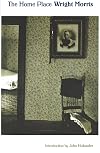
This is an American regionalist novel about a family in rural Nebraska. It's unusual because every double-page spread is a page of text facing a photograph. It's a curious book, a mixture of some very dated-sounding mid-twentieth century rural Plains dialogue and simple photographs of chairs, tables, the ground, farm implements, and parts of buildings. I'll just note four things in particular:
1. The relation of the images to the text varies, so that it seems Morris was working out how show more images related to text throughout his novel. Photographs vary widely in the way they are attached to the text. Here is an incomplete catalog:
(A) The person in the photograph is referred to in the text (p. 1).
(B) At several points the text might be referring to the photograph, and the reader may check that, but find there's no connection (p. 3).
(C) The picture is an emblem of something in the text. Old people, the narrator says at one point, "were like the single plow below my window" because "you couldn't show them, or give them anything"; this is accompanied by a photo of a plow. (p. 25).
(D) The image is an example of things listed in the text (p. 109).
(E) The image is a study of something that is only mentioned briefly, in passing, in the text (p. 130).
(F) The image doesn't fit the narrative, or contradicts it. (P. 132, a photo of coats, opposite a description of an empty house; but the next page is of a bed that perfectly matches the narrative description.)
(G) Images that might, or might not, illustrate something in the text, making the reader cross back and forth from image to text (pp. 145, 146).
(H) An image described in the text is illustrated, but not on the facing page (pp. 141-2).
This list could be made about twice as long; for me, it's a sign that the book was an ongoing experiment, never resolved during the writing. Hollander makes a point of one image that shows newspaper clippings that are quoted by the narrator; but it's an anomaly, and it's text-based (the image as such doesn't play a part in Hollander's description).
2. In terms of layout, the book has full-page images all the way up to p. 154, when the reader is surprised by a single photograph, printed across the gutter, with just seven lines of text on each page beneath. It's significant that this double-lage spread is a family photo: more on that below.
From that point to the end of the book, the layout changes: the images are again full page, on the right, but the text on the left pages doesn't reach to the bottom of the page. The only conclusion it's possible to draw is that Morris decided to write just as much as would respond to the image on the facing page, and then go on to the next pair. That makes for a much closer relation between image and text, because a reader knows that the paragraphs on each page were probably written with that particular photo in mind; it also makes the pages into prose poems or independent sections of prose, producing an entirely different effect than the one in most of the book, where the reader turns pages at the speed of the narrative. (When the text is continuous, you're not obligated to stop a moment and look at each picture before you turn the page. When the text stops halfway down the page, it's a signal that only that amount of text responds to the picture.)
3. There are few photographs of people. This is a common theme, I've found, in novels with captionless images. The immediate reason is that if a character in the novel is shown in a photograph, it disrupts reading, and suspends disbelief, in a particular way, which is different from the way that a photograph of a house or a street might disrupt reading. There's a lot to be said about this! In "The Home Place," faces are presented in three ways: (A) In this family photograph, where people are small in the distance, so the reader's imagination is still fairly free; (B) in photographs of portrait photographs hanging on walls (p. 20), so the reader is insulated by a representation of a representation; and (C) by throwing the face into shadow, as in the very first photograph in the book, which is of an old man and an inner tube, standing in front of a barn: we see the kind of place and person, but not the expression itself. (See also p. 127, where a face is in shadow, and p. 50, where we see the old man's wrinkled neck from behind, but not his face.)
4. There is a theory of images in the book. On p. 141, the narrator explains using ideas of Protestant imagery:
"The word beauty is not a Protestant thing. It doesn't describe what there is about an old man's shoes. The Protestant word for that is character. Character is supposed to cover what I feel..."
It would be interesting to pursue this reading: the images aren't beautiful, in the way other authors (like Walker Evans?) had taken them to be; they have something to do with a non-aesthetic property called, inadequately, "character."
5. Precedents for the book. The history of novels with captionless images is not continuous. From "Bruges-la-Morte" to Sebald, it seems to have been reinvented several times. The introduction by John Hollander names some precedents for "The Home Place" (1968), including books in the 1930s that used photographs from the Farm Security Administration, and "Let Us Now Praise Famous Men" (1941). Buy Hollander also notes that this book is "almost a unique sort of novel" because it is a novel "with" photographs, rather than "in" photographs. It's possible Morris imagined himself as the inventor of this way of writing.
For all these and other reasons, this is a very engaging book. The prose itself is accomplished and sharp, but it wouldn't be the thing that would lead me to re-read the book. show less
1. The relation of the images to the text varies, so that it seems Morris was working out how show more images related to text throughout his novel. Photographs vary widely in the way they are attached to the text. Here is an incomplete catalog:
(A) The person in the photograph is referred to in the text (p. 1).
(B) At several points the text might be referring to the photograph, and the reader may check that, but find there's no connection (p. 3).
(C) The picture is an emblem of something in the text. Old people, the narrator says at one point, "were like the single plow below my window" because "you couldn't show them, or give them anything"; this is accompanied by a photo of a plow. (p. 25).
(D) The image is an example of things listed in the text (p. 109).
(E) The image is a study of something that is only mentioned briefly, in passing, in the text (p. 130).
(F) The image doesn't fit the narrative, or contradicts it. (P. 132, a photo of coats, opposite a description of an empty house; but the next page is of a bed that perfectly matches the narrative description.)
(G) Images that might, or might not, illustrate something in the text, making the reader cross back and forth from image to text (pp. 145, 146).
(H) An image described in the text is illustrated, but not on the facing page (pp. 141-2).
This list could be made about twice as long; for me, it's a sign that the book was an ongoing experiment, never resolved during the writing. Hollander makes a point of one image that shows newspaper clippings that are quoted by the narrator; but it's an anomaly, and it's text-based (the image as such doesn't play a part in Hollander's description).
2. In terms of layout, the book has full-page images all the way up to p. 154, when the reader is surprised by a single photograph, printed across the gutter, with just seven lines of text on each page beneath. It's significant that this double-lage spread is a family photo: more on that below.
From that point to the end of the book, the layout changes: the images are again full page, on the right, but the text on the left pages doesn't reach to the bottom of the page. The only conclusion it's possible to draw is that Morris decided to write just as much as would respond to the image on the facing page, and then go on to the next pair. That makes for a much closer relation between image and text, because a reader knows that the paragraphs on each page were probably written with that particular photo in mind; it also makes the pages into prose poems or independent sections of prose, producing an entirely different effect than the one in most of the book, where the reader turns pages at the speed of the narrative. (When the text is continuous, you're not obligated to stop a moment and look at each picture before you turn the page. When the text stops halfway down the page, it's a signal that only that amount of text responds to the picture.)
3. There are few photographs of people. This is a common theme, I've found, in novels with captionless images. The immediate reason is that if a character in the novel is shown in a photograph, it disrupts reading, and suspends disbelief, in a particular way, which is different from the way that a photograph of a house or a street might disrupt reading. There's a lot to be said about this! In "The Home Place," faces are presented in three ways: (A) In this family photograph, where people are small in the distance, so the reader's imagination is still fairly free; (B) in photographs of portrait photographs hanging on walls (p. 20), so the reader is insulated by a representation of a representation; and (C) by throwing the face into shadow, as in the very first photograph in the book, which is of an old man and an inner tube, standing in front of a barn: we see the kind of place and person, but not the expression itself. (See also p. 127, where a face is in shadow, and p. 50, where we see the old man's wrinkled neck from behind, but not his face.)
4. There is a theory of images in the book. On p. 141, the narrator explains using ideas of Protestant imagery:
"The word beauty is not a Protestant thing. It doesn't describe what there is about an old man's shoes. The Protestant word for that is character. Character is supposed to cover what I feel..."
It would be interesting to pursue this reading: the images aren't beautiful, in the way other authors (like Walker Evans?) had taken them to be; they have something to do with a non-aesthetic property called, inadequately, "character."
5. Precedents for the book. The history of novels with captionless images is not continuous. From "Bruges-la-Morte" to Sebald, it seems to have been reinvented several times. The introduction by John Hollander names some precedents for "The Home Place" (1968), including books in the 1930s that used photographs from the Farm Security Administration, and "Let Us Now Praise Famous Men" (1941). Buy Hollander also notes that this book is "almost a unique sort of novel" because it is a novel "with" photographs, rather than "in" photographs. It's possible Morris imagined himself as the inventor of this way of writing.
For all these and other reasons, this is a very engaging book. The prose itself is accomplished and sharp, but it wouldn't be the thing that would lead me to re-read the book. show less
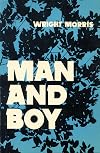
My latest plunge into the archives of books published in 1951 has come up with Man and Boy by Wright Morris. It is perhaps the strangest novel from that year that I have read. Not because of its content or its flirtation with experimental writing, but just because of its feeling of oddball people and oddball behaviour. One wonders if readers were expected to believe that such characters were the norm in America at that time.
The book is really of novella length and alternate chapters carry show more the point of view of Mr Ormsby and Mother. They are retired and Mr Ormsby is starting his day as usual at the bec and call of Mother, who is actually his wife. They had a son Virgil referred to as the boy, but he was killed in the second world war at Guadalcanal. Mother no longer finds it necessary to speak to Mr Ormsby apart from calling for him and writes a series of notes that amount to tasks for the day. Mother is an expert on wild birds and from time to time lectures to interested groups. Mr Ormsby does not go out much spending his time catering to Mother. Mother has received a notification from the American Navy that they are about to name a boat after their son for his heroic service in the war. Mr Ormsby must find his old travelling bag which has been mouldering in the loft for many years. They take the train and Mr Ormsby sits apart from his wife, next to a service man; private Lupido. A strange conversation about the candling of eggs ensues. Lupido is described as having an overlarge head and a boyish face and easily takes offence. Mr Ormsby invites him to come along with them to the commemoration service at the Brooklyn naval yard. The novel features strong female characters whose command and energy contrasts with the rather foolish men in their life.
Wright Morris was an American novelist, photographer and essayist and according to Wikipedia was known for his portrayals of people and artifacts of the Great Plains. His most read novels were [The field of Vision ]1956 and [Plains Song: for female voices] 1980. Man and boy with its rather curious perspective of the dominant female and its sense of characters isolated from the rest of the world, holds the readers attention. We are immediately immersed in the odd, ironic, humorous world created by Wright Morris to the extant that we don't question its existence. It is a rather slight novel, but I enjoyed it well enough 3 stars. show less
The book is really of novella length and alternate chapters carry show more the point of view of Mr Ormsby and Mother. They are retired and Mr Ormsby is starting his day as usual at the bec and call of Mother, who is actually his wife. They had a son Virgil referred to as the boy, but he was killed in the second world war at Guadalcanal. Mother no longer finds it necessary to speak to Mr Ormsby apart from calling for him and writes a series of notes that amount to tasks for the day. Mother is an expert on wild birds and from time to time lectures to interested groups. Mr Ormsby does not go out much spending his time catering to Mother. Mother has received a notification from the American Navy that they are about to name a boat after their son for his heroic service in the war. Mr Ormsby must find his old travelling bag which has been mouldering in the loft for many years. They take the train and Mr Ormsby sits apart from his wife, next to a service man; private Lupido. A strange conversation about the candling of eggs ensues. Lupido is described as having an overlarge head and a boyish face and easily takes offence. Mr Ormsby invites him to come along with them to the commemoration service at the Brooklyn naval yard. The novel features strong female characters whose command and energy contrasts with the rather foolish men in their life.
Wright Morris was an American novelist, photographer and essayist and according to Wikipedia was known for his portrayals of people and artifacts of the Great Plains. His most read novels were [The field of Vision ]1956 and [Plains Song: for female voices] 1980. Man and boy with its rather curious perspective of the dominant female and its sense of characters isolated from the rest of the world, holds the readers attention. We are immediately immersed in the odd, ironic, humorous world created by Wright Morris to the extant that we don't question its existence. It is a rather slight novel, but I enjoyed it well enough 3 stars. show less

This book consists of photographs on the right-hand page, short stories opposite and a line of text across the top of each left-hand page which links all of the stories and photographs together. Reading this book is unlike any other reading experience I have had. The photographs are like wisps of memory, ghostly remains after all the people have gone. The words echo the human activity that went before in a wonderful recreation of verbal wit, wisdom, hopes, sorrows and dreams. It was the show more closest I've come to the experience of time-travelling! show less
Lists
Awards


You May Also Like


Associated Authors
Statistics
- Works
- 56
- Also by
- 19
- Members
- 1,485
- Popularity
- #17,290
- Rating
- 3.8
- Reviews
- 14
- ISBNs
- 126
- Languages
- 3
- Favorited
- 6