
Stanley Elkin (1930–1995)
Author of The Living End
About the Author
Stanley Elkin was an American Jewish novelist, short story writer, and essayist. He was born on May 11, 1930. Elkin steadily and quietly worked his way into the higher ranks of contemporary American novelists. He was born in Brooklyn, New York, but grew up in Chicago and has spent most of his life show more since in the Midwest, receiving his Ph.D. in English from the University of Illinois with a dissertation on William Faulkner. He was a member of the English faculty at Washington University in St. Louis from 1960 until his death, and battled multiple sclerosis for most of his adult life. Reviewers found Elkin's first novel, Boswell: A Modern Comedy (1964), the story of an uninhibited modern-day counterpart of the eighteenth-century biographer, hilarious and promising, while the stories in Criers and Kibitzers, Kibitzers and Criers (1966) established Elkin as a writer capable of writing short stories of textbook-anthology quality. The ironically entitled A Bad Man (1967) is about a Jewish department store magnate who deliberately arranges to have himself convicted of several misdeeds so that he can experience the real world of a prison and carry on his own war with the warden in what takes on the dimensions of a burlesque existential allegory. The Dick Gibson Show (1971) uses the host of a radio talk show as a way of showing fancifully what it means to live "at sound barrier," and both Searchers and Seizures (1973) and The Living End (1979) are triptychs of related stories verging on surrealism. The Franchiser (1976), generally considered Elkin's best novel before George Mills, uses the story of a traveling salesman of franchises to show the flattening homogenization of American life. But as usual, what happens in this Elkin novel is less important than the way in which the story is told. Elkin won the National Book Critics Circle Award on two occasions: for George Mills in 1982 and for Mrs. Ted Bliss, his last novel, in 1995. The MacGuffin was a finalist for the 1991 National Book Award for Fiction. Although he enjoyed high critical praise, his books never enjoyed popular success. Elkin died May 31, 1995 of a heart attack. His manuscripts and correspondence are archived in Olin Library at Washington University in St. Louis. (Bowker Author Biography) show less
Image credit: Courtesy of Dalkey Archive Press
Works by Stanley Elkin
The Muses Are Heard 2 copies
Elkin Stanley 1 copy
Associated Works
The Art of the Tale: An International Anthology of Short Stories (1986) — Contributor — 383 copies, 3 reviews
The Worst Years of Your Life: Stories for the Geeked-Out, Angst-Ridden, Lust-Addled, and Deeply Misunderstood Adolescent in All of Us (2007) — Contributor — 94 copies, 1 review
Fiction, Volume 1, Number 1 — Contributor — 1 copy
The Human Commitment - An Anthology of Contemporary Short Fiction — Contributor — 1 copy
Tagged
Common Knowledge
- Canonical name
- Elkin, Stanley
- Legal name
- Elkin, Stanley Lawrence
- Birthdate
- 1930-05-11
- Date of death
- 1995-05-31
- Gender
- male
- Education
- University of Illinois, Urbana-Champaign (BA|1952|MA|1953|Ph.D|1961)
- Occupations
- novelist
short story writer
professor (English)
essayist - Organizations
- Washington University in St. Louis (Merle Kling Professor of Modern Letters)
United States Army - Awards and honors
- American Academy of Arts and Letters (1982)
National Book Critics Circle Award (1982, 1995)
American Academy of Arts and Letters Academy Award (Literature, 1974)
St Louis Walk of Fame (1991) - Short biography
- Stanley Elkin was born in Brooklyn, New York. He grew up in Chicago, where his parents moved when he was three years old. He began writing as a boy. He attended the University of Illinois at Champaign-Urbana, earning a bachelor's degree in English in 1952, a master's degree in 1953 and a doctorate in 1961. In 1953, he married Joan Jacobson, with whom he had three children. He served in the U.S. Army from 1955 to 1957. In 1960, he joined the faculty of Washington University in St. Louis as an English instructor, and remained at the university the rest of his life. He rose to full professor in 1969 and was appointed Merle Kling Professor of Modern Letters in 1983. He became a famed teacher whose students were known to tremble in the wake of his comments. Stanley Elkin published his first novel "Boswell" in 1964 and his first collection of short stories, "Criers and Kibitzers, Kibitzers and Criers," in 1966. He became a prolific writer, producing 9 more novels, two volumes of novellas, two books of short stories, a collection of essays, radio plays, a screenplay, and numerous articles and stories for magazines such as Harper's, Playboy, and Esquire. His darkly comic and satiric writing style focused on American pop culture and the (often) painful side of human relationships. Elkin enjoyed critical acclaim and international popularity for many of his works. His extravagant, exuberant, and baroque language was widely admired. A diagnosis of multiple sclerosis in 1972 and two heart attacks did not stop Elkin's writing or teaching careers or keep him from taking travel assignments.
- Cause of death
- heart attack
- Nationality
- USA
- Birthplace
- New York, New York, USA
- Places of residence
- Chicago, Illinois, USA
Brooklyn, New York, USA
St. Louis, Missouri, USA - Place of death
- St. Louis, Missouri, USA
- Map Location
- New York, USA
Members
Reviews

Stanley Elkin's [The Living End] fetches a mention in Stephen King's [Danse Macabre], a non-fiction treatise on the best, and worst, of horror from the 1950s through the 1980s. It appears in a chapter where Uncle Stevie names his best ten horror books, listed in a discussion about [Rosemary's Baby] and the ambient paranoia pervading the best horror stories. In Elkin's case, the paranoia is theological, or maybe transcendental, in nature - that God might not know exactly what he's doing at show more every moment in time, might actually get it wrong occasionally.
The book starts starts at a roaring pace, and humorously, with a modern-day Job narrative. Ellerbee, a man with a nagging jezebel of a wife, is killed in one of a string of organized armed robberies committed by a group intent on taking over businesses in the neighborhood. It's not the first time Ellerbee was targeted. But, in the afterlife, he finds himself at the pearly gates, peering over at a theme park scene, only to be scuttled to hell by a flippant, six-gun-toting St. Peter. In hell, he manages briefly to stop the suffering, only to realize the suffering is better than nothing at all. The narrative picks up with another of hell's residents, Ladlehaus, whom is accidentally sent into the very nothingness Ellerbee feared. Ladlehaus finds himself again a resident in his own corpse, decaying in a cemetery that was converted for the grounds of a high school. There, he torments Quiz, the groundskeeper, as a ghostly voice. Quiz, not fond of ghosts, enlists the students to playact a number of scenarios around the tomb in an effort to make Ladlehaus shut-up. But God takes Quiz before his time, in another of a comedy of error. As the mistakes unravel, in heaven and hell, God appears to proclaim that it isn't his fault if he grew bored of what his creation had made of itself - it's just not his fault.
Elkin is a keen writer, sharp-witted and irreverent. As other reviewers have noted, this book is full of blasphemy - so, be warned if that offends. But the creativity with which he handles religious dullardry is worth reading, and heeding. My principal quibble is that Elkin sets up such a fall with no landing ground. If not this, then what - where does one go from here when God has been disrobed. If there's nothing else, Elkins must be firmly in the nihilist camp. But it feels so much like there's another chapter somewhere with a redemption of sorts.
3 1/2 bones!!!! show less
The book starts starts at a roaring pace, and humorously, with a modern-day Job narrative. Ellerbee, a man with a nagging jezebel of a wife, is killed in one of a string of organized armed robberies committed by a group intent on taking over businesses in the neighborhood. It's not the first time Ellerbee was targeted. But, in the afterlife, he finds himself at the pearly gates, peering over at a theme park scene, only to be scuttled to hell by a flippant, six-gun-toting St. Peter. In hell, he manages briefly to stop the suffering, only to realize the suffering is better than nothing at all. The narrative picks up with another of hell's residents, Ladlehaus, whom is accidentally sent into the very nothingness Ellerbee feared. Ladlehaus finds himself again a resident in his own corpse, decaying in a cemetery that was converted for the grounds of a high school. There, he torments Quiz, the groundskeeper, as a ghostly voice. Quiz, not fond of ghosts, enlists the students to playact a number of scenarios around the tomb in an effort to make Ladlehaus shut-up. But God takes Quiz before his time, in another of a comedy of error. As the mistakes unravel, in heaven and hell, God appears to proclaim that it isn't his fault if he grew bored of what his creation had made of itself - it's just not his fault.
Elkin is a keen writer, sharp-witted and irreverent. As other reviewers have noted, this book is full of blasphemy - so, be warned if that offends. But the creativity with which he handles religious dullardry is worth reading, and heeding. My principal quibble is that Elkin sets up such a fall with no landing ground. If not this, then what - where does one go from here when God has been disrobed. If there's nothing else, Elkins must be firmly in the nihilist camp. But it feels so much like there's another chapter somewhere with a redemption of sorts.
3 1/2 bones!!!! show less
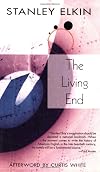
The best satire is beautifully written (thus, consign almost all 'satire' to the garbage can); it can be enjoyed by people who disagree with the author on large matters (a religious person should enjoy The Living End, because they will agree on the smaller absurdities that Elkin deals with so well, and his treatment of God is nuanced rather than new-atheistical); and ultimately is less about what the book hates and more about loving something (here: humanity) that the object of hatred seems show more to be inhibiting.
And The Living End is very good satire indeed. I hear that this is 'minor' Elkin, which makes me very excited to read his other works, but also apprehensive. 'Minor' in what way? Because it's short (usually a good thing)? Because it's weird (again, a good thing)? Because it's unclear whether he's using religion as an allegory for literature ('God,' who is supposedly an object of satire, seems very much to be Stanley Elkin by the end of the book) or literature as an allegory for religion? Because it's three interconnected stories rather than one novel? Because Joseph speaks cod Yiddish?
I do not know, and won't know until I read the rest of Elkin, which I certainly plan to do now. Funny but serious authors are ridiculously scarce (there is surely an essay waiting to be written about 'literary fiction,' grief-porn, memoir, post-New-Yorker short fiction, America, and the scarcity of serious writers who are funny). Elkin writes beautiful sentences when he chooses to, and doesn't choose to all the time, because it's easier to be funny when your sentences aren't funny--but he also chooses not be funny all the time. It's this sense that he's choosing what to do that sets him apart as a serious author. Elkin has not found his 'voice.' He gets to decide what voice he writes in. Also, I could write a dissertation about theology, literary criticism, and this book. Anyone who reads it as straightforward and easy satire on Christianity is missing *a lot*. show less
And The Living End is very good satire indeed. I hear that this is 'minor' Elkin, which makes me very excited to read his other works, but also apprehensive. 'Minor' in what way? Because it's short (usually a good thing)? Because it's weird (again, a good thing)? Because it's unclear whether he's using religion as an allegory for literature ('God,' who is supposedly an object of satire, seems very much to be Stanley Elkin by the end of the book) or literature as an allegory for religion? Because it's three interconnected stories rather than one novel? Because Joseph speaks cod Yiddish?
I do not know, and won't know until I read the rest of Elkin, which I certainly plan to do now. Funny but serious authors are ridiculously scarce (there is surely an essay waiting to be written about 'literary fiction,' grief-porn, memoir, post-New-Yorker short fiction, America, and the scarcity of serious writers who are funny). Elkin writes beautiful sentences when he chooses to, and doesn't choose to all the time, because it's easier to be funny when your sentences aren't funny--but he also chooses not be funny all the time. It's this sense that he's choosing what to do that sets him apart as a serious author. Elkin has not found his 'voice.' He gets to decide what voice he writes in. Also, I could write a dissertation about theology, literary criticism, and this book. Anyone who reads it as straightforward and easy satire on Christianity is missing *a lot*. show less

Dick Gibson’s radio career takes him around the country and gives Stanley Elkin the opportunity to riff on the foibles and foolery of 20th-c. USA in a text that is virtuosic, wacky, and darkly poignant.
It did no good to change policy or fiddle with format. The world pressed in. It opened your windows. All one could hope for was to find his scapegoat, to wait for him, lurking in alleys, pressed flat against walls, crouched behind doors while the key jiggles in the lock, taking all the show more melodramatic postures of revenge. To be there in closets when the enemy comes for his hat, or to surprise him with guns in swivel chairs, your legs dapperly crossed when you turn to face him, to pin him down on hillsides or pounce on him from trees as he rides by, to meet him on the roofs of trains roaring on trestles, or leap at him while he stops at red lights, to struggle with him on the smooth faces of cliffs, national monuments, chasing him round Liberty’s torch, or up girders of bridges, or across the enormous features of stone presidents. To pitch him from ski lifts and roller coasters, to Normandy his ass and guerilla his soul. To be always in ambush at the turnings in tunnels, or wrestle him under the tides of the seas. Gestures, gestures, saving gestures, life-giving and meaningless and sweet as appetite, delivered by gestures and redeemed by symbols, by necessities of your own making and a destiny dreamed in a dream. To be free—yes, existential and generous. show less
It did no good to change policy or fiddle with format. The world pressed in. It opened your windows. All one could hope for was to find his scapegoat, to wait for him, lurking in alleys, pressed flat against walls, crouched behind doors while the key jiggles in the lock, taking all the show more melodramatic postures of revenge. To be there in closets when the enemy comes for his hat, or to surprise him with guns in swivel chairs, your legs dapperly crossed when you turn to face him, to pin him down on hillsides or pounce on him from trees as he rides by, to meet him on the roofs of trains roaring on trestles, or leap at him while he stops at red lights, to struggle with him on the smooth faces of cliffs, national monuments, chasing him round Liberty’s torch, or up girders of bridges, or across the enormous features of stone presidents. To pitch him from ski lifts and roller coasters, to Normandy his ass and guerilla his soul. To be always in ambush at the turnings in tunnels, or wrestle him under the tides of the seas. Gestures, gestures, saving gestures, life-giving and meaningless and sweet as appetite, delivered by gestures and redeemed by symbols, by necessities of your own making and a destiny dreamed in a dream. To be free—yes, existential and generous. show less
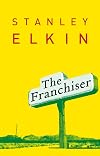
A few lines are spoken deep in the Franchiser where the course of events suddenly shift, the novel’s focus jolts away towards being more than just a self-conscious, slightly corny satire of the golden-arch homogenization of small-town-big-city America. Ben Flesh, Elkin’s hero and franchisee, is suddenly faced with an impending multiply-sclerotic powerlessness that bounds back and forth, grows and subsides through the rest of the novel—the scope of the novel no longer space wasted on show more been-there-done-that social commentary but deliriously depressing and impacting tragicomedy, well worth its place on McCaffery’s 20th-century best-of.
[N.B. This review includes images, and was formatted for my site, dendrobibliography -- located here.]
Ben Flesh’s anxious breakdown shifts between surreal comedy and genuine heartbreak. The twins, the triplets, all their bizarre health disorders, humourous but fucking damning and you know it. Between all the silly ha-has we get from the uncontrollably prejudiced (“It’s like a disease.”), the chronically constipated, &c., we’re still left waiting for the page they begin dropping like flies. And Flesh’s life takes a turn following a retrobulbar optic neuritis and an accompanying suggestion—an experience shared in dangerous detail to the reader as it was felt by Elkin himself outside of his writing—his Everyman Walt Disney is, in the flesh, powerless, and it’s pretty heartbreaking at times, especially having witnessed this struggle with a similarly-crippling disease affecting a loved one, the powerlessness derived just as crushing both personally and socially.
Standing out: It’s impossible to forget the surreality of the imposter Colonel Sanders (“finger-lickin’ good!”—DUH! wudyooespect?), the dropping of those beloved flies interspersed too casually with Ben Flesh’s failing Travel Inn—his final franchise!—, the discovery of sexual deviancy sweeping the nation—honestly, the whole ending, the last 50 pages in their entirety: Brilliant. Delivery made comedy upsetting; it’s, like, uhm, too deadpan and matter-of-fact when things get absurd and poetically rich and then, ahh! there’s more failure in the Flesh and—seriously?—excruciating descriptions of hotel room furnishings. Dang. It hurts, it had too much an impact, a physical punch to them there guts, and it came with such a buildup! from slow and steady (and maybe—an aside—a little bit tiring-slash-boring) to rock-‘em-friggin'-sock’em.
From what I’ve read, powerlessness and its impacts are Elkin’s forte; coming close to death but never quite reaching it, it’s always impending, threatening and real for his heroes and heroines. Keeps me interested, and I’ll be checking out more from Elkin in the future, starting with the sickly Magic Kingdom. Ahh, ahh!
[94] show less
[N.B. This review includes images, and was formatted for my site, dendrobibliography -- located here.]
Ben Flesh’s anxious breakdown shifts between surreal comedy and genuine heartbreak. The twins, the triplets, all their bizarre health disorders, humourous but fucking damning and you know it. Between all the silly ha-has we get from the uncontrollably prejudiced (“It’s like a disease.”), the chronically constipated, &c., we’re still left waiting for the page they begin dropping like flies. And Flesh’s life takes a turn following a retrobulbar optic neuritis and an accompanying suggestion—an experience shared in dangerous detail to the reader as it was felt by Elkin himself outside of his writing—his Everyman Walt Disney is, in the flesh, powerless, and it’s pretty heartbreaking at times, especially having witnessed this struggle with a similarly-crippling disease affecting a loved one, the powerlessness derived just as crushing both personally and socially.
Standing out: It’s impossible to forget the surreality of the imposter Colonel Sanders (“finger-lickin’ good!”—DUH! wudyooespect?), the dropping of those beloved flies interspersed too casually with Ben Flesh’s failing Travel Inn—his final franchise!—, the discovery of sexual deviancy sweeping the nation—honestly, the whole ending, the last 50 pages in their entirety: Brilliant. Delivery made comedy upsetting; it’s, like, uhm, too deadpan and matter-of-fact when things get absurd and poetically rich and then, ahh! there’s more failure in the Flesh and—seriously?—excruciating descriptions of hotel room furnishings. Dang. It hurts, it had too much an impact, a physical punch to them there guts, and it came with such a buildup! from slow and steady (and maybe—an aside—a little bit tiring-slash-boring) to rock-‘em-friggin'-sock’em.
From what I’ve read, powerlessness and its impacts are Elkin’s forte; coming close to death but never quite reaching it, it’s always impending, threatening and real for his heroes and heroines. Keeps me interested, and I’ll be checking out more from Elkin in the future, starting with the sickly Magic Kingdom. Ahh, ahh!
[94] show less
Lists
Best First Lines (1)
Dead narrators (1)
Awards


You May Also Like


Associated Authors
Statistics
- Works
- 34
- Also by
- 26
- Members
- 2,654
- Popularity
- #9,670
- Rating
- 3.7
- Reviews
- 28
- ISBNs
- 146
- Languages
- 6
- Favorited
- 12