
Robert Coover (1932–2024)
Author of The Universal Baseball Association, Inc., J. Henry Waugh, Prop.
About the Author
Robert Coover is a midwesterner who has earned a reputation as one of the most innovative of contemporary writers of fiction. Coover likes to experiment with an abundance of differing styles. The Origin of the Brunists (1966), his first novel, is a religious parable heavily loaded with symbolism show more and mythical parallels. It deals with the rise following an Appalachian coal-mine disaster of a sect of worshipers made up of fundamentalists and theosophists whose leader, Giovanni Bruno, is less a preacher than a silent enigma. The principal analogue is apparently meant to be the founding of the Christian religion, but Coover's extensive irony requires that he reverse many of the traditional features of the Christian legend. The Universal Baseball Association (1968), Coover's most accessible novel to date, is also dominated by religious symbolism. Over the years, J. Henry Waugh, a middle-aged bachelor and accountant, has developed an elaborately structured game, which he plays with dice. His game is based on the mathematical probabilities of baseball. Every evening Henry plays his game and maintains his extensive record books. J. Henry Waugh is a surrogate for God, and the participants in his imaginary baseball league seem almost to come to life, raising as they do age-old questions about fate and free will, success and failure, games and religions. Coover's Pricksongs and Descants (1969) is a collection of 20 short pieces and a theoretical "Prologo" in which the author states his belief that contemporary fiction should be based on familiar historical or mythical forms. Most of the stories in this volume, which was well received by critics, are based on biblical episodes or classical fairy tales retold in startling new ways. The Public Burning (1977) is based on the controversial trial of the Rosenbergs. With the exception of a novel, A Night at the Movies (1992), Coover's publications in recent years have consisted mainly of shorter works, written at various stages of his career, published in limited editions to appeal to collectors. Coover is one of the founders of the Electronic Literature Organization. In 1987 he was chosen as the winner of the Rea Award for the Short Story. Coover is indeed one of the foremost short story writers of the postmodern period, as exemplified by the "Seven Exemplary Fictions" contained in his 1969 book Pricksongs and Descants. (Bowker Author Biography) show less
Series
Works by Robert Coover
The Colonel’s Daughter 3 copies
A Pedestrian Accident 2 copies
The Boss 1 copy
HLa Ibabysitter 1 copy
Last One 1 copy
Grandmother's Nose 1 copy
The frog prince 1 copy
Invasion of the Martians 1 copy
The End of Books 1 copy
Associated Works
Spells of Enchantment: The Wondrous Fairy Tales of Western Culture (1991) — Contributor — 605 copies, 5 reviews
For the Love of Books: 115 Celebrated Writers on the Books They Love Most (1999) — Contributor — 480 copies, 4 reviews
You've Got to Read This: Contemporary American Writers Introduce Stories that Held Them in Awe (1994) — Introduction — 414 copies, 3 reviews
The Art of the Tale: An International Anthology of Short Stories (1986) — Contributor — 381 copies, 3 reviews
The New Gothic: A Collection of Contemporary Gothic Fiction (1991) — Contributor — 273 copies, 2 reviews
The Year's Best Fantasy & Horror 2006: 19th Annual Collection (2006) — Contributor — 244 copies, 4 reviews
A Convergence of Birds: Original Fiction and Poetry Inspired by Joseph Cornell (2001) — Contributor — 208 copies, 2 reviews
Field of Fantasies: Baseball Stories of the Strange and Supernatural (2014) — Contributor — 46 copies
The Good Book: Writers Reflect on Favorite Bible Passages (2015) — Contributor — 44 copies, 3 reviews
Antaeus No. 64/65, Spring/Autumn 1990 - Twentieth Anniversary Issue (1990) — Contributor — 14 copies
The Review of Contemporary Fiction: Robert Coover Festschrift: Spring 2012 (2012) — Contributor — 5 copies
Tagged
Common Knowledge
- Legal name
- Coover, Robert Lowell
- Birthdate
- 1932-02-04
- Date of death
- 2024-10-05
- Gender
- male
- Education
- Southern Illinois University
Indiana University (BA - Slavic Studies, 1955)
University of Chicago (MA - General Studies in the Humanities, 1965) - Occupations
- writer
professor - Organizations
- United States Navy
Brown University
American Academy of Arts and Letters (Literature, 1987)
Electronic Literature Organization (Co-founder) - Awards and honors
- Lannan Literary Award (Fiction, 2000)
Rea Award for the Short Story (1987)
American Academy of Arts and Letters Academy Award (Literature, 1976) - Relationships
- Caldwell, Sara (offspring)
- Nationality
- USA
- Birthplace
- Charles City, Iowa, USA
- Place of death
- Warwick, Warwickshire, England, UK
- Associated Place (for map)
- USA
Members
Reviews

"Oh no, my dear. there are no disenchantments, merely progressions and styles of possession. To exist is to be spell-bound" (74), says a nameless character in Robert Coover's "The Magic Poker," a prose work riffing on Shakespeare's Tempest. That piece is collected as one of thirty "short fictions" in Going for a Beer.
The title avoids calling the objects of the collection "stories," although they are all conspicuously narrative. But they are technically and structurally unorthodox, with show more rhetorical flow that sometimes darts in and out of various characters, themselves mutable, often replaying events with variations and abstaining from the signals that could fix what "really" happened for a reader in search of such a thing. In such cases, Coover's playful style invites the reader to collaborate in deciding what has occurred and in whose perception or imagination. But in among the variants and mutations there are archetypes outlined with a sort of buzzing field of possibility that gives the core a weight of the inevitable.
I have read some other Coover works, and these fictions are most like what I encountered in Briar Rose and Spanking the Maid, not in his more conventional novel The Origin of the Brunists. I was also reminded of the incantatory and associational techniques of Alain Robbe-Grillet, as well as the subversive and libidinal writing of Angela Carter. Like Carter, Coover often uses fairy tales as a formal basis or point of departure, and about a half dozen of these pieces are constructed thus. The reader is given new perspectives on Hansel & Gretel, Snow White, Goldilocks and the Three Bears, the Pied Piper, and Little Red Riding Hood, not to mention Noah's Ark.
Like Robbe-Grillet, Coover does new things with text by invoking the cinematic sensibility of modern readers. This approach can be very overt, as in the three pieces "Inside the Frame," "The Phantom of the Movie Palace," and "Lap Dissolves," which appear consecutively in the collection. In one text he exploits a classic movie in the way that he does fairy-tales: "You Must Remember This" supplements Casablanca. Other sorts of entertainment serve as structural and thematic scaffolding as well: the puppet show in "Punch" and stage magic in "The Hat Act."
One of the longest pieces in the volume is what introducer T.C. Boyle calls Coover's "best-known story," the 1969 suburban fugue "The Babysitter." Strangely, it was made into a direct-to-video movie in 1995, which has been roundly panned. I suppose more people have seen the film than have read the story. But the text is an exercise in sustained provocation, with so much of it consisting of the fantasies and fears of the characters, that the attentive reader can only speculate upon an objective state of affairs.
"Going for a Beer" is one of the shortest texts of the collection, and it keenly depicts a foreshortened and inconsequential life, raced through to its unremarkable end. It's interesting that it should give its title to the larger book as an eponym.
The whole book is admirable: often funny, sometimes profound, occasionally hair-raising. I came into my copy cheaply, but I will be keeping it, because there are several of these stories that I can easily imagine myself returning to. show less
The title avoids calling the objects of the collection "stories," although they are all conspicuously narrative. But they are technically and structurally unorthodox, with show more rhetorical flow that sometimes darts in and out of various characters, themselves mutable, often replaying events with variations and abstaining from the signals that could fix what "really" happened for a reader in search of such a thing. In such cases, Coover's playful style invites the reader to collaborate in deciding what has occurred and in whose perception or imagination. But in among the variants and mutations there are archetypes outlined with a sort of buzzing field of possibility that gives the core a weight of the inevitable.
I have read some other Coover works, and these fictions are most like what I encountered in Briar Rose and Spanking the Maid, not in his more conventional novel The Origin of the Brunists. I was also reminded of the incantatory and associational techniques of Alain Robbe-Grillet, as well as the subversive and libidinal writing of Angela Carter. Like Carter, Coover often uses fairy tales as a formal basis or point of departure, and about a half dozen of these pieces are constructed thus. The reader is given new perspectives on Hansel & Gretel, Snow White, Goldilocks and the Three Bears, the Pied Piper, and Little Red Riding Hood, not to mention Noah's Ark.
Like Robbe-Grillet, Coover does new things with text by invoking the cinematic sensibility of modern readers. This approach can be very overt, as in the three pieces "Inside the Frame," "The Phantom of the Movie Palace," and "Lap Dissolves," which appear consecutively in the collection. In one text he exploits a classic movie in the way that he does fairy-tales: "You Must Remember This" supplements Casablanca. Other sorts of entertainment serve as structural and thematic scaffolding as well: the puppet show in "Punch" and stage magic in "The Hat Act."
One of the longest pieces in the volume is what introducer T.C. Boyle calls Coover's "best-known story," the 1969 suburban fugue "The Babysitter." Strangely, it was made into a direct-to-video movie in 1995, which has been roundly panned. I suppose more people have seen the film than have read the story. But the text is an exercise in sustained provocation, with so much of it consisting of the fantasies and fears of the characters, that the attentive reader can only speculate upon an objective state of affairs.
"Going for a Beer" is one of the shortest texts of the collection, and it keenly depicts a foreshortened and inconsequential life, raced through to its unremarkable end. It's interesting that it should give its title to the larger book as an eponym.
The whole book is admirable: often funny, sometimes profound, occasionally hair-raising. I came into my copy cheaply, but I will be keeping it, because there are several of these stories that I can easily imagine myself returning to. show less
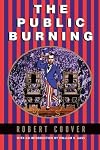
Insane, in the best way possible.
It's particularly amazing to think that this came from the mind of one person, long before it was possible to look things up on the internet. It's hard to explain what I mean by that, but parts of the book almost had the tone of a malfunctioning ChatGPT run amok, grabbing phrases, ideas, and images willy-nilly and combining them into a poisonous soup of political satire that is both spot-on and persistently nonsensical. I'm not sure I've ever read a book show more loaded with so many off-putting and surreally-deployed references to history and popular culture, engineered to make you feel uncomfortable, aroused, nauseous, and amused all at the same time. A document created by a blazing, rage-filled, and insanely intelligent magpie with the darkest imagination you can conjure.
RIP Mr Coover. You almost made me feel sorry for Richard Nixon. show less
It's particularly amazing to think that this came from the mind of one person, long before it was possible to look things up on the internet. It's hard to explain what I mean by that, but parts of the book almost had the tone of a malfunctioning ChatGPT run amok, grabbing phrases, ideas, and images willy-nilly and combining them into a poisonous soup of political satire that is both spot-on and persistently nonsensical. I'm not sure I've ever read a book show more loaded with so many off-putting and surreally-deployed references to history and popular culture, engineered to make you feel uncomfortable, aroused, nauseous, and amused all at the same time. A document created by a blazing, rage-filled, and insanely intelligent magpie with the darkest imagination you can conjure.
RIP Mr Coover. You almost made me feel sorry for Richard Nixon. show less
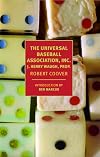
Summary: An accountant creates a fantasy baseball league that takes over his life.
Before modern fantasy baseball leagues. Before the invention of Sabremetrics to analyze every possible baseball statistic. In 1968, Robert Coover introduced us to J. Henry Waugh, sole proprietor of the Universal Baseball League. It is a league created in Waugh’s apartment. But no one else knows about it. He named the eight teams after early pro teams. He filled the rosters with players who he named, who took show more on lives of their own. Games were played by the role of three dice. Waugh had created an elaborate system for each possible dice combination.
As the book opens, the league is in its fifty-sixth (LVI) season of 84 games. But something is wrong, both with the league and with Henry. The league just doesn’t seem to have the same excitement. Yet it is taking over more and more of Henry’s life. His day job is as an accountant with a big accounting firm. Then he ran the league in the evening and weekends. His only social life is trips to the local dive bar, his friend Lou from work, and Hetty, his neighbor and “friend with benefits.” A local grocer delivers his food.
But it gets worse. Not only does he play the games, and keep records of all the statistics, promote rookies, and retire veterans. He also has allowed the players to occupy his mind with their lives–their off the field escapades and tragedies. There are long passages of imagined bar scenes with bawdy songs (including one with a rape). And as the league occupies more of his head space, his work suffers and his job is at risk. Sometimes, fantasy dialogue leaks out in real life conversation.
By Season LVI, star players have sons in the game. For example, Damon Rutherford is a rookie pitcher who looks like he will follow in the steps of his Hall of Fame Father Brock Rutherford. The book opens with him in the middle of pitching a perfect game. And Henry realizes that Damon hold the hope of a revitalized league. And then, in the next game it all changes with one roll of the dice that come up 1-1-1. That unlikely combination means a batter hit by a pitch that kills him. And who is at the plate when this unlucky role comes up? Damon Rutherford.
With that, it all spirals downward, for Henry and for the League. He even lets Lou help him with a game, letting him in on his secret obsession. It doesn’t go well. As his job hangs by a thread, he considers winding it all up and getting his life in order. But will he?
Robert Coover invents a character with an unusual fantasy obsession that holds up a mirror to our obsessions and addictions. With the advent of online sports betting, we hear more and more stories of those who have wrecked their lives and their families’ finances with their obsession. But Coover uncovers a more profound truth. What does Henry have to live for that is better than his personal fantasy league?
This is an adult book with adult language and sexual material, some of which may be triggering. But it also explores the adult obsessions and addictions with which we fill our lives when nothing greater and better does. It’s both fascinating and painful. But the life you save may be your own. show less
Before modern fantasy baseball leagues. Before the invention of Sabremetrics to analyze every possible baseball statistic. In 1968, Robert Coover introduced us to J. Henry Waugh, sole proprietor of the Universal Baseball League. It is a league created in Waugh’s apartment. But no one else knows about it. He named the eight teams after early pro teams. He filled the rosters with players who he named, who took show more on lives of their own. Games were played by the role of three dice. Waugh had created an elaborate system for each possible dice combination.
As the book opens, the league is in its fifty-sixth (LVI) season of 84 games. But something is wrong, both with the league and with Henry. The league just doesn’t seem to have the same excitement. Yet it is taking over more and more of Henry’s life. His day job is as an accountant with a big accounting firm. Then he ran the league in the evening and weekends. His only social life is trips to the local dive bar, his friend Lou from work, and Hetty, his neighbor and “friend with benefits.” A local grocer delivers his food.
But it gets worse. Not only does he play the games, and keep records of all the statistics, promote rookies, and retire veterans. He also has allowed the players to occupy his mind with their lives–their off the field escapades and tragedies. There are long passages of imagined bar scenes with bawdy songs (including one with a rape). And as the league occupies more of his head space, his work suffers and his job is at risk. Sometimes, fantasy dialogue leaks out in real life conversation.
By Season LVI, star players have sons in the game. For example, Damon Rutherford is a rookie pitcher who looks like he will follow in the steps of his Hall of Fame Father Brock Rutherford. The book opens with him in the middle of pitching a perfect game. And Henry realizes that Damon hold the hope of a revitalized league. And then, in the next game it all changes with one roll of the dice that come up 1-1-1. That unlikely combination means a batter hit by a pitch that kills him. And who is at the plate when this unlucky role comes up? Damon Rutherford.
With that, it all spirals downward, for Henry and for the League. He even lets Lou help him with a game, letting him in on his secret obsession. It doesn’t go well. As his job hangs by a thread, he considers winding it all up and getting his life in order. But will he?
Robert Coover invents a character with an unusual fantasy obsession that holds up a mirror to our obsessions and addictions. With the advent of online sports betting, we hear more and more stories of those who have wrecked their lives and their families’ finances with their obsession. But Coover uncovers a more profound truth. What does Henry have to live for that is better than his personal fantasy league?
This is an adult book with adult language and sexual material, some of which may be triggering. But it also explores the adult obsessions and addictions with which we fill our lives when nothing greater and better does. It’s both fascinating and painful. But the life you save may be your own. show less

An enduring classic for anyone who has every spent hours rolling the APBA dice (or Strat-O-Matic, etc.) Accountant J. Henry Waugh has become so immersed in the baseball simulation he has created that then when the unthinkable--an extremely rare play--occurs, well...let's just say it gets weird from that point. Truly brilliant and unique. I suppose this could be about any obsession, but there's really no obsession like a baseball simulation, is there? :-)
Lists
Awards


You May Also Like


Associated Authors
Statistics
- Works
- 72
- Also by
- 47
- Members
- 5,767
- Popularity
- #4,275
- Rating
- 3.6
- Reviews
- 106
- ISBNs
- 208
- Languages
- 10
- Favorited
- 21