

Joseph McElroy (1) (1930–)
Author of Women and Men
For other authors named Joseph McElroy, see the disambiguation page.
About the Author
Joseph McElroy is the author of eight novels, including A Smuggler's Bible and Lookout Cartridge. He is the recipient of the Award in Literature from the American Academy of Arts and Letters and fellowships from the Guggenheim, Rockefeller, Ingram Merrill Foundations, and the National Endowment for show more the Arts. He lives in New York City show less
Works by Joseph McElroy
Associated Works
For the Love of Books: 115 Celebrated Writers on the Books They Love Most (1999) — Contributor — 479 copies, 4 reviews
Storming the Reality Studio: A Casebook of Cyberpunk and Postmodern Science Fiction (1991) — Contributor — 263 copies
TriQuarterly 34, Fall 1975 — Contributor — 1 copy
Black Clock 3 — Contributor — 1 copy
Tagged
Common Knowledge
- Canonical name
- McElroy, Joseph
- Legal name
- McElroy, Joseph Prince
- Birthdate
- 1930-08-21
- Gender
- male
- Education
- Williams College (BA)
Columbia University (MA, PhD) - Occupations
- novelist
short story writer
essayist - Organizations
- United States Coast Guard (1952-54)
University of New Hampshire
Queens College, City University of New York - Awards and honors
- American Academy of Arts and Letters Academy Award (Literature, 1977)
Guggenheim Fellowship
Grantee, Rockefeller Foundation
Fellowship, Ingram Merrill Foundation
Grantee, National Endowment for the Arts - Nationality
- USA
- Birthplace
- Brooklyn, New York, USA
- Associated Place (for map)
- New York, USA
Members
Reviews

I really wanted to like this book. I loved the publication/production of it - it's a beautiful limited edition of one chapter of a work in progress by [[Joseph McElroy]], an oft out-of-print author. And the book is well-written, quite poetic in its own hyper, anxiety-filled way. The rendering of the geological feature that serves as the book's title and the surrounding landscape is beautiful. But this type of writing is hard for my old-fashioned brain to sort. Most post-modern stuff just show more leaves me a little bewildered.
So, 4 bones for the execution, both in production and writing.
Recommended for the McElroy collector or post-modern fans. show less
So, 4 bones for the execution, both in production and writing.
Recommended for the McElroy collector or post-modern fans. show less
Do we not use each other to slip across the frontiers of self-scrutiny as something other than lonely people?
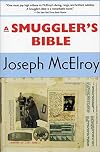
I found The Smuggler's Bible to be a rumination on parasite and host. Much like an article on deconstruction, and even more like a slugfest between Bellow protagonists: imagine Herzog and Mr. Sammler in a practical death struggle over influence and affectation. Imagine constructing a musical canon and adding middlebrow references in maddening sequences. Listen to Roger Waters cover show more REM's Strange Currencies and consider the ironies. The Smuggler's Bible transports and imprints, much like the protagonist's penchant for chain letters, each confesses, obscures and by proxy contributes to these Chinese Whispers of life. show less
I found The Smuggler's Bible to be a rumination on parasite and host. Much like an article on deconstruction, and even more like a slugfest between Bellow protagonists: imagine Herzog and Mr. Sammler in a practical death struggle over influence and affectation. Imagine constructing a musical canon and adding middlebrow references in maddening sequences. Listen to Roger Waters cover show more REM's Strange Currencies and consider the ironies. The Smuggler's Bible transports and imprints, much like the protagonist's penchant for chain letters, each confesses, obscures and by proxy contributes to these Chinese Whispers of life. show less
Some books I can get absorbed in, losing myself in the story, or the characters, or the structure, or the style. A very few books I can read without being interested in any of this in anything other than a purely intellectual way, and this is one of them. 'A Smuggler's Bible' is more or less seven often quite bad novellas and short stories connected in so many ways that my mind, at least, was boggled; the novel that comprises these short fictions is mainly a frame designed to investigate show more questions of identity and solipsism.
The frame itself is intriguing [plot spoilers ahead, but if you're reading for plot, you should just skip this book]. A man has some kind of psychotic break and decides he needs to reconstitute his identity. He decides to do this by writing the aforementioned stories/novellas, which are told from the perspectives of his friends, his wife, his family and finally himself. He takes these narratives to an 'old man,' probably a friend's father, certainly a mythical stand-in for at least one god, in the U.K. He reads and edits the narratives on the way. We are told all of this by the narrator of the frame story, who is possibly a demiurge creator of David Brooke (the man in question), or a part of David Brooke's mind, which makes sense to anyone who's ever written a narrative through another person's voice.
The links between the stories are as small as individual words ('infusoria', implausibly, shows up multiple times) and as large as mythical structural parallels (a lot of people being followed, a lot of father/son strife, and so on). It was first published in 1966, so there's an unfortunately large amount of existential nonsense and bad philosophizing (note to those who still get worried by Descartes' demons or Sartre's nausea: the very possibility of these problems has been refuted many, many, many times since). Luckily, treating these problems in literature can be more rewarding than just treating them philosophically, and McElroy almost succeeds in making it interesting here.
He doesn't entirely succeed because most of the stories David Brooke writes about others/himself aren't all that interesting, with the exception of the glorious 'An American Hero,' which would make a great self-standing realist novella. This is hardly surprising. McElroy is out for much bigger game than realism can bring down; he's not likely to waste energy on writing good realism; the realism is therefore not very good. And you're left with an interesting intellectual game, part cod-existentialism, part Joyce (endless mythic analogues).
Foster Wallace was still trying to solve these non-existent problems decades later. 'Smuggler's Bible' is most interesting at the end, when the difficulties of subjectivity are tied to the difficulties of religious faith (Brooke's stories are, at one point, stored in a smuggler's bible, a bible from which a hole has been cut, to act as a small box).
"Do you not see how Christ was in fact hte most remarkable contraband of all time, and was simultaneously himself an arch-smuggler? And the Virgin Mary, too?... (Sartre's wrong: *God* is other people!)"
Some people believe in god, some people do not; in any case, god's existence cannot be proven or disproven. Similarly, the fact that we're existentially alone cannot be proven or disproven; to state that we're existentially alone is as much a theological statement as the statement that we are in a state of divine grace, and, strictly speaking, about as meaningful/less, depending on your assumptions.
So 'A Smuggler's Bible' gives you lots of space to think about what it means to be an individual subject, and how that subjectivity is related to other people, without forcing you to take one position or another. That's a pretty great achievement. It's worth checking out for its formal ingenuity. But you can easily skip the stories that aren't holding your interest without losing much; in a sense, this is a piece of conceptual art, and it's more fun to think about the concept than it is to experience the art. That might be a problem. show less
The frame itself is intriguing [plot spoilers ahead, but if you're reading for plot, you should just skip this book]. A man has some kind of psychotic break and decides he needs to reconstitute his identity. He decides to do this by writing the aforementioned stories/novellas, which are told from the perspectives of his friends, his wife, his family and finally himself. He takes these narratives to an 'old man,' probably a friend's father, certainly a mythical stand-in for at least one god, in the U.K. He reads and edits the narratives on the way. We are told all of this by the narrator of the frame story, who is possibly a demiurge creator of David Brooke (the man in question), or a part of David Brooke's mind, which makes sense to anyone who's ever written a narrative through another person's voice.
The links between the stories are as small as individual words ('infusoria', implausibly, shows up multiple times) and as large as mythical structural parallels (a lot of people being followed, a lot of father/son strife, and so on). It was first published in 1966, so there's an unfortunately large amount of existential nonsense and bad philosophizing (note to those who still get worried by Descartes' demons or Sartre's nausea: the very possibility of these problems has been refuted many, many, many times since). Luckily, treating these problems in literature can be more rewarding than just treating them philosophically, and McElroy almost succeeds in making it interesting here.
He doesn't entirely succeed because most of the stories David Brooke writes about others/himself aren't all that interesting, with the exception of the glorious 'An American Hero,' which would make a great self-standing realist novella. This is hardly surprising. McElroy is out for much bigger game than realism can bring down; he's not likely to waste energy on writing good realism; the realism is therefore not very good. And you're left with an interesting intellectual game, part cod-existentialism, part Joyce (endless mythic analogues).
Foster Wallace was still trying to solve these non-existent problems decades later. 'Smuggler's Bible' is most interesting at the end, when the difficulties of subjectivity are tied to the difficulties of religious faith (Brooke's stories are, at one point, stored in a smuggler's bible, a bible from which a hole has been cut, to act as a small box).
"Do you not see how Christ was in fact hte most remarkable contraband of all time, and was simultaneously himself an arch-smuggler? And the Virgin Mary, too?... (Sartre's wrong: *God* is other people!)"
Some people believe in god, some people do not; in any case, god's existence cannot be proven or disproven. Similarly, the fact that we're existentially alone cannot be proven or disproven; to state that we're existentially alone is as much a theological statement as the statement that we are in a state of divine grace, and, strictly speaking, about as meaningful/less, depending on your assumptions.
So 'A Smuggler's Bible' gives you lots of space to think about what it means to be an individual subject, and how that subjectivity is related to other people, without forcing you to take one position or another. That's a pretty great achievement. It's worth checking out for its formal ingenuity. But you can easily skip the stories that aren't holding your interest without losing much; in a sense, this is a piece of conceptual art, and it's more fun to think about the concept than it is to experience the art. That might be a problem. show less

Cartwright, middle-aged businessman of questionable repute, and his friend Dagger, both Americans living in London, decided to make a film together. They shot about 10 scenes of the film and Cartwright kept a written diary of the shooting. But before the film could be processed, someone broke into Dagger's flat and destroyed most of it. This is the basic premise, or what we know up front. What follows is an ever-widening gyre of Cartwright's investigation into the circumstances surrounding show more the film's destruction, cut in with first-person reports of the shooting of key scenes in the film. These reports are Cartwright's dictations of his diary entries to his teenage daughter Jenny, though Cartwright the narrator also supplements the text with his recollections, interjecting to note when something was or was not included in the diary. Cartwright's narration of his own investigation (told in past tense) is also fluid, with frequent shifts in time and place, fueled by the fact that he travels back and forth between New York City and various places in the UK, sometimes in the same day.
Cartwright employs a rolling metaphor of film cartridges to place the action in perspective for himself and for the reader ('you who have me'), to whom he makes occasional brief asides. He repeats things, intriguing things, that may or may not be red herrings, and may or may not be worth keeping track of in order to chip away at the mystery. Fragments of past events slow-reveal, sometimes adding up to a whole. Mysterious and menacing characters lurk on both sides of the Atlantic. The film becomes something more than a film. Conspiratorial threads appear. Everyone knows a little or a lot, but no one seems to know it all. At times the plot operates like an elaborate and maddening game of Telephone. Cartwright and Dagger are at odds, each thinking the other is trying to co-opt the film, each unaware of what the other knows. As characters, they are both difficult to pin down. Since Cartwright is narrating, we only see Dagger through his eyes, so this portrait is uncertain. Cartwright had an idealistic vision for the film ('taking other energy in process and using it for our own peaceful ends'), whereas Dagger's possible ulterior motives materialize over time as the hinge on which the suspense swings.
The story pivots on information and power, namely how information empowers those who will wield it. It delves into methods for information acquisition and transfer, and how to use information once acquired, particularly to obtain yet more information. It also underscores the dangers (including for the reader) of information that is incomplete or out of context, and the frustration in not knowing the value of certain information one has that others seem to want. At one point late in the book, Cartwright laments (brags?), 'Information theory? I had none.' It's clear he's only been winging it thus far, but it's hard not to cheer for a guy getting by on instinct and a little luck. show less
Lists
Awards


You May Also Like


Associated Authors
Statistics
- Works
- 15
- Also by
- 19
- Members
- 1,336
- Popularity
- #19,273
- Rating
- 3.6
- Reviews
- 24
- ISBNs
- 38
- Languages
- 1
- Favorited
- 11