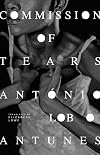
Commission of Tears (Portuguese Literature)
by António Lobo Antunes
55 Members (3.25)
On This Page
Description
António Lobo Antunes's twenty-fifth novel, Commission of Tears (2011, Comissão das Lágrimas) is set during the Angolan Civil War (1975-2002). Angola attained official independence on November 11, 1975 and, while the stage was set for transition, a combination of ethnic tensions and international pressures rendered Angola's hard-won victory problematic. As with many post-colonial states, Angola was left with both economic and social difficulties which translated into a power struggle show more between the three predominant liberation movements. The People's Movement for the Liberation of Angola (MPLA), formed in December of 1956 as an offshoot of the Angolan Communist Party, had as its support base the Ambundu people and was largely supported by other African countries, Cuba, and the Soviet Union. In this novel, Lobo Antunes delves into this traumatic period of Angola's history through the fragmented memories and dreams of a broken woman. The author drew from the story of the commander of the female battalion MPLA (Popular movement for the liberation of Angola) who was tortured and killed following the state coup of May 1977. It is said that while they tortured her she did not stop singing. This is the story of Cristina, admitted in to a psychiatric clinic in Lisbon. In her torrent of memories, dialogues and traumatic episodes, Cristina remembers her early childhood in Africa, at the time when everything inside her head was intertwined with her father´s voice, who was a former Black priest and became one of the torturers of the "Commission of Tears." Cristina's white mother, a cabaret dancer imported from Lisbon to entertain Portuguese farmers in Angola, marries the Black ex-priest because she finds herself pregnant with Cristina by her the man who exploits her, the cabaret manager. The long, twisting narrative weaves together the three voices of daughter, father, and mother as they recall the terrors of their life in Angola, and their own suffering. Their personal tragedies, scarred by racism and abuse, mirror those of the country that is being torn asunder around them. show lessTags
Recommendations




























Member Reviews
Members
- Recently Added By
Author Information

74+ Works 4,794 Members
Lobo Antunes, a psychiatrist and a soldier in the Portuguese colonial wars in Angola, was born in Lisbon. "South of Nowhere", his second novel, published in 1980, became the center of controversy both because of its daring content and its novel structure. The action is very brief: it lasts only one night. The author tells a silent woman companion show more his frank impressions about his experience as a medical doctor in the war of liberation against Portuguese colonialism. In some passages, the novel makes allusion to The Lusiads and its allegorical intentions. It denounces with lucid sarcasm the failure of Portuguese colonization in Africa. (Bowker Author Biography) show less
Series
Belongs to Publisher Series
btb (71404)
Common Knowledge
- Original title
- Comissão das Lágrimas
- Original publication date
- 2011
Classifications
- Genres
- Fiction and Literature, General Fiction, Romance, Historical Fiction
- DDC/MDS
- 869.342 — Literature & rhetoric Spanish Literature Literatures of Portuguese and Galician languages Portuguese fiction 20th Century 1945-1999
- LCC
- PQ9263 .N77 .C6513 — Language and Literature French, Italian, Spanish and Portuguese literatures Portuguese literature Individual authors, 1961-2000
- BISAC
Statistics
- Members
- 55
- Popularity
- 554,372
- Rating
- (3.25)
- Languages
- 5 — English, German, Portuguese, Spanish, Swedish
- Media
- Paper, Ebook
- ISBNs
- 9
- ASINs
- 1