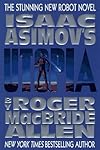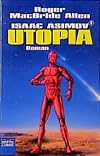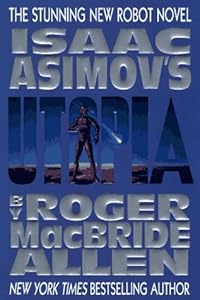
Isaac Asimov's Utopia
by Roger MacBride Allen
Isaac Asimov's Robot Mysteries (3), Asimov's Caliban (3)
On This Page
Description
Fiction. Science Fiction. In a universe protected by the Three Laws of Robotics, humans are safe. The Third Law states, A robot must protect its own existence as long as such protection does not conflict with the First or Second Law. The world of Inferno is dying. A world where Spacers work with Settlers, where standard Three-Law robots exist alongside the controversial New-Law robots. A world that will be uninhabitable in a few decades. Their only hope comes from a plan some call insane, show more and some call visionary: drop a comet on the planet. The impact could create new rivers that would save the planet but it could also destroy Inferno completely! Now the Spacers of Inferno must take a risk. A risk that their robots, pledged to protect humans from any harm, real or imagined, may not let them take... show lessTags
Recommendations














Member Reviews
The scientific enterprise of using a comet to dig canals on a planet (by exploding it and guiding the chunks to fall along a predetermined line) was interesting. The philosophical problems investigated by contrasting 3-law, new-law, and no-law robots are no different from those of people more-or-less bound by human law & convention (and you can't discuss them for metal or meat intelligences without considering the reality of Free Will).
The character were fairly well drawn, reasonably interesting, but ultimately it's just a nice read not an earth-shattering revelation.
MacBride does a good job of channeling Asimov's style but doesn't have the Doctor's depth of scientific understanding, or life-experiences to really substitute for show more him.
Basically, putting Asimov's name on the book is like putting a trademark symbol on a product.
NOTES: pp160-ff: circumventing a 3-law computer (not ambulatory robot) by posing real-world data and decisions as "simulations" works up to a point (more interestingly explored in "Ender's Game" of course).
p. 188: A conundrum not just with robots but with children: "It was bad enough when you could do very little for your own creations. It was worse when they expected even less."
p. 268: reaching the crux of the primary theme - does having robot slaves enable people to do more and better things, or does it disable them through dependence and arrogance? The author is unquestionably of the latter belief, although (Like Asimov) he really wants a partnership of meat and metal people. "In the old days, the people of Inferno had only known of one way to do things, one way of living life: have the robots do it. That was the answer to everything. And it was an answer that had worked. Now they had been exposed not just to other possibilities, but also to the notion that there were other possibilities, other answers that might work as well....Now a way of life based solely on robotic labor was merely one option among many. How could that be changed back?"
Not knowing anything about the author's political positions, still I wonder if he even sees that this is directly analogous to believing that the solution to every problem is "have the Government do it?"
pp. 298-299: facing another conundrum that applies to meat as well as metal persons: acting to save one person in danger can result in harm to more people, and will-less obedience to the "law" actually defeats the purpose of that law. Donald is a Three-Law robot with the usual problem of balancing conflicting demands of the Laws in some instances. Kresh is his owner, governor of Inferno, who ordered him not to tell other robots of the man Beddle's possible danger. "In short, distracting robots from the evacuation could cause endless mischief. Besides which, the clear intent of Governor Kresh's order had been to prevent Donald from talking. By disobeying only part of Kresh's order, he had minimized his violation of the Second Law. Donald had done his best to balance all the conflicting demands, retaining the option of hyperwaving a warning to the other Three-Law robots while refraining from actually doing so...But the time would come. He knew that. Unless Beddle was rescued in time, the First Law demand that Donald act to save him would, sooner or later, overwhelm the conflicting First and Second demands that he keep silent. Sooner or later, he would be compelled to act. Understanding the compulsion he was under in no way reduced the force of that compulsion. He would have to do something. But he had no idea what." show less
The character were fairly well drawn, reasonably interesting, but ultimately it's just a nice read not an earth-shattering revelation.
MacBride does a good job of channeling Asimov's style but doesn't have the Doctor's depth of scientific understanding, or life-experiences to really substitute for show more him.
Basically, putting Asimov's name on the book is like putting a trademark symbol on a product.
NOTES: pp160-ff: circumventing a 3-law computer (not ambulatory robot) by posing real-world data and decisions as "simulations" works up to a point (more interestingly explored in "Ender's Game" of course).
p. 188: A conundrum not just with robots but with children: "It was bad enough when you could do very little for your own creations. It was worse when they expected even less."
p. 268: reaching the crux of the primary theme - does having robot slaves enable people to do more and better things, or does it disable them through dependence and arrogance? The author is unquestionably of the latter belief, although (Like Asimov) he really wants a partnership of meat and metal people. "In the old days, the people of Inferno had only known of one way to do things, one way of living life: have the robots do it. That was the answer to everything. And it was an answer that had worked. Now they had been exposed not just to other possibilities, but also to the notion that there were other possibilities, other answers that might work as well....Now a way of life based solely on robotic labor was merely one option among many. How could that be changed back?"
Not knowing anything about the author's political positions, still I wonder if he even sees that this is directly analogous to believing that the solution to every problem is "have the Government do it?"
pp. 298-299: facing another conundrum that applies to meat as well as metal persons: acting to save one person in danger can result in harm to more people, and will-less obedience to the "law" actually defeats the purpose of that law. Donald is a Three-Law robot with the usual problem of balancing conflicting demands of the Laws in some instances. Kresh is his owner, governor of Inferno, who ordered him not to tell other robots of the man Beddle's possible danger. "In short, distracting robots from the evacuation could cause endless mischief. Besides which, the clear intent of Governor Kresh's order had been to prevent Donald from talking. By disobeying only part of Kresh's order, he had minimized his violation of the Second Law. Donald had done his best to balance all the conflicting demands, retaining the option of hyperwaving a warning to the other Three-Law robots while refraining from actually doing so...But the time would come. He knew that. Unless Beddle was rescued in time, the First Law demand that Donald act to save him would, sooner or later, overwhelm the conflicting First and Second demands that he keep silent. Sooner or later, he would be compelled to act. Understanding the compulsion he was under in no way reduced the force of that compulsion. He would have to do something. But he had no idea what." show less
My sixth-month journey through random bits of Isaac Asimov that began with Foundation and Chaos finally comes to an end. Allen turns in another solid installment in the Caliban trilogy, even if it does entirely lack a murder mystery in what is ostensibly a series of them. But that's easy to overlook, as what we're left with is another thorough examination of Isaac Asimov's Three Laws and their implications. Inferno's better, but only by a hair. Unit Dee is the difficulties of the First Law taken to their radical conclusion, and Caliban finally gets to contribute to the plot in the series ostensibly named after him. And the terraforming feats in this novel are spectacularly audacious. It's a shame none of Allen's ideas were ever really show more followed up on, though given the quality of most Asimov tie-in fiction, that's probably for the best. show less
Utopia is the third and final Asimov universe book from Allen. It centers around an attempt to accelerate the terraforming of a planet by drastic measures which drive third law robots wild... The measures are so drastic that they endanger humans, whilst protecting a large number of humans. Unfortunately three law robots have trouble seeing the difference between the two.
I don't think this book is as well written as the earlier two Allen books (Caliban and Inferno) and therefore not as good as the Asimov books set in the universe. It was however reasonably engaging and I'm not offended that I spent time and money on it. An ok book, but nothing special basically.
http://www.stillhq.com/book/Roger_MacBride_Allen/Utopia.html
I don't think this book is as well written as the earlier two Allen books (Caliban and Inferno) and therefore not as good as the Asimov books set in the universe. It was however reasonably engaging and I'm not offended that I spent time and money on it. An ok book, but nothing special basically.
http://www.stillhq.com/book/Roger_MacBride_Allen/Utopia.html
Not quite as good as Asimov himself, this is a decent approximation. Set in Asimov's universe, and exploring the usual human/robot relationship.
A good novel, which sums up a nice three book addition to Asimov's universe!
See Caliban.
Members
- Recently Added By
Author Information

Series


Belongs to Publisher Series
Bastei Science Fiction-Special (24273)
Work Relationships
Is contained in
Common Knowledge
- Canonical title
- Isaac Asimov's Utopia
- Original title
- Isaac Asimov's Utopia
- Original publication date
- 1996
- People/Characters
- Dr. Lavlo Lentrall; R. CFL-001 "Kaelor"; Justen Devray; R. GRD-112 "Gervad"; R. SPR-323 "Sapper"; Alvar Kresh (show all 26); R. Donald 111; Norlan Fiyle; Dr. Fredda Leving; R. CBN-001 "Caliban"; R. Prospero; R. OBR-323 "Oberon"; Tonya Welton; Dr. Gubber Anshaw; R. Lacon-03; Simcor Beddle; Jadelo Gildern; Cinta Melloy; Senall Delmok; R. Sophon-06; Dr. Leschar Soggdon; Hilyar Lews; Pherlan Bukket; Unit Dum; Unit Dee; Sones
Classifications
Statistics
- Members
- 492
- Popularity
- 61,132
- Reviews
- 9
- Rating
- (3.56)
- Languages
- 7 — Dutch, English, French, German, Hungarian, Italian, Spanish
- Media
- Paper, Ebook
- ISBNs
- 15
- ASINs
- 3