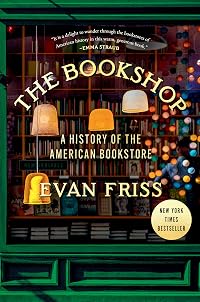
The Bookshop: A History of the American Bookstore
by Evan Friss
On This Page
Description
"An affectionate and engaging history of the American bookstore and its central place in American cultural life, from department stores to indies, from highbrow dealers trading in first editions to sidewalk vendors, and from chains to special-interest community destinations Bookstores have always been unlike any other kind of store, shaping readers and writers, and influencing our tastes, thoughts, and politics. They nurture local communities while creating new ones of their own. Bookshops show more are powerful spaces, but they are also endangered ones. In The Bookshop, we see those stakes: what has been, and what might be lost. Evan Friss's history of the bookshop draws on oral histories, archival collections, municipal records, diaries, letters, catalogs, and interviews with leading booksellers to offer a fascinating look at this institution beloved by so many-not just as a merchant, but as a gathering place for likeminded people who cherish books. The story begins with Benjamin Franklin's first bookstore in Philadelphia, and takes us to a range of booksellers including The Strand, Chicago's Marshall Field & Co., Gotham Book Mart, specialty stores like Oscar Wilde and Drum and Spear, sidewalk sellers of used books, Barnes & Noble, Amazon Books, and Parnassus. The Bookshop is also a history of the leading figures in American bookselling, often impassioned eccentrics, and a history of how books have been marketed and sold over the course of more than two centuries-including, for example, a 3,000-pound elephant who appeared to sign books at Marshall Field's in 1944. The Bookshop is a book every bookstore will want to carry, as there has never been a more affectionate and engaging celebration of this beloved institution"-- show lessTags
Recommendations

























Member Reviews
I don’t remember where I saw this, whether a recommendation or a feed suggestion but it is a wonderful book for people who love books and the places you can buy them. Frisks says,
“Bookstores are weird. They’re unlike any other retail store. They are viewed as cultural landmarks, places where financial profit is secondary to social profit. And yet they need to make money to survive. Competing narratives can’t decide whether indies are dying or multiplying. The optimistic version has encouraged people to open new stores and has kept publishers invested in brick-and-mortar bookselling. The pessimistic version has utility as well. Customers feel compelled to “save” a species on the edge of extinction. They appreciate the show more precariousness of a little bookstore’s life. It’s not enough to offer occasional support, Allison Hill reminds indie shoppers. For the indies to survive, fans need to buy all of their books from local bookshops. They have to shut Amazon off completely. They have to go cold turkey.”
And,
“As recently as 1993, the US Census Bureau counted 13,499 bookstores (one bookstore for every 19,253 people). That included indies, general bookstores, superstores, specialty shops, and any place with at least 50 percent of revenue derived from books. By 2021, however, there were just 5,591 bookstores left (one bookstore for every 59,283 people).”
Probably fewer now. Buy local. Whenever possible. Mr. Friss quotes H. L. Mencken, who in 1930 “asked what could ‘be done to rescue the poor bookseller,’ destined to become a bootlegger or, worse, a chiropractor.”
I look for specific used books wherever I go, and try to support the local bookshops. On a trip last month, I had a half day in Denver and a couple of days in Santa Barbara. In Denver, I found one I was looking for in one of two stores. In Santa Barbara, none in the two shops I checked, but I found a gem of a shop not far away in Ojai (Bart’s Books in case you are ever near there!)
Friss covers more than two hundred years of bookselling in the US, including some esoteric niche shops (even a distasteful US Nazis’ “Aryan bookshop”.)
Great stuff. show less
“Bookstores are weird. They’re unlike any other retail store. They are viewed as cultural landmarks, places where financial profit is secondary to social profit. And yet they need to make money to survive. Competing narratives can’t decide whether indies are dying or multiplying. The optimistic version has encouraged people to open new stores and has kept publishers invested in brick-and-mortar bookselling. The pessimistic version has utility as well. Customers feel compelled to “save” a species on the edge of extinction. They appreciate the show more precariousness of a little bookstore’s life. It’s not enough to offer occasional support, Allison Hill reminds indie shoppers. For the indies to survive, fans need to buy all of their books from local bookshops. They have to shut Amazon off completely. They have to go cold turkey.”
And,
“As recently as 1993, the US Census Bureau counted 13,499 bookstores (one bookstore for every 19,253 people). That included indies, general bookstores, superstores, specialty shops, and any place with at least 50 percent of revenue derived from books. By 2021, however, there were just 5,591 bookstores left (one bookstore for every 59,283 people).”
Probably fewer now. Buy local. Whenever possible. Mr. Friss quotes H. L. Mencken, who in 1930 “asked what could ‘be done to rescue the poor bookseller,’ destined to become a bootlegger or, worse, a chiropractor.”
I look for specific used books wherever I go, and try to support the local bookshops. On a trip last month, I had a half day in Denver and a couple of days in Santa Barbara. In Denver, I found one I was looking for in one of two stores. In Santa Barbara, none in the two shops I checked, but I found a gem of a shop not far away in Ojai (Bart’s Books in case you are ever near there!)
Friss covers more than two hundred years of bookselling in the US, including some esoteric niche shops (even a distasteful US Nazis’ “Aryan bookshop”.)
Great stuff. show less
Summary: A history of bookstores in America through the lens of fourteen bookstores or bookselling venues.
As a bibliophile, I love books on books, reading, and bookstores. In The Bookshop, Evan Friss offers a history of bookshops in America through the lens of fourteen bookshops or bookselling venues. Friss tells us he prefers the term “shop” at the outset. “Stores” sound too commercial. While there is a necessity to make enough to keep bookshops afloat (always a challenge throughout their history), a theme here is the unique bond booksellers build (or don’t build, in one case) with their customers.
Friss establishes that ethos in his Introduction, profiling the small Three Lives & Company shop in New York’s West Village. show more From Toby the owner to “the regulars” to Miriam, who listens well to customers, one has the sense that, like “Cheers,” this is a place where everyone knows, or wants to know, your name. After this, and each following chapter, there is a vignette on bookshop life–the UPS driver, the smell of books, the store buyer, and the ubiquitous bookstore cat among them.
From the Introduction, Friss takes us on a journey in time and geography from Ben Franklin’s shop in Philadelphia to Ann Patchett’s Parnassus books in Nashville. Along the way we learn Franklin didn’t call it a bookstore. He was a printer, and that led to printing and selling a number of books, including his own Almanac. His first big hit was the preacher, George Whitefield, selling his journals and sermons. Meanwhile, in another cradle of the Revolution, also a cradle of bookselling, we are introduced to the Old Corner bookshop. It was the hangout for the likes of Emerson, Holmes, Harriet Beecher Stowe, and Longfellow. Behind it was the partnership of William D. Ticknor and a clerk, James D. Fields, who rose to become a partner.
Friss introduces us to some legendary stores. Having worked in a department store, I was fascinated by the sheer magnificence of the Marshall Field book department in Chicago, especially under Marcella Hahner. Another woman-run store was the Gotham Book Mart. Frances Steloff maintained an office in this rambling store with books piled everywhere until she was over one hundred. She found a way to sell the books that were banned. And then there was the Strand, once on Booksellers Row before it moved a few blocks. A Bass family member still manages it.
By contrast, there are the niche stores. One of those was the Aryan Book Store, selling, you guessed it, Nazi literature. Friss notes similar shops around the country for workers and the Communist Party. Then there is the Oscar Wilde, a pathbreaker in the sale of LGBTQ+ literature. Finally, the Drum & Spear represents Black bookseller, on the rise with Black Lives Matter.
Friss also chronicles the booksellers who don’t sell from brick and mortar shops. Parnassus on Wheels from the early 1900’s represents the booksellers who sold books from wagons and later bookmobiles. Then there are the sidewalk booksellers in New York City and other places, following the precedent of the bouquinistes selling books along the West Bank of the Seine in Paris. In New York, we learn of the hassles they face from the city, even while building their own community of clientele. Finally, there is the story of online bookselling typified by Amazon, the behemoth. Friss also covers their misbegotten venture into brick and mortar stores, and their failure to embrace a bookselling ethos.
The book concludes with the two major players in the bookshop world of today. There are the big box chains, represented by Barnes and Noble. And there are the thousands of indies, represented by Ann Patchett’s Parnassus Books. The chapters devoted to each trace their birth and growth. For Barnes and Noble, it is a longer story, from a single New York store, to Leonard Riggio’s pivotal role in building the chain, to James Daunt’s role as rescuer, teaching booksellers to think like indies. On the other hand, the story of Parnassus is one where an accomplished author and a publisher’s sales rep team up when Nashville’s beloved Davis-Kidd store closed. and we learn how Barnes and Noble and the indies, once rivals, have learned to see each other as allies in the effort to keep bookselling personal and a presence in every community.
Of course, there are thousands of stories that go untold. Places like Austin’s BookPeople and Powell’s only have cameo appearances. Not one of the many great bookshops in my home state were mentioned. But no matter. The various expressions of bookselling were there and the stores featured are kin. Friss captures both the hard work behind bookselling and the wonder of these special “third places.” Whether the street stand, a corner shop, the indies I know of that create events and comfortable spaces in small towns, or my local Barnes and Noble, all are celebrated in Friss’ account. And because of that, I appreciate even more the gift all of these are to the common good. show less
As a bibliophile, I love books on books, reading, and bookstores. In The Bookshop, Evan Friss offers a history of bookshops in America through the lens of fourteen bookshops or bookselling venues. Friss tells us he prefers the term “shop” at the outset. “Stores” sound too commercial. While there is a necessity to make enough to keep bookshops afloat (always a challenge throughout their history), a theme here is the unique bond booksellers build (or don’t build, in one case) with their customers.
Friss establishes that ethos in his Introduction, profiling the small Three Lives & Company shop in New York’s West Village. show more From Toby the owner to “the regulars” to Miriam, who listens well to customers, one has the sense that, like “Cheers,” this is a place where everyone knows, or wants to know, your name. After this, and each following chapter, there is a vignette on bookshop life–the UPS driver, the smell of books, the store buyer, and the ubiquitous bookstore cat among them.
From the Introduction, Friss takes us on a journey in time and geography from Ben Franklin’s shop in Philadelphia to Ann Patchett’s Parnassus books in Nashville. Along the way we learn Franklin didn’t call it a bookstore. He was a printer, and that led to printing and selling a number of books, including his own Almanac. His first big hit was the preacher, George Whitefield, selling his journals and sermons. Meanwhile, in another cradle of the Revolution, also a cradle of bookselling, we are introduced to the Old Corner bookshop. It was the hangout for the likes of Emerson, Holmes, Harriet Beecher Stowe, and Longfellow. Behind it was the partnership of William D. Ticknor and a clerk, James D. Fields, who rose to become a partner.
Friss introduces us to some legendary stores. Having worked in a department store, I was fascinated by the sheer magnificence of the Marshall Field book department in Chicago, especially under Marcella Hahner. Another woman-run store was the Gotham Book Mart. Frances Steloff maintained an office in this rambling store with books piled everywhere until she was over one hundred. She found a way to sell the books that were banned. And then there was the Strand, once on Booksellers Row before it moved a few blocks. A Bass family member still manages it.
By contrast, there are the niche stores. One of those was the Aryan Book Store, selling, you guessed it, Nazi literature. Friss notes similar shops around the country for workers and the Communist Party. Then there is the Oscar Wilde, a pathbreaker in the sale of LGBTQ+ literature. Finally, the Drum & Spear represents Black bookseller, on the rise with Black Lives Matter.
Friss also chronicles the booksellers who don’t sell from brick and mortar shops. Parnassus on Wheels from the early 1900’s represents the booksellers who sold books from wagons and later bookmobiles. Then there are the sidewalk booksellers in New York City and other places, following the precedent of the bouquinistes selling books along the West Bank of the Seine in Paris. In New York, we learn of the hassles they face from the city, even while building their own community of clientele. Finally, there is the story of online bookselling typified by Amazon, the behemoth. Friss also covers their misbegotten venture into brick and mortar stores, and their failure to embrace a bookselling ethos.
The book concludes with the two major players in the bookshop world of today. There are the big box chains, represented by Barnes and Noble. And there are the thousands of indies, represented by Ann Patchett’s Parnassus Books. The chapters devoted to each trace their birth and growth. For Barnes and Noble, it is a longer story, from a single New York store, to Leonard Riggio’s pivotal role in building the chain, to James Daunt’s role as rescuer, teaching booksellers to think like indies. On the other hand, the story of Parnassus is one where an accomplished author and a publisher’s sales rep team up when Nashville’s beloved Davis-Kidd store closed. and we learn how Barnes and Noble and the indies, once rivals, have learned to see each other as allies in the effort to keep bookselling personal and a presence in every community.
Of course, there are thousands of stories that go untold. Places like Austin’s BookPeople and Powell’s only have cameo appearances. Not one of the many great bookshops in my home state were mentioned. But no matter. The various expressions of bookselling were there and the stores featured are kin. Friss captures both the hard work behind bookselling and the wonder of these special “third places.” Whether the street stand, a corner shop, the indies I know of that create events and comfortable spaces in small towns, or my local Barnes and Noble, all are celebrated in Friss’ account. And because of that, I appreciate even more the gift all of these are to the common good. show less
Books about books often win a high ranking in my book, and Friss’ anecdote-driven tome about bookstores is no exception. It offers something for every bibliophile regardless of reading preference or geographical locale.
From overviews of Ben Franklin’s involvement in the business and thumbnail sketches of several “little, mighty, and resilient independent” shops, to the origins of behemoths such as Amazon and Barnes and Noble, Friss’ work provides a fascinating glimpse into the industry. True, this isn’t a definitive or linear look at the history of the American book industry. It’s more of an eclectic collection of vignettes about a diverse number of bookstores that touches on their marketing tactics, their challenges and show more some of the colorful characters behind these enterprises.
Like any smorgasbord, not every literary morsel will delight every reader. A few chapters were a tad tedious. The nice thing about this book’s structure is that a chapter or two can be skimmed or even skipped without hurting the overall reading experience.
The book is laced with some “fun facts,” including profiles of sidewalk booksellers. Also, who knew there was a law on the books for a short period that prevented booksellers from discounting new titles?
The clear takeaway is that bookstores possess magical powers that can help shape our communities. show less
From overviews of Ben Franklin’s involvement in the business and thumbnail sketches of several “little, mighty, and resilient independent” shops, to the origins of behemoths such as Amazon and Barnes and Noble, Friss’ work provides a fascinating glimpse into the industry. True, this isn’t a definitive or linear look at the history of the American book industry. It’s more of an eclectic collection of vignettes about a diverse number of bookstores that touches on their marketing tactics, their challenges and show more some of the colorful characters behind these enterprises.
Like any smorgasbord, not every literary morsel will delight every reader. A few chapters were a tad tedious. The nice thing about this book’s structure is that a chapter or two can be skimmed or even skipped without hurting the overall reading experience.
The book is laced with some “fun facts,” including profiles of sidewalk booksellers. Also, who knew there was a law on the books for a short period that prevented booksellers from discounting new titles?
The clear takeaway is that bookstores possess magical powers that can help shape our communities. show less
This is a very well researched book, with lots of references to archives and other primary sources. Not surprising for a book by a professional historian. More surprising is that it is readable and entertaining. Friss follows a roughly chronological arrangement and covers a small number of bookshops in depth, with some others noted in passing. He begins with Franklin in Philadelphia and next moves on to the Old Corner Bookstore/Ticknor and Fields in Boston, a major force in early nineteenth-century American literature. Then he moves to bookshops on wheels, department store bookshops (Marshall Field's), Bookshop Row (NYC), Gotham Book Mart (NYC), The Strand (NYC), a variety of theme-oriented bookshops (feminist, LGBTQ, radical, Black), show more street booksellers, Barnes & Noble, Amazon. He ends with Ann Patchett's indie bookshop, Parnassus, in Nashville.
This is very much an east coast book; it reminds one of the New Yorker map of the US. Most of the bookshops are in the northeast, mostly in NYC. I will grant the cultural and commercial significance of most of his picks, but he omits or scants a lot. City Lights in San Francisco, at least as significant as Gotham and the Strand, gets only a couple of mentions. Powell's (Portland) likewise. Border's also gets relatively little attention; the Borders in Ann Arbor, originally an indie, was a great bookshop and the chain was higher quality than most of the competition. Barnes & Noble may have been first, but it was never as good as Borders. Antiquarian and second-hand bookshops get relatively little attention. Friss also generally ignores specialty bookshops: mystery, scifi (e.g., Uncle Edgar's and Uncle Hugo's in Minneapolis), non-English language books (e.g., Schoenhof's in Cambridge) etc. But they are an important part of the bookshop scene.
This is a pretty good book and I learned a number of things that I hadn't known. But as a history of American bookshops, it is quite selective and spotty. Much is a paean to the indies (Friss is married to an indie bookseller). I like indies and buy a lot of books from them (most recently Moon Palace in Minneapolis). But I also buy from chains and Amazon. People forget that in the days before Borders, Barnes & Noble, and Amazon, most places were book deserts. And even if you had a good indie nearby, there was a lot that you could only get by special order and mail order. I only started buying from Amazon, when our really fine local indie was taken over by Books-a-Million (aka, the barbarians from Birmingham) and they told me to take my special orders to Amazon. Which I did, along with much of the rest of my business. When I was a college student, I had to open an account with Blackwells in Oxford to get Latin and Greek books by mail; nobody much in America stocks them (then and now).
Four stars and not three because I am uncomfortable dinging an author for not writing the book that I would have wanted him to write. show less
This is very much an east coast book; it reminds one of the New Yorker map of the US. Most of the bookshops are in the northeast, mostly in NYC. I will grant the cultural and commercial significance of most of his picks, but he omits or scants a lot. City Lights in San Francisco, at least as significant as Gotham and the Strand, gets only a couple of mentions. Powell's (Portland) likewise. Border's also gets relatively little attention; the Borders in Ann Arbor, originally an indie, was a great bookshop and the chain was higher quality than most of the competition. Barnes & Noble may have been first, but it was never as good as Borders. Antiquarian and second-hand bookshops get relatively little attention. Friss also generally ignores specialty bookshops: mystery, scifi (e.g., Uncle Edgar's and Uncle Hugo's in Minneapolis), non-English language books (e.g., Schoenhof's in Cambridge) etc. But they are an important part of the bookshop scene.
This is a pretty good book and I learned a number of things that I hadn't known. But as a history of American bookshops, it is quite selective and spotty. Much is a paean to the indies (Friss is married to an indie bookseller). I like indies and buy a lot of books from them (most recently Moon Palace in Minneapolis). But I also buy from chains and Amazon. People forget that in the days before Borders, Barnes & Noble, and Amazon, most places were book deserts. And even if you had a good indie nearby, there was a lot that you could only get by special order and mail order. I only started buying from Amazon, when our really fine local indie was taken over by Books-a-Million (aka, the barbarians from Birmingham) and they told me to take my special orders to Amazon. Which I did, along with much of the rest of my business. When I was a college student, I had to open an account with Blackwells in Oxford to get Latin and Greek books by mail; nobody much in America stocks them (then and now).
Four stars and not three because I am uncomfortable dinging an author for not writing the book that I would have wanted him to write. show less
A charming and timely look into the history of American bookstores and the people who run and frequent them. The business has always been tough and it's demise has frequently been predicted. And yet it remains in the commerce landscape and is beloved by its respective communities.
The author profiles various pivotal bookshops in the history and development of the industry. Although many end with a sad not about their closure, others provide hope and insight into the future.
It's a light and easy read which does not mean its content is frivolous. I enjoyed the journey and it inspired me to continue to support those institutions in my orbit that fill this particular niche.
The author profiles various pivotal bookshops in the history and development of the industry. Although many end with a sad not about their closure, others provide hope and insight into the future.
It's a light and easy read which does not mean its content is frivolous. I enjoyed the journey and it inspired me to continue to support those institutions in my orbit that fill this particular niche.
A nonfiction account of the history of American bookstores. I loved that we start all the way back with Benjamin Franklin and continue until Barnes & Noble and Amazon change the landscape of bookshops. Along the way we learn about gay rights and black-owned shops that acted more like community building hubs than a traditional store. I loved traveling to each new space and hearing their stories. If this doesn't make you want to support your local independents, I don't know what will.
I received this book as a gift and wondered if I would have the fortitude to read it: I'm not a big non fiction reader. I was pleasantly surprised: with short, themed chapters and a vignette between each to break the rhythm, this book is an easy and interesting read. From early book shops, to reading trends, to political and social action, and finally big box and on-line stores, I learned a lot about the role of bookstores, their evolution and their unique place in the community. What I associate with libraries obviously widely applies to bookstores as well and I love that they still play such a strong role whatever shape they take.
Members
- Recently Added By
Lists

Books Read in 2024
4,727 works; 128 members

Kindle Non-Fiction
221 works; 1 member

On Books
70 works; 1 member

Fiction With Familiar Settings
280 works; 93 members
Author Information

3 Works 862 Members
Evan Friss is associate professor of history at James Madison University and author of On Bicycles: A 200-Year History of Cycling in New York City.
Some Editions
Awards and Honors
Awards
Common Knowledge
- Canonical title
- The Bookshop: A History of the American Bookstore
- Original title
- The Bookshop: A History of the American Bookstore
- Original publication date
- 2024
- Dedication
- For all the booksellers (especially Amanda)
- First words
- Introduction
Three Lives & Company is a 650-square-foot bookshop on a corner in New York City's West Village. Along the hand-carved shelves and glowing under Jolly Rancher-green lamps, there's fiction and non, frontlis... (show all)t and backlist, picture books and cookbooks, history and travel, queer and poetry, art and architecture, Granta and graphic novels, The Paris Review and all things New York. The dog treats are behind the counter.
All new books come out on Tuesdays. Selling them before their publication date is considered unscrupulous, scandalous even. At Three Lives, the books wait for their big day in the basement, over by the teakettle and screwdriv... (show all)ers. -The UPS Driver - Last words
- (Click to show. Warning: May contain spoilers.)They already have.
- Blurbers
- Straub, Emma
- Canonical DDC/MDS
- 381.450020973
- Canonical LCC
- Z280.F75
Classifications
- Genres
- Nonfiction, General Nonfiction, History
- DDC/MDS
- 381.450020973 — Society, government, & culture Commerce, communications & transportation regulations Domestic Trade (Commerce) Specific products and services Books
- LCC
- Z280 .F75 — Bibliography, Library Science and Information Resources Book industries and trade Bookselling and publishing
- BISAC
Statistics
- Members
- 823
- Popularity
- 33,534
- Reviews
- 21
- Rating
- (4.08)
- Languages
- English
- Media
- Paper, Audiobook, Ebook
- ISBNs
- 4
- ASINs
- 3