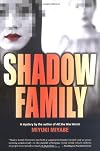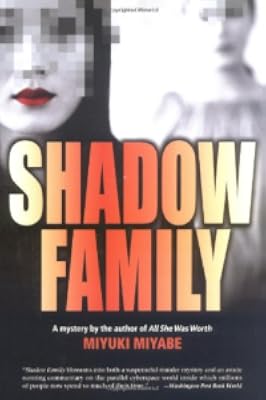
Shadow Family
by Miyuki Miyabe
On This Page
Description
This compelling murder mystery focuses on the murky world of Internet chat rooms. Veteran Desk Sergeant Takegami finds himself in center stage of the investigations after his colleague is hospitalized.Tags
Recommendations



















Member Reviews
It's hard to talk about a mystery, especially one as short as Shadow Family, without giving too much away. What I am comfortable saying is that the story is not exactly what I'd expected from the summary, but not in the way which makes me cringe and wonder if the blurb writer even read the same book. Rather, to have said too much would have dampened my enjoyment of the revelations made throughout the novel. The author slowly pulls back layer after layer of stories and role-play, to expose the truth of the murder. I could almost say that the entire novel is one long Parlor Scene during which the detective stands up and announces that the murderer is here in this very room and explains how he solved the mystery.
But even that would be show more inaccurate, as our detective, Desk Sergeant Takegami, is far too self-effacing to command the attention of a roomful of interested parties. He would, by his own account, feel much more comfortable pursuing paperwork than conducting interviews. The language itself is far more beautiful than I expect from literature of this genre, though I'm sure that's an unfair generalization. I loved the way characters' appearances were sketched in with a few clever turns of phrase and the beautiful use of metaphor and analogy, especially towards the very end.
Shadow Family is a good, fast read. My only trouble with it arose from the high number of unfamiliar family names which were introduced too quickly in the opening chapters for me for me to get a good handle on which name belonged to which character. A reader more versed in Japanese names would probably not have the same problem, and I could have made my own life easier by cribbing a character sheet to refer to until I had the names down. show less
But even that would be show more inaccurate, as our detective, Desk Sergeant Takegami, is far too self-effacing to command the attention of a roomful of interested parties. He would, by his own account, feel much more comfortable pursuing paperwork than conducting interviews. The language itself is far more beautiful than I expect from literature of this genre, though I'm sure that's an unfair generalization. I loved the way characters' appearances were sketched in with a few clever turns of phrase and the beautiful use of metaphor and analogy, especially towards the very end.
Shadow Family is a good, fast read. My only trouble with it arose from the high number of unfamiliar family names which were introduced too quickly in the opening chapters for me for me to get a good handle on which name belonged to which character. A reader more versed in Japanese names would probably not have the same problem, and I could have made my own life easier by cribbing a character sheet to refer to until I had the names down. show less
I enjoyed the writing style and pacing of this - I stayed engaged while reading it - but the structure was a bit confusing for me at firs. The story really starts half way (or more) through the plot. It's almost like watching a TV show not realizing that you are tuning in to the second show in a crossover, the first show of which you have never watched and so have no frame of reference for who the characters are and what the plot was that brought the story to the point that you are now watching. I think in the hands of a less talented author, I would not have stuck out the first part long enough to get things straight and keep reading. That being said, if I found out in the future that this was a "part two", I would not be that surprised.
Shadow Family is a mystery story. Two people get murdered within a couple of days of each other, and seemingly unrelated. But thread from a striking blue parka left on both crime scenes soon prove to the police that things are more than meets the eye. Meeting dead end after dead end, one of the officers come up with a theory that could potentially make or break the mystery behind the curious deaths.
And it is here that the story finally starts to reveal itself.
One of the victims had, during the one year or so before his tragic death, been part of an online ‘family’. He called himself ‘Dad’, and his family consisted of ‘Mom’, ‘Minoru’, and ‘Kazumi’. A 4-member family. A typical family set-up, only that it was all show more virtual.
Upon finding out about this make-believe family, how does the real-life family respond? And how do these deaths reveal the truth behind all the pain, anger and loneliness?
*
Personally, I feel that the mystery in this plot is not at all strong. In fact, I felt like I already knew who the culprit was half-way through the book. However, I also feel that the redeeming point of this book is how the story unfolds. The mystery of the plot itself may not have been its strongest virtue, but certainly the way the characters were introduced, and how certain things were thrown into light just when you least expect it… These make the plot feel less significant.
We’re made to think, exactly why does a man with his own family go in search for a virtual family on the Internet? What drives a person to such measures? Then we are given a chance to see things from the wife’s perspective. How would one feel if her husband were to find another ‘wife’ on the Internet? Does one feel lonely? Does one feel like a failure?
How about the people with whom this man forms a ‘family’ with? Why does one choose to be the virtual daughter of a stranger?
On the face of it, this is a mystery story. But underlying this story is the undeniable search for connection. Under the surface of it all, is the question of how each different person reacts to a given set of circumstances. How does one overcome feelings of loneliness and desperation?
At the end of it all, when family ties start to tangle up into a big mess, or maybe fray away at the ends, what is it that holds the family unit together? show less
And it is here that the story finally starts to reveal itself.
One of the victims had, during the one year or so before his tragic death, been part of an online ‘family’. He called himself ‘Dad’, and his family consisted of ‘Mom’, ‘Minoru’, and ‘Kazumi’. A 4-member family. A typical family set-up, only that it was all show more virtual.
Upon finding out about this make-believe family, how does the real-life family respond? And how do these deaths reveal the truth behind all the pain, anger and loneliness?
*
Personally, I feel that the mystery in this plot is not at all strong. In fact, I felt like I already knew who the culprit was half-way through the book. However, I also feel that the redeeming point of this book is how the story unfolds. The mystery of the plot itself may not have been its strongest virtue, but certainly the way the characters were introduced, and how certain things were thrown into light just when you least expect it… These make the plot feel less significant.
We’re made to think, exactly why does a man with his own family go in search for a virtual family on the Internet? What drives a person to such measures? Then we are given a chance to see things from the wife’s perspective. How would one feel if her husband were to find another ‘wife’ on the Internet? Does one feel lonely? Does one feel like a failure?
How about the people with whom this man forms a ‘family’ with? Why does one choose to be the virtual daughter of a stranger?
On the face of it, this is a mystery story. But underlying this story is the undeniable search for connection. Under the surface of it all, is the question of how each different person reacts to a given set of circumstances. How does one overcome feelings of loneliness and desperation?
At the end of it all, when family ties start to tangle up into a big mess, or maybe fray away at the ends, what is it that holds the family unit together? show less
Right away, let me tell you that this book is not really "active," in the sense that it is purely psychological. So if you're looking for an action-packed mystery, this is not the one for you. A large number of people totally panned this book because there was very little action between its covers. But, if (like me) you are okay with exploring psychological motivation behind a person's acts, then you'll like this one.
The Metropolitan Police District is investigating two linked murders: a young girl and a middle-aged man. They have a suspect, but for some of the investigators, the suspect just doesn't feel right. So they keep digging, and find that the dead man was keeping up a regular Internet correspondence with three other people, show more known only as Mom, Minoru and Kazumi. As it turns out these four people were playing at being a "family" on the internet...the "shadow" family of the title. The police want to put the remaining "family" members together to take a look at them individually and as a group to see what they can discover not only about the dead man, but also to take a look at why 4 people would keep up this bizarre relationship.
Miyabe's last book, For All She Was Worth, took on predatory credit practices in Japan and the concept of identity; this one takes a look at alienation within families there, as well as the separate lives people lead in cyberspace. At first you may be a little in the dark, scratching your head going "huh?" but do NOT stop reading -- there is a very nice twist at the end of the novel which plays out in a way I haven't seen before in a mystery. Sadly, I figured out who the killer was long before I got to the end, but the ride was fun.
I liked this book, but it may not be for all mystery readers. show less
The Metropolitan Police District is investigating two linked murders: a young girl and a middle-aged man. They have a suspect, but for some of the investigators, the suspect just doesn't feel right. So they keep digging, and find that the dead man was keeping up a regular Internet correspondence with three other people, show more known only as Mom, Minoru and Kazumi. As it turns out these four people were playing at being a "family" on the internet...the "shadow" family of the title. The police want to put the remaining "family" members together to take a look at them individually and as a group to see what they can discover not only about the dead man, but also to take a look at why 4 people would keep up this bizarre relationship.
Miyabe's last book, For All She Was Worth, took on predatory credit practices in Japan and the concept of identity; this one takes a look at alienation within families there, as well as the separate lives people lead in cyberspace. At first you may be a little in the dark, scratching your head going "huh?" but do NOT stop reading -- there is a very nice twist at the end of the novel which plays out in a way I haven't seen before in a mystery. Sadly, I figured out who the killer was long before I got to the end, but the ride was fun.
I liked this book, but it may not be for all mystery readers. show less
A man is found stabbed to death in a home under construction, and as they look into his life they find he has another "family" on the internet. This is an interesting look at the psychology behind internet relationships as the victim filled the role of "Dad" to a couple of teenagers, and a woman joined in in the role of "Mom". It later leads to tragedy and the methods the police use to solve the mystery are ingenious. Highly recommended.
Ishizu returns!
In Miyabe's second English-translated police procedural (Crossfire being the first), we are reacquainted with Isizu Chikako, middle-aged policewoman. Demoted due to her "disobedience" in Crossfire, Ishizu now finds herself in the middle of a cat-and-mouse game involving two murders, a fictional family that exists solely online and a broken family falling apart offline.
For a short novel there's a relatively large cast of characters, and each is referred to by both family and first name. The police department members are also listed by rank, and a lot of names are multisyllabic and similar to one another, so a bit of memorization will be necessary. It's worth it.
In Miyabe's second English-translated police procedural (Crossfire being the first), we are reacquainted with Isizu Chikako, middle-aged policewoman. Demoted due to her "disobedience" in Crossfire, Ishizu now finds herself in the middle of a cat-and-mouse game involving two murders, a fictional family that exists solely online and a broken family falling apart offline.
For a short novel there's a relatively large cast of characters, and each is referred to by both family and first name. The police department members are also listed by rank, and a lot of names are multisyllabic and similar to one another, so a bit of memorization will be necessary. It's worth it.
It's a mystery set on the fringe of Tokyo. A father has a family and he has a cyber-family. He likes his cyber-family more than his real family. Someone gets killed. Someone gets accused. They talk a lot and then they figure out who did it. Not very mysterious. Kind of a let down. This book was recommended to me by a Japanese bookseller in Kyoto. Last time I seek his advice.
Members
- Recently Added By
Author Information

157+ Works 3,170 Members
Series
Belongs to Publisher Series
Common Knowledge
- Canonical title
- Shadow Family
- Original title
- R.P.G.
- Original publication date
- 2001-08-25 (original Japanese) (original Japanese); 2004 (English: Carpenter) (English: Carpenter)
- People/Characters
- Etsuro Takegami (Sergeant); Chikako Ishizu (Detective); Matsuo Tokunaga (Detective); Noriyoshi Shimojima (Captain); Fusao Nakamoto (Sergeant); Mikie Fuchigami (Patrol Officer) (show all 17); Ryosuke Tokoroda; Kazumi Tokoroda; Harue Tokoroda; Minoru Kitajo; Ritsuko Kawara; Yoshie Mita; Miss A; Tatsuya Ishiguro; Tomiko Fukada; Tachikawa (Chief of Police); Naoko Imai
- Important places
- Tokyo, Japan
- Epigraph
- Role-playing: a method of learning in which real-life situations are acted out; by playing various imaginary roles, participants master techniques of problem-solving.
- First words
- A light rap sounded, and the meeting room door swung open. (Chapter 1)
- Last words
- (Click to show. Warning: May contain spoilers.)"We've got work to do."
- Original language
- Japanese
- Disambiguation notice
- Originally published in Japan under the title R.P.G.
Classifications
- Genres
- Fiction and Literature, Mystery
- DDC/MDS
- 895.635 — Literature & rhetoric Literatures of other languages Literatures of East and Southeast Asia Japanese Japanese fiction 1945–2000
- LCC
- PL856 .I856 .R213 — Language and Literature Languages and literatures of Eastern Asia, Africa, Oceania Languages of Eastern Asia, Africa, Oceania Japanese language and literature Japanese literature Individual authors and works
- BISAC
Statistics
- Members
- 159
- Popularity
- 205,491
- Reviews
- 13
- Rating
- (3.31)
- Languages
- 6 — Danish, English, French, Japanese, Spanish, Turkish
- Media
- Paper
- ISBNs
- 8