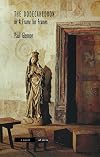
The Dodecahedron: Or A Frame for Frames
by Paul Glennon
On This Page
Description
Written by the author of How Did You Sleep?, this collection of stories takes the author's adventures in short fiction to strange regions, where professional polygamists, heretical alcoholics and hallucinating arctic explorers find themselves sharing plot points, character traits and dialogue.Tags
Recommendations





































Member Reviews
I made a sketch of this book here.
I kind of feel I should just leave it there. But no, I won't.
I had good fun with Paul Glennon's The Dodecahedron. This series of twelve interlinked stories, structured like a dodecahedron in which each shares five referential "sides" with its contiguous stories, and thrice-repeated phrases create "vertices" among story-triads, functions like a giant Sudoku puzzle and kept me reaching for my pen and subsequently for my computer to track the appearances and reappearances of various motifs. While Glennon's stories are more clever and stylized than affective or deep, more of an ingenious game than Kafka's "axe for the frozen sea within," I still found The Dodecahedron to be a thoroughly enjoyable little show more excursion into literary geometry. The overarching interest and suspense, for me, came not from the individual stories themselves but from watching their interrelationships tug and rearrange themselves, seeming to fall into place in one story only to be brought into question in the next.
Indeed, one of the most interesting things about Glennon's highly structured book is the number of places that structure seems in danger of collapsing in on itself. Sometimes, as in "The Parlor Game" and "Some Clippings on My Article on Machine Literature," this happened in a way that almost felt like "cheating": it is easier, after all, to incorporate references to five other stories into the story you're writing if you use a kind of clip show format. In general, I found the stories stronger toward the beginning because of just this phenomenon. In many cases, though, I liked the ambiguity created by the way Glennon's ostensibly geometric formations don't quite fit together, like a door sticking in its jamb. The stories often echo each other without mapping precisely one onto the next; the ones that come later in the book don't necessarily "explain" the ones that come earlier.
Throughout the collection, for example, there is a recurring theme of a young boy whose father is missing, and the three shadowy strangers who are searching for him. Variations on this basic plot resurface again and again. One expects them to resolve at some point, but they never truly do: is the narrator of "My Father's Library" merely the protagonist of the adventure novel written by Jensen in "Why Are There No Penguins?" Is the Arctic explorer in that story merely hallucinating Jensen's novel, or did he hallucinate his entire previous life based on something Jensen once told him? Is the "Why Are There No Penguins" narrator the Ulrich Gjedson mentioned in "The Collector"? If so, the details don't exactly fit: a seemingly analogous character is at one point named "Jenkins," elsewhere "Jensen"—and in one case he dies by fever, in another by poison. Similarly, another character is "Katerina" in one story, "Catherine" elsewhere. Even the repeated phrases at the vertices occasionally refuse to match up exactly, so that we get "self-expression is a feeble excuse" ("The American Shahrazad"); "wish-fulfillment, like self-expression, is a feeble excuse" ("The Tenebrian Chronicles"); and "Self-expression and self-exploration are feeble excuses" ("The Last Story"). In this last example, the addition of "and self-exploration" is not required by the story; it would have been easy enough for all of the phrases to match exactly, but Glennon appears to insist on a strong, yet inexact, correlation.
The strength of the narrative echoes sometimes build up to a point where they compromise or disguise Glennon's laboriously-built scaffolding. The plots of young boys protecting their imperiled fathers, for example, and the theme of pre-Columbian contact between American and Europe, crop up in so many of these stories that their appearance can no longer be taken to signal anything about the collection's geometry: they spread among non-adjacent stories throughout the book. It can therefore sometimes be difficult to find the key "connection" between two stories, even if they have MANY obvious connections, if those same connections crop up too often elsewhere. The journalist narrator of "The Plot to Hide America" writes that
But Glennon's work also suggests the opposite problem: that when the human mind is looking for connections, looking to "reintegrate distant facts into a coherent story," it's apt to find those connections even when they don't exist. Or, when the mind starts finding legitimate connections between two things, it will then find more and more until it can't distinguish which connections are the important ones, and which irrelevant. So too, connections in Glennon's book are just as likely to call into question their earlier incarnations, as they are to reinforce them. Little, as the journalist says, that is "reassuring," except the fun of assembling and disassembling narratives as connections come and go. show less
I kind of feel I should just leave it there. But no, I won't.
I had good fun with Paul Glennon's The Dodecahedron. This series of twelve interlinked stories, structured like a dodecahedron in which each shares five referential "sides" with its contiguous stories, and thrice-repeated phrases create "vertices" among story-triads, functions like a giant Sudoku puzzle and kept me reaching for my pen and subsequently for my computer to track the appearances and reappearances of various motifs. While Glennon's stories are more clever and stylized than affective or deep, more of an ingenious game than Kafka's "axe for the frozen sea within," I still found The Dodecahedron to be a thoroughly enjoyable little show more excursion into literary geometry. The overarching interest and suspense, for me, came not from the individual stories themselves but from watching their interrelationships tug and rearrange themselves, seeming to fall into place in one story only to be brought into question in the next.
Indeed, one of the most interesting things about Glennon's highly structured book is the number of places that structure seems in danger of collapsing in on itself. Sometimes, as in "The Parlor Game" and "Some Clippings on My Article on Machine Literature," this happened in a way that almost felt like "cheating": it is easier, after all, to incorporate references to five other stories into the story you're writing if you use a kind of clip show format. In general, I found the stories stronger toward the beginning because of just this phenomenon. In many cases, though, I liked the ambiguity created by the way Glennon's ostensibly geometric formations don't quite fit together, like a door sticking in its jamb. The stories often echo each other without mapping precisely one onto the next; the ones that come later in the book don't necessarily "explain" the ones that come earlier.
Throughout the collection, for example, there is a recurring theme of a young boy whose father is missing, and the three shadowy strangers who are searching for him. Variations on this basic plot resurface again and again. One expects them to resolve at some point, but they never truly do: is the narrator of "My Father's Library" merely the protagonist of the adventure novel written by Jensen in "Why Are There No Penguins?" Is the Arctic explorer in that story merely hallucinating Jensen's novel, or did he hallucinate his entire previous life based on something Jensen once told him? Is the "Why Are There No Penguins" narrator the Ulrich Gjedson mentioned in "The Collector"? If so, the details don't exactly fit: a seemingly analogous character is at one point named "Jenkins," elsewhere "Jensen"—and in one case he dies by fever, in another by poison. Similarly, another character is "Katerina" in one story, "Catherine" elsewhere. Even the repeated phrases at the vertices occasionally refuse to match up exactly, so that we get "self-expression is a feeble excuse" ("The American Shahrazad"); "wish-fulfillment, like self-expression, is a feeble excuse" ("The Tenebrian Chronicles"); and "Self-expression and self-exploration are feeble excuses" ("The Last Story"). In this last example, the addition of "and self-exploration" is not required by the story; it would have been easy enough for all of the phrases to match exactly, but Glennon appears to insist on a strong, yet inexact, correlation.
The strength of the narrative echoes sometimes build up to a point where they compromise or disguise Glennon's laboriously-built scaffolding. The plots of young boys protecting their imperiled fathers, for example, and the theme of pre-Columbian contact between American and Europe, crop up in so many of these stories that their appearance can no longer be taken to signal anything about the collection's geometry: they spread among non-adjacent stories throughout the book. It can therefore sometimes be difficult to find the key "connection" between two stories, even if they have MANY obvious connections, if those same connections crop up too often elsewhere. The journalist narrator of "The Plot to Hide America" writes that
Connecting the four stories was a small miracle, but nothing about it is reassuring. The sheer luck of it makes me doubt my own profession. I'm reminded of how many stories are out there undiscovered. Even when the characters and events are known to everyone, luck has to intervene to assemble the story. It convinces me that for every story we chance to put together, thousands of others remain disassembled and lost. For every person like myself with an interest in reintegrating distant facts into a coherent story, there are many others who would prefer to keep those facts scattered and confused. It reminds me that there are people working to assure that the thing we imagine is out there cannot be captured on paper.
But Glennon's work also suggests the opposite problem: that when the human mind is looking for connections, looking to "reintegrate distant facts into a coherent story," it's apt to find those connections even when they don't exist. Or, when the mind starts finding legitimate connections between two things, it will then find more and more until it can't distinguish which connections are the important ones, and which irrelevant. So too, connections in Glennon's book are just as likely to call into question their earlier incarnations, as they are to reinforce them. Little, as the journalist says, that is "reassuring," except the fun of assembling and disassembling narratives as connections come and go. show less
Dodecahedron: A Platonic solid composed of twelve pentagonal faces, with three meeting at each vertex. It has twenty vertices and thirty edges. Definition from Wikipedia.org
Paul Glennon’s The Dodecahedron or A Frame for Frames: a novel of sorts is composed of twelve short stories, each representing one of the pentagonal faces of a dodecahedron. The key to understanding this unique work is in the subtitle: “a novel of sorts.âÂ? Instead of creating a series of unrelated short stories, Glennon has added a new dimension to his work by applying Oulipian principles (OuLiPo is a group of French authors who create literature based on arbitrary constraints of their own making) to his collection. Glennon explains these principles in the show more bookâÂÂs afterword:
âÂÂEach chapter was to be as self-contained and whole as any short story. As in a story cycle, each story would cast a new light on the ones that preceded it, and promote a novel-like unity of themes. What I did not want to write was a cyclical book, in which the final story is the final word, a story with more authority than all others, one that casts a sort of judgment on the restâ¦I envisioned a book in which each of the twelve chapters or stories represented a face of the dodecahedron. In A Frame for Frames these sides represent a relationship to an adjacent storyâ¦Each story must refer to or be referred to by each of the five stories adjacent to it.âÂ?
A further constraint Glennon puts on his work is also best explained by his own words:
âÂÂA dodecahedron has twenty vertices, points where three sides meet. In A Frame for Frames these vertices are represented by certain repetitions and recurrences in each of the three stories that meet in these points. If the elements that represent the vertices were extracted and placed in the order of their first appearance, they would form another text of sorts, which might provide another perspective for evaluating the whole.âÂ?
GlennonâÂÂs stories cover a wide range of genres; diaries of adventurers, conspiracy theories, academic essays, all leading to unexpected connections. The stories, as stand-alone tales, are entertaining but it is in their interlacings that they become luminous. A Frame for Frames consists of stories about stories, adding both a platform on which to build this three dimensional creation, and the invisible conception itself. Readers will be tempted to create a dodecahedron of their own to unravel GlennonâÂÂs creation.
The ethereal creations arise, like the shadow child in âÂÂWhy Are There No Penguins?âÂ?, taunting the reader with half-realized ideas. Even if the reader never sees the creation Glennon intends, the hallucinatory threads invented by the mind are magical in their own right.
Hallucination and dream states exist throughout these stories, most apparently being in âÂÂTenebrian ChroniclesâÂ? where monks spend months each year dreaming the histories and world events they later inscribe as fact.
Glennon introduces his readers to a profound journey of the mind and senses; one that will remain in their minds as clearly as if they had eaten the pages of this mesmerizing book, like the hero in the lead story âÂÂIn My FatherâÂÂs Library.âÂ? The quote by Francis Bacon, which prefaces "Library," could easily be applied to the entirety of A Frame for Frames: âÂÂSome books are to be tasted, others to be swallowed, and some few to be chewed and digested.âÂ?
No matter how the reader dips into The Dodecahedron or A Frame for Frames: a novel of sorts, this book will remain with them long after the final page is consumed.
See the review posted at ReadySteadyBook - http://www.readysteadybook.com/BookReview.aspx?isbn=0889842752. show less
Paul Glennon’s The Dodecahedron or A Frame for Frames: a novel of sorts is composed of twelve short stories, each representing one of the pentagonal faces of a dodecahedron. The key to understanding this unique work is in the subtitle: “a novel of sorts.âÂ? Instead of creating a series of unrelated short stories, Glennon has added a new dimension to his work by applying Oulipian principles (OuLiPo is a group of French authors who create literature based on arbitrary constraints of their own making) to his collection. Glennon explains these principles in the show more bookâÂÂs afterword:
âÂÂEach chapter was to be as self-contained and whole as any short story. As in a story cycle, each story would cast a new light on the ones that preceded it, and promote a novel-like unity of themes. What I did not want to write was a cyclical book, in which the final story is the final word, a story with more authority than all others, one that casts a sort of judgment on the restâ¦I envisioned a book in which each of the twelve chapters or stories represented a face of the dodecahedron. In A Frame for Frames these sides represent a relationship to an adjacent storyâ¦Each story must refer to or be referred to by each of the five stories adjacent to it.âÂ?
A further constraint Glennon puts on his work is also best explained by his own words:
âÂÂA dodecahedron has twenty vertices, points where three sides meet. In A Frame for Frames these vertices are represented by certain repetitions and recurrences in each of the three stories that meet in these points. If the elements that represent the vertices were extracted and placed in the order of their first appearance, they would form another text of sorts, which might provide another perspective for evaluating the whole.âÂ?
GlennonâÂÂs stories cover a wide range of genres; diaries of adventurers, conspiracy theories, academic essays, all leading to unexpected connections. The stories, as stand-alone tales, are entertaining but it is in their interlacings that they become luminous. A Frame for Frames consists of stories about stories, adding both a platform on which to build this three dimensional creation, and the invisible conception itself. Readers will be tempted to create a dodecahedron of their own to unravel GlennonâÂÂs creation.
The ethereal creations arise, like the shadow child in âÂÂWhy Are There No Penguins?âÂ?, taunting the reader with half-realized ideas. Even if the reader never sees the creation Glennon intends, the hallucinatory threads invented by the mind are magical in their own right.
Hallucination and dream states exist throughout these stories, most apparently being in âÂÂTenebrian ChroniclesâÂ? where monks spend months each year dreaming the histories and world events they later inscribe as fact.
Glennon introduces his readers to a profound journey of the mind and senses; one that will remain in their minds as clearly as if they had eaten the pages of this mesmerizing book, like the hero in the lead story âÂÂIn My FatherâÂÂs Library.âÂ? The quote by Francis Bacon, which prefaces "Library," could easily be applied to the entirety of A Frame for Frames: âÂÂSome books are to be tasted, others to be swallowed, and some few to be chewed and digested.âÂ?
No matter how the reader dips into The Dodecahedron or A Frame for Frames: a novel of sorts, this book will remain with them long after the final page is consumed.
See the review posted at ReadySteadyBook - http://www.readysteadybook.com/BookReview.aspx?isbn=0889842752. show less
Ratings
Members
- Recently Added By
Lists

Connected Stories
6 works; 3 members
Author Information
7 Works 101 Members
Awards and Honors
Classifications
Statistics
- Members
- 48
- Popularity
- 627,103
- Reviews
- 2
- Rating
- (3.57)
- Languages
- English
- Media
- Paper, Ebook
- ISBNs
- 2