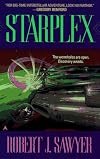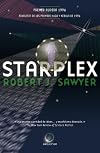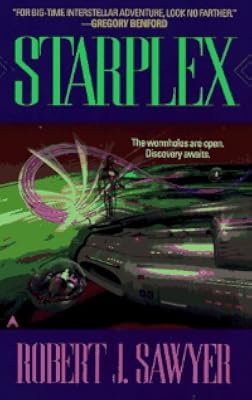
Starplex
by Robert J. Sawyer
On This Page
Description
"For nearly twenty years, Earth's space exploration had exploded outward, thanks to a series of mysterious, artificial wormholes....When an unknown vessel--with no windows, no seams, and no visible means of propulsion--arrives through a new wormhold," it could be the start of an intergalactic war.Tags
Recommendations





















Member Reviews
Definitely not my favorite Sawyer but interesting anyway. I found it a bit dry, but with lots of science and lots of imagination about where the future might lead us. I especially liked the aliens and how different from us they were.
The races of intelligent beings in this book are described very well, both physically as well as their way of thinking, beliefs, culture, etc. Their interactions on a ship together are a big part of why I loved this book. There is a lot discovered about the Universe in the course of the story and these things are quite unexpected. I do like science fiction with some philosophy and I got that here. Sawyer always delivers something to ponder.
Really neat ideas and good characters. It read a bit like a really good Star Trek episode. Once again though, I wish he wouldn't have put on the last chapter. In the WWW series, I felt the end undermined the rest of the series. In this one, it just was a little too neat. Never gild the lilly baby! Never gild the lily!
Starplex
Since a lot of Sawyer’s current writing is strained and when not strained political, I look back at his earlier stuff that I do like. I have not read Starplex (the name of the starship) and really liked its similaries to Star Trek, and the adventures the ship’s crew was having.
Really liked the interaction between Keith and his wife Clarissa as her husband struggled against his “mid life crisis” and a certain sexy assistant who had her eyes on Keith.
Despite that subplot we meet all kinds of characters and creatures and even come to like a few of them. Too bad this was never a continuing series.
The scientific babble that goes on is a bit over my head and it needn’t be if the author defines his terms better.
Otherwise show more quite an enjoyable, eventful hard science story from 1995. show less
Since a lot of Sawyer’s current writing is strained and when not strained political, I look back at his earlier stuff that I do like. I have not read Starplex (the name of the starship) and really liked its similaries to Star Trek, and the adventures the ship’s crew was having.
Really liked the interaction between Keith and his wife Clarissa as her husband struggled against his “mid life crisis” and a certain sexy assistant who had her eyes on Keith.
Despite that subplot we meet all kinds of characters and creatures and even come to like a few of them. Too bad this was never a continuing series.
The scientific babble that goes on is a bit over my head and it needn’t be if the author defines his terms better.
Otherwise show more quite an enjoyable, eventful hard science story from 1995. show less
I wanted to yell at the protagonist, but the sketches of alien races, the use of dark matter, and the solution to preventing the heat death of the universe were all interesting.
Welcome to a future where human beings and dolphins are in contact with two other sentient races from other planets, connected by a network of singularities created by some other long-gone race. When stars begin coming through the singularities, our heroes figure out they may be coming from the future, and that mystery combined with the opportunistic attack by one of the more violent races sets off a race against time to save a brand new life form and, you know, also all of humanity.
This is pretty great science fiction, from an author who consistently provides great ideas in his novels. Unfortunately the characterization of the protagonist and his cringeworthy perception of his relationship to his wife and a young girl who works for him show more left me a little bit uncomfortable, but at least there was an attempt to make the people more real, and not stereotypes or caricatures. The resolution is satisfying and it's almost enough to make a reader sad that Sawyer later decided to concentrate on more modern sci fi. show less
This is pretty great science fiction, from an author who consistently provides great ideas in his novels. Unfortunately the characterization of the protagonist and his cringeworthy perception of his relationship to his wife and a young girl who works for him show more left me a little bit uncomfortable, but at least there was an attempt to make the people more real, and not stereotypes or caricatures. The resolution is satisfying and it's almost enough to make a reader sad that Sawyer later decided to concentrate on more modern sci fi. show less
It started of weak and b-story like and then worked itself up to some amazing page turning middle part to then just end in some fizzle micro ending.
Not bad, but could have been much better.
Not bad, but could have been much better.
Members
- Recently Added By
Author Information

107+ Works 20,048 Members
Robert J. Sawyer was born in Ottawa on April 29, 1960, but raised in Toronto. In 1980, while still in high school, Sawyer submitted a short story to the the Rochester Museum and Science Center, which was running a contest for light show ideas. Sawyer didn't win, but the Museum purchased his story Motive anyway and it ran for 192 performances. show more Sawyer went on to attend Toronto's Ryerson Polytechnical Institute, majoring in Radio and Television Arts. In September 1979, he had his first piece of fiction published at the end of his first year, in Ryerson's literary annual, White Wall Review. Sawyer graduated from Ryerson in 1982. Sawyer was hired back the following semester to teach television studio production techniques to second- and third-year students. In the four months interim, he worked for minimum wage at the local SF bookstore, spending all his earnings on books. From 1984 to 1992, while teaching, Sawyer also coordinated a social group of Toronto-area science-fiction writers founded by SF editor Judith Merril. He established a Canadian region of the Science Fiction and Fantasy Writers of America; and in 1998, served as that organization's president. Sawyer also retained freelance nonfiction writing contracts, writing articles for newspapers and magazines, press releases and brochures for corporations, newsletters for government departments. He churned out vast amounts of promotional materials and over 200 articles for computing and personal-finance magazines in a span of five years. But in that time, his only really significant publication was the novelette Golden Fleece, which appeared as the cover story in the September 1988 edition of Amazing Stories. The novel-length Golden Fleece was sold to Warner Books a year later in 1989. The sales of his first five books were uninspiring and Sawyer faced being dropped by his publisher. Sawyer decided to take the time to write a book, without a contract, take as long as necessary, and produce a blockbuster. He also wanted to tackle a controversial issue and deal with it head on. With that in mind, Sawyer wrote The Terminal Experiment, about abortion and the soul. His publisher rejected it on grounds of controversy. HarperPrism then bought the book and serialization rights were sold to Analog, the number-one best-selling English-language SF magazine. The Terminal Experiment went on to win the Science Fiction and Fantasy Writers of America's Nebula Award for Best Novel of 1995. His novel Frameshift was his first book published in hardcover, and was nominated for the Hugo Award, and won Japan's Seiun Award for best foreign novel of the year. (Bowker Author Biography) show less
Some Editions
Awards and Honors
Awards
Notable Lists
Work Relationships
Is contained in
Common Knowledge
- Original title
- Starplex
- Original publication date
- 1996-07 (Analog Science Fiction) (Analog Science Fiction); 1996-10 (book) (book)
- Epigraph
- Even though the arc of the moral universe is long,
it bends towards justice.
—Martin Luther King, Jr. - Dedication
- For Ariel Reich
Every SF writer should be lucky enough to have a good friend who is both a Ph.D. in physics and a lawyer specializing in intellectual property. Thanks, Ari, for helping me launch the Argo on its relativ... (show all)istic flight, work out the Lagrange points for the Quintaglio system, design a chemical structure for a new form of matter, and prosecute an extraterrestrial defendant. - First words
- There would be hell to pay.
- Last words
- (Click to show. Warning: May contain spoilers.)He gingerly replaced it, then lay back against the pillow, and slowly fell into unconsciousness, dreaming of a glass man.
- Publisher's editor
- Allison, Susan; Schmidt, Stanley
- Blurbers
- Benford, Gregory; Resnick, Mike; McDevitt, Jack
- Original language
- English
Classifications
Statistics
- Members
- 607
- Popularity
- 48,350
- Reviews
- 11
- Rating
- (3.55)
- Languages
- 5 — English, French, Italian, Polish, Spanish
- Media
- Paper, Audiobook, Ebook
- ISBNs
- 10
- ASINs
- 5