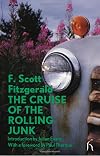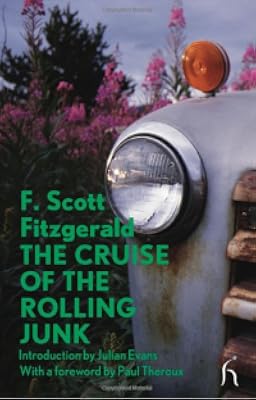
The Cruise of the Rolling Junk
by F. Scott Fitzgerald
On This Page
Description
Tales of Scott and Zelda roadtripping, finally back in print In an early series of journalistic pieces for Motor magazine, F. Scott Fitzgerald described a journey he took with his wife Zelda from Connecticut to Alabama in a clapped out automobile which he called the "Rolling Junk." It is a piece of writing whose style, in free-ranging alternation of fact and fiction, has been compared to Jerome K. Jerome's Three Men in a Boat. This book collects together the articles as one text, show more illustrated with the original illustrations of Fitzgerald, Zelda, and the "Junk." show lessTags
Recommendations



























Member Reviews
I couldn't help notice the familiarity of images that seem to lay the groundwork for The Great Gatsby. Each mention of "Dr. Jones's Guide Book" and I couldn't shake the image of the "eyes of Dr. T.J. Eckleburg" on the billboard opposite the Wilson's garage. Elements of the character of Daisy Buchanan can be glimpsed in Fitzgerald's portrayal of Zelda driving and skiving. It is a fascinating account of the beginnings of the golden age of the automobile. Regrettable that it sold for a pittance yet that it did reflects Fitzgerald's own sense of self that provides a constant foil to Hemingway's boastfulness. I cannot see how these two author's can truly exist without each other. In many ways they present two different outcomes for the same show more tortured soul. The Cruise of the Rolling Junk" is frivolity at its finest, yet one catches a glimpse of the pending tragic outcome. It may be years in the making, but it is there nonetheless, like a self-fulfilling prophecy. This novella is difficult to put down and you will read it with the same energy that propels them toward Alabama. show less
This is a wondeful little book brought out by Hesperus and certainly lives up to their ethos of bringing back into print short/lost works. As usual it's beautifully produced and the contents are wonderful. The tale could the subtitled "The Adventures of Scott and Zelda in a Rubbish Car" and the writing is humourous but also very moving in places. The descriptions of driving through American to the South are lovely and the pictures of Scott and Zelda used to illustrate are wonderful (though a little dark in the printing which is my only quibble).
There is a very informative introduction (as with all Hesperus books) though I could do with a little less of the apologising for politically non-correct elements. I've noticed this also in show more forewords to Virginia Woolf volumes they publish and surely they over-labour the point. We know these people were writing when attitudes were wrong and their views reflect the culture they come from. But surely as readers we are intelligent enough to allow for this and simply enjoy the works without all the carping?
But enough of that - this is a wonderful read by a wonderful author and highly recommended. show less
There is a very informative introduction (as with all Hesperus books) though I could do with a little less of the apologising for politically non-correct elements. I've noticed this also in show more forewords to Virginia Woolf volumes they publish and surely they over-labour the point. We know these people were writing when attitudes were wrong and their views reflect the culture they come from. But surely as readers we are intelligent enough to allow for this and simply enjoy the works without all the carping?
But enough of that - this is a wonderful read by a wonderful author and highly recommended. show less
A very nice novelette based on the Fitzgeralds' 1920 honeymoon trip. I gotta say, it was great reading some mature and restrained Scott Fitzgerald again, after mucking through The Beautiful and the Damned for a year and still mucking through it. There are (four) things that I'd like to mention about this work. (1) Fitzgerald was at his best when he wasn't trying to dazzle his readers with everything and kitchen sink, but with a restrained observing eye, and some hilarious interruptions in narrative. Some of his passages were just like precious jewels that I wanted pluck out and make my own, but no, it cannot be. (2) I can't stand the character/non-character of F. Scott Fitzgerald. He's such a dandy. He's such a weakling!
He's like Niles show more Crane from (Frasier)!
True, Zelda Fitzgerald is no Maris Crane—rare photos of this most exotic and most-in-demand flightless Alabamian bird have been included in the book, she remains an elusive character despite Fitzgerald's numerous attempts to capture her in the text. (3) There is absolutely no way to predict from this text how badly we (in the grand year of two-aught-twelve) will know how they wind up. (4) Finally, this book was on the whole, funny and satisfying.
T'was a treat to read
For those in the know
Of these
Those damned
Fitzgeralds. © ;)
[One thumb up!] show less
He's like Niles show more Crane from (Frasier)!
True, Zelda Fitzgerald is no Maris Crane—rare photos of this most exotic and most-in-demand flightless Alabamian bird have been included in the book, she remains an elusive character despite Fitzgerald's numerous attempts to capture her in the text. (3) There is absolutely no way to predict from this text how badly we (in the grand year of two-aught-twelve) will know how they wind up. (4) Finally, this book was on the whole, funny and satisfying.
T'was a treat to read
For those in the know
Of these
Those damned
Fitzgeralds. © ;)
[One thumb up!] show less
Ratings
Members
- Recently Added By
Published Reviews
"Though verging on mawkish, Fitzgerald's observation anticipates the deep romanticism that comes to maturity in Gatsby: the ambivalent attitude to the past; the desire, innate and imperfect, for not only the antebellum world, but the impossible future which Gatsby strains to see."
added by GYKM
Author Information

634+ Works 143,154 Members
F(rancis) Scott Fitzgerald was born in St. Paul, Minnesota, on September 24, 1896. He was educated at Princeton University and served in the U.S. Army from 1917 to 1919, attaining the rank of second lieutenant. In 1920 Fitzgerald married Zelda Sayre, a young woman of the upper class, and they had a daughter, Frances. Fitzgerald is regarded as one show more of the finest American writers of the 20th Century. His most notable work was the novel, The Great Gatsby (1925). The novel focused on the themes of the Roaring Twenties and of the loss of innocence and ethics among the nouveau riche. He also made many contributions to American literature in the form of short stories, plays, poetry, music, and letters. Ernest Hemingway, who was greatly influenced by Fitzgerald's short stories, wrote that Fitzgerald's talent was "as fine as the dust on a butterfly's wing." Yet during his lifetime Fitzgerald never had a bestselling novel and, toward the end of his life, he worked sporadically as a screenwriter at motion picture studios in Los Angeles. There he contributed to scripts for such popular films as Winter Carnival and Gone with the Wind. Fitzgerald's work is inseparable from the Roaring 20s. Berenice Bobs Her Hair and A Diamond As Big As The Ritz, are two short stories included in his collections, Tales of the Jazz Age and Flappers and Philosophers. His first novel The Beautiful and Damned was flawed but set up Fitzgerald's major themes of the fleeting nature of youthfulness and innocence, unattainable love, and middle-class aspiration for wealth and respectability, derived from his own courtship of Zelda. This Side of Paradise (1920) was Fitzgerald's first unqualified success. Tender Is the Night, a mature look at the excesses of the exuberant 20s, was published in 1934. Much of Fitzgerald's work has been adapted for film, including Tender is the Night , The Great Gatsby, and Babylon Revisited which was adapted as The Last Time I Saw Paris by Metro-Goldwyn-Mayer in 1954. The Last Tycoon, adapted by Paramount in 1976, was a work in progress when Fitzgerald died of a heart attack on December 21, 1940, in Hollywood, California. Fitzgerald is buried in the historic St. Mary's Cemetery in Rockville, Maryland. (Bowker Author Biography) show less
Some Editions
Common Knowledge
- Canonical title
- The Cruise of the Rolling Junk
Classifications
Statistics
- Members
- 87
- Popularity
- 367,926
- Reviews
- 3
- Rating
- (3.92)
- Languages
- 6 — English, French, German, Italian, Portuguese, Spanish
- Media
- Paper, Audiobook, Ebook
- ISBNs
- 12
- ASINs
- 2