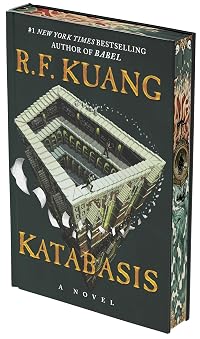
Katabasis
by R. F. Kuang
On This Page
Description
Dante's Inferno meets Susanna Clarke's Piranesi in this all-new dark academia fantasy from R. F. Kuang, the #1 New York Times bestselling author of Babel and Yellowface, in which two graduate students must put aside their rivalry and journey to Hell to save their professor's soul—perhaps at the cost of their own.Katabasis, noun, Ancient Greek:
The story of a hero's descent to the underworld
Alice Law has only ever had one goal: to become one of the brightest minds in the field of Magick. show more She has sacrificed everything to make that a reality: her pride, her health, her love life, and most definitely her sanity. All to work with Professor Jacob Grimes at Cambridge, the greatest magician in the world.
That is, until he dies in a magical accident that could possibly be her fault.
Grimes is now in Hell, and she's going in after him. Because his recommendation could hold her very future in his now incorporeal hands and even death is not going to stop the pursuit of her dreams....
Nor will the fact that her rival, Peter Murdoch, has come to the very same conclusion.
With nothing but the tales of Orpheus and Dante to guide them, enough chalk to draw the Pentagrams necessary for their spells, and the burning desire to make all the academic trauma mean anything, they set off across Hell to save a man they don't even like.
But Hell is not like the storybooks say, Magick isn't always the answer, and there's something in Alice and Peter's past that could forge them into the perfect allies...or lead to their doom.
. show less
Tags
Recommendations




Member Reviews
Alice Law is a driven, highly competitive PhD. candidate. Unfortunately, her advisor, Dr. Jacob Grimes has unexpectedly died and this might have negative repercussions on Alice’s finalizing of her thesis and professional status. So Alice has decided that she is going to go down into hell and bring her advisor back from the dead. Based on her studies, this will likely involve visiting each of Dante’s eight courts. She isn’t sure whether she’ll find Grimes in Pride, Desire, or Greed, but she has no intention of failing in this particular quest. As it happens, despite her own preference and careful planning, at the last minute she is accompanied by a second Grimes advisee, Peter Murdoch. Making one’s way through Hell is not show more simple and the two have many adventures before the novel’s end.
There are plenty of allusions in Katabasis. Having gotten through Katabasis once, my immediate reaction is to sit down and go through it again. Just as Gaiman’s American Gods challenged the reader to recognize references to folklore and mythology, so Kuang’s book challenges us to consider ideas and their nuances regarding Death and Judgement. There are many considerations. As noted in the text: “if you’re guilty of wrath, do you necessarily need to be punished for pride? Does greed entail desire? Is it all a nesting doll of wrongdoing, or can you skip over some…” Kuang touches on a multitude of cultural and theological assumptions about the afterlife.
In my view this is the primary reason behind her writing Katabasis. While the world-building here is solid, Kuang wants her protagonists to wrestle with the Big Questions the way that serious scholars do. (Back in time, the question of how many angels could dance on the head of a pin was in fact a serious point of contention. Only in the modern world, do we see it as a meaningless concern.) Kuang essentially enters into a conversation with Dante, with Virgil, with T.S. Eliot and others about the experience of Hell.
There are parts of Katabasis that are bleak. Hell can be a desert; it can be an Escher staircase. Other parts are humorous. There were one or two segments that I found horrific. By book’s end, she has taken the reader on a very thorough tour of Hell.
The marketing pitch for this book was mixed. At the highest level, the market viewed it as being fantasy because, after all, who actually believes in Hell?There were hints that it was a romance, a love story where opposites attract. It was described as dark academe and certainly, Kuang has no love for the traditional process followed in gaining a PhD. While each of those descriptions has validity, Katabasis is not froth. One can read it that way, but you’ll be missing a lot of Kuang’s intent if you settle for that. show less
There are plenty of allusions in Katabasis. Having gotten through Katabasis once, my immediate reaction is to sit down and go through it again. Just as Gaiman’s American Gods challenged the reader to recognize references to folklore and mythology, so Kuang’s book challenges us to consider ideas and their nuances regarding Death and Judgement. There are many considerations. As noted in the text: “if you’re guilty of wrath, do you necessarily need to be punished for pride? Does greed entail desire? Is it all a nesting doll of wrongdoing, or can you skip over some…” Kuang touches on a multitude of cultural and theological assumptions about the afterlife.
In my view this is the primary reason behind her writing Katabasis. While the world-building here is solid, Kuang wants her protagonists to wrestle with the Big Questions the way that serious scholars do. (Back in time, the question of how many angels could dance on the head of a pin was in fact a serious point of contention. Only in the modern world, do we see it as a meaningless concern.) Kuang essentially enters into a conversation with Dante, with Virgil, with T.S. Eliot and others about the experience of Hell.
There are parts of Katabasis that are bleak. Hell can be a desert; it can be an Escher staircase. Other parts are humorous. There were one or two segments that I found horrific. By book’s end, she has taken the reader on a very thorough tour of Hell.
The marketing pitch for this book was mixed. At the highest level, the market viewed it as being fantasy because, after all, who actually believes in Hell?There were hints that it was a romance, a love story where opposites attract. It was described as dark academe and certainly, Kuang has no love for the traditional process followed in gaining a PhD. While each of those descriptions has validity, Katabasis is not froth. One can read it that way, but you’ll be missing a lot of Kuang’s intent if you settle for that. show less
When Alice Law and Peter Murdoch's doctoral supervisor is killed by a spell, the two postgraduates feel they have no choice but to go to Hell to retrieve his soul so they can finish their degrees. As two students of analytic magic, getting to Hell is the easy part. Once there they'll discover that the greatest trials in Hell may not be the various courts but ones of their own making.
Kuang is a brilliant writer and she shines so brightly here. While the novel starts in a place of "academia is Hell," which is already an excellent premise, she then dives into a character study that touches on mental health and depression, the power of memory, our inability to truly understand another person, and ultimately what makes a person want to keep show more living. And yet while delving into these themes she also writes a compelling plot and creates a fascinating world in Hell that is influenced by multiple cultural visions of the underworld. An emotionally demanding read, it was one I ultimately found rewarding. Recommended for those who are in or have survived university (particularly graduate and postgraduate programs) and/or those who have always been fascinated by tales of the underworld whether in ancient myths, Dante, or elsewhere. show less
Kuang is a brilliant writer and she shines so brightly here. While the novel starts in a place of "academia is Hell," which is already an excellent premise, she then dives into a character study that touches on mental health and depression, the power of memory, our inability to truly understand another person, and ultimately what makes a person want to keep show more living. And yet while delving into these themes she also writes a compelling plot and creates a fascinating world in Hell that is influenced by multiple cultural visions of the underworld. An emotionally demanding read, it was one I ultimately found rewarding. Recommended for those who are in or have survived university (particularly graduate and postgraduate programs) and/or those who have always been fascinated by tales of the underworld whether in ancient myths, Dante, or elsewhere. show less
I remember being curious about Kuang’s first fantasy novel but whatever I read about it led me to conclude that the book sounded a bit too dark for my taste, and any details I gleaned over the years about her subsequent novels did not encourage me to reconsider.
Last year I kept scrolling past discussions about people’s reactions to Katabasis. I had absolutely no intention of reading about two Cambridge PhD students journeying into hell to retrieve their advisor’s soul, for all that it’s a fantasy novel about academia, so I was not paying too much attention to these discussions. Neither was I trying to avoid spoilers.
I actually didn’t encounter any spoilers. But I started noticing a theme. People who liked the novel said it show more was a love story. And people who didn’t objected to the academic tone of the worldbuilding. After a while, it occurred to me that that probably wasn’t something I’d object to.
So I looked at the opening chapters on Libby and after the line about how Alice’s preparation for journeying into Hell had included consulting The Waste Land, I was sold. And by sold, I mean I put the book on hold and then waited months and months to borrow it. (I wasn’t actually sold-sold until I was a third of the way through – that was when I bought it.)
I absolutely loved this book!
I love how the story develops. At first, there were things I didn’t know (even if Alice did) and also things that Alice didn’t know yet, and the way these are revealed and explained throughout the book was compelling.
I liked the prose. I loved the intertextuality and the fact that, even though Alice’s field of study (analytic magick) does not exist in my world, Alice’s research involves literary works that were discussed and referenced in my university classes (because, for Alice, these texts are not purely fictional). It took me a long time to wonder if Alice’s name is an intentional nod to Alice’s Adventures in Wonderland but whether or not this is intentional, the novel allows one to ponder these types of parallels and allusions and I love that.
I quickly became invested in Alice and Peter’s relationship, even before I knew them and their backstory fully.
I loved how, even though this story is set in Hell, so much of the book manages to actually be about academia – because there are lots of flashbacks and references to Alice’s experiences at university, and the different Courts of Hell mimic and distort different aspects of academia. I’ve never pursued a PhD and my uni experience was different from Alice’s in many, many ways, but some of the things she says about the stress of academia are very relatable.
I didn’t enjoy some of the later chapters so much. I thought it was most likely that the book was still heading for an ending I’d find satisfying but I wasn’t completely sure and that was a bit stressful. But then I loved the ending, even more than I’d expected to.
It has occurred to me that quite a few of my favourite books involve trying to save someone’s soul from Hell. Usually trying to save them before they end up in Hell (e.g. most Tam Lin retellings) but I still came away reflecting that Katabasis is, if not directly in conversation with those particular books, then at least in conversation about many of the same topics as those books. It’s a “This book should be friends with that book!” sort of feeling.
Katabasis is not perfectly to my tastes in absolutely everything, and not only because of those later chapters I mentioned. But it came close.
Last year I kept scrolling past discussions about people’s reactions to Katabasis. I had absolutely no intention of reading about two Cambridge PhD students journeying into hell to retrieve their advisor’s soul, for all that it’s a fantasy novel about academia, so I was not paying too much attention to these discussions. Neither was I trying to avoid spoilers.
I actually didn’t encounter any spoilers. But I started noticing a theme. People who liked the novel said it show more was a love story. And people who didn’t objected to the academic tone of the worldbuilding. After a while, it occurred to me that that probably wasn’t something I’d object to.
So I looked at the opening chapters on Libby and after the line about how Alice’s preparation for journeying into Hell had included consulting The Waste Land, I was sold. And by sold, I mean I put the book on hold and then waited months and months to borrow it. (I wasn’t actually sold-sold until I was a third of the way through – that was when I bought it.)
I absolutely loved this book!
I love how the story develops. At first, there were things I didn’t know (even if Alice did) and also things that Alice didn’t know yet, and the way these are revealed and explained throughout the book was compelling.
I liked the prose. I loved the intertextuality and the fact that, even though Alice’s field of study (analytic magick) does not exist in my world, Alice’s research involves literary works that were discussed and referenced in my university classes (because, for Alice, these texts are not purely fictional). It took me a long time to wonder if Alice’s name is an intentional nod to Alice’s Adventures in Wonderland but whether or not this is intentional, the novel allows one to ponder these types of parallels and allusions and I love that.
I quickly became invested in Alice and Peter’s relationship, even before I knew them and their backstory fully.
I loved how, even though this story is set in Hell, so much of the book manages to actually be about academia – because there are lots of flashbacks and references to Alice’s experiences at university, and the different Courts of Hell mimic and distort different aspects of academia. I’ve never pursued a PhD and my uni experience was different from Alice’s in many, many ways, but some of the things she says about the stress of academia are very relatable.
“We only need to get down,” she told Peter. For one of them had to keep the cheer; one of them had to be delusional. This was the key to flourishing in graduate school. You could do anything if you were delusional. “I’m sure it’s very nice below.”I loved how there is a lot of very pointed and very nuanced commentary about the problems within academia, but at the same time, the novel also vividly captures why Alice and Peter are passionate about their studies.
I didn’t enjoy some of the later chapters so much. I thought it was most likely that the book was still heading for an ending I’d find satisfying but I wasn’t completely sure and that was a bit stressful. But then I loved the ending, even more than I’d expected to.
It has occurred to me that quite a few of my favourite books involve trying to save someone’s soul from Hell. Usually trying to save them before they end up in Hell (e.g. most Tam Lin retellings) but I still came away reflecting that Katabasis is, if not directly in conversation with those particular books, then at least in conversation about many of the same topics as those books. It’s a “This book should be friends with that book!” sort of feeling.
Katabasis is not perfectly to my tastes in absolutely everything, and not only because of those later chapters I mentioned. But it came close.
Over the past month she had become a self-taught expert in Tartarology, which was not one of her subfields. These days it was not anyone’s subfield, as Tartarologists rarely survived to publish their work. Since Professor Grimes’s demise she had spent her every waking moment reading every monograph, paper, and shred of correspondence she could find on the journey to Hell and back. At least a dozen scholars had made the trip and lived to credibly tell the tale, but very few in the past century. All existing sources were unreliable to different degrees and devilishly tricky to translate besides. Dante’s account was so distracted with spiteful potshots that the reportage got lost within. T.S. Eliot had supplied some of the more recent and detailed landscape descriptions on record, but The Waste Land was so self-referential that its status as a sojourner’s account was under serious dispute. dispute. Orpheus’s notes, already in archaic Greek, were largely in shreds like the rest of him. And Aeneas—well, that was all Roman propaganda. Possibly there were more accounts in lesser-known languages—Alice could have spent decades poring through the archives—but her funding clock could not wait. Her progress review loomed at the end of the term, and without a living and breathing advisor, the best Alice could hope for was an extension of funding sufficient to last until she transferred elsewhere and found a new advisor.
But she didn’t want to transfer elsewhere, she wanted a Cambridge degree. And she didn’t want any advisor, she wanted Professor Jacob Grimes, department chair, Nobel Prize laureate, and twice-elected president of the Royal Academy of Magick.
And she had a volume of Proust, in case at night she ever got bored. (To be honest she had never gotten round to trying Proust, but Cambridge had made her the kind of person who wanted to have read Proust, and she figured Hell was a good place to start.)
Truly this was top-notch scholarship. When Alice really thought about it, this was the worst thing that Professor Grimes had ever done to her—made her doubt she was a good scholar. He’d destroyed her faith in her own ability to think, and to judge the results of her thought, instead of turning to him at every step for confirmation. And it was just so unfortunate that it took his death for her to conceive, research, and carry out an entire project on her own.show less
This is mythological dark academia on an epic scale. It pulls from all kinds of myths and legends about descent into hell, the domains you travel through, the puzzles and bargains required to claw your way back. I first fell in love with Babel, then felt thrown off by the lit-fic turn in Yellowface, so I was excited to get back to Kuang’s writing in this domain. So much of this story hit too close to home. I’m nearly five years out from my PhD, and honestly, some parts didn’t feel like fantastical exaggeration at all. I savoured this book, I cried for Alice and Peter, for the guilt and dashed dreams, the moments of hope and relief, and everything in between. We’ve all lived through our own little hells, and it meant something to show more see that reflected on the page. Also, turns out molecular biology and magick aren’t so different after all. My biggest complaint is predictable: it dragged. At over 500 pages, of course it felt epic, but it also felt padded in places. I braced myself to hate Alice, having seen early complaints about how insufferable it was to live in her head. But I couldn’t. I didn’t love her either, but so much of what made her frustrating lives in me too, the desperation to succeed paired with the fear of not being good enough, that swing between drive and despair. I basically cried through the last 30 pages for every possible reason. I’d recommend this book widely, though maybe not to anyone currently slogging through a PhD. Save it for after your defense. show less
Katabasis — from the ancient Greek for "descent into the underworld" — is set in 1980s Cambridge, in a world where analytic magick is an elite, punishing academic discipline, spells drawn with chalk pentagrams and powered by logical paradoxes. Alice Law has sacrificed everything — her health, her relationships, her sanity — for one goal: to be one of the greatest magicians of her generation, working under Professor Jacob Grimes, the most influential analytick magician in England. Then a magical accident in the lab that may be Alice's fault kills Grimes, sending his soul to Hell. With his letters of recommendation still in his now-incorporeal hands and her entire future on the line, Alice draws her pentagram, strikes a brutal show more bargain — half her remaining life for passage — and descends.
She is immediately joined, uninvited, by Peter Murdoch: smug, brilliant, infuriating, her fiercest academic rival, who has his own private reasons for wanting Grimes back. Hell is structured into eight Courts — Pride, Desire, Greed, Wrath, Violence, Cruelty, Tyranny, and a mysterious Eighth — and each one mirrors the moral universe they came from. Pride is a chilly library demanding scholars define The Good in an exam that never ends. Desire is a student center. Alongside bone-creature monsters, a terrifying faction called the Kripkes who can annihilate even the spirits of the dead, and an unexpected ally in Elspeth — a long-dead grad student now ferrying souls across the River Lethe — there is also a cat named Archimedes. The novel Kuang considers a dark academic duology with Babel. Debuted #1 in the US, UK, Canada simultaneously. Amazon MGM television adaptation already in development.
[May contain spoilers]
The revelations about Alice and Peter's pasts in the second half are where the novel truly ignites — both characters are deeply, genuinely flawed in ways that reframe the entire quest. Grimes himself is not the great man Alice believed him to be — the mentor worship the novel has been quietly dismantling throughout the descent culminates in a reckoning with what Alice has actually been chasing and what it has cost her. The ending is cathartic rather than triumphant — Grimes is essentially damned by his own choices while Alice and Peter choose each other and life over prestige. Peter is based on Kuang's own husband.
What I think: This is ambitious, dense, and fiercely intelligent dark academia fantasy — the first half is a deliberate slog for some readers due to heavy philosophical exposition, but the second half pays off hard. show less
She is immediately joined, uninvited, by Peter Murdoch: smug, brilliant, infuriating, her fiercest academic rival, who has his own private reasons for wanting Grimes back. Hell is structured into eight Courts — Pride, Desire, Greed, Wrath, Violence, Cruelty, Tyranny, and a mysterious Eighth — and each one mirrors the moral universe they came from. Pride is a chilly library demanding scholars define The Good in an exam that never ends. Desire is a student center. Alongside bone-creature monsters, a terrifying faction called the Kripkes who can annihilate even the spirits of the dead, and an unexpected ally in Elspeth — a long-dead grad student now ferrying souls across the River Lethe — there is also a cat named Archimedes. The novel Kuang considers a dark academic duology with Babel. Debuted #1 in the US, UK, Canada simultaneously. Amazon MGM television adaptation already in development.
[May contain spoilers]
The revelations about Alice and Peter's pasts in the second half are where the novel truly ignites — both characters are deeply, genuinely flawed in ways that reframe the entire quest. Grimes himself is not the great man Alice believed him to be — the mentor worship the novel has been quietly dismantling throughout the descent culminates in a reckoning with what Alice has actually been chasing and what it has cost her. The ending is cathartic rather than triumphant — Grimes is essentially damned by his own choices while Alice and Peter choose each other and life over prestige. Peter is based on Kuang's own husband.
What I think: This is ambitious, dense, and fiercely intelligent dark academia fantasy — the first half is a deliberate slog for some readers due to heavy philosophical exposition, but the second half pays off hard. show less
Summary: Two graduate students studying Magick follow their deceased advisor on a journey through Hell, struggling to trust each other.
Katabasis. The word refers to a descent into the underworld, a theme in mythology from the Odyssey and Aeneid to Ovid and Dante. In fact, just about every culture has its katabasis myths. And now R. F. kuang has given us one for dark academia in a post-post-modern twenty-first century.
The story, in brief, is about two doctoral students studying Magick at Cambridge, Alice Law and Peter Murdoch. Both work under Jacob Grimes, by many estimates, the greatest magician in academia. But he is not a nice man–manipulative and brutal, and many have dropped out. Murdoch and Law are determined not to, and are show more rivals. That is until an accident with a pentagram drawn by Alice rips his body apart and sends him to Hell.
The real disaster here is the loss of an advisor, which can mean starting over. Not only that, a recommendation from Grimes held the key to their futures, futures they had worked so hard to achieve. That is why they are willing to forfeit half of their life span to gain entrance to hell. Somehow, they hope to find Grimes and restore him to the upper world, at least long enough for those coveted degrees and recommendations. And the spell they use works to get them into Hell.
This novel is many things in one. Perhaps the dominant one is that it is an academic satire. Hell, as it appears to them is an academic campus. And it is one that reveals all the pretensions and petty rivalries of academia. For example, the first level, Pride, is not unlike a research library, with its inhabitants competing to compose theses that will allow them to move on, and perhaps across the River Lethe. But no one knows of any who have succeeded despite all the latest theories.
It’s also an adventure. Throughout the narrative, Alice and Peter are pursued by bony creatures energized by the Kripkes, extremely clever magicians who never made it in the academic world but were wildly successful in popular culture. Then there are others, like the Weaver Girl, who tests their loyalty to each other through posing them a Prisoner’s Dilemma challenge.
That challenge raises another aspect of the book. Kuang’s characters survive not merely by their wits and magical training. Throughout, they draw upon logic, philosophy, as well as a crash course in the mythology of the underworld. If you like intellectual puzzles, you will enjoy this.
The Prisoner’s Dilemma, exposes another element–their trust in one another. Alice discovers in some of Peter’s papers that it looks like he is prepared to sacrifice Alice to retrieve Grimes. And there is a long history to their rivalry, including a compromising moment between Alice and Grimes, witnessed by Murdoch. Everything seemed to come easy for him while Alice would grind away.
Finally, while many of Hell’s inhabitants seem oblivious to their sins, the journey lays bare those of Alice. She comes face to face with the overweening ambition behind her relentless pursuit of her degree–an ambition revealed in a willingness to harm others for her own ends.
Kuang portrays a Hell without a God or paradise, only a King Yama, on which their hope of return hinges. But the irony is that in the end, survival will depend on grace of a sort.
So what did I think? Having worked in college ministry with grad students and professors, Kuang’s satire of their pretensions as well as the portrayals of the delights of the life of the mind seemed spot on. As in the Poppy Wars trilogy, Kuang is a world builder. She has added to the mythology of the geography of Hell. Most of all, she explores flawed, fallen human nature, and our blindness to our flaws. And we watch her lead character grope toward the realization that in the end, the greatest virtue is love. But we wonder if she will learn in time. show less
Katabasis. The word refers to a descent into the underworld, a theme in mythology from the Odyssey and Aeneid to Ovid and Dante. In fact, just about every culture has its katabasis myths. And now R. F. kuang has given us one for dark academia in a post-post-modern twenty-first century.
The story, in brief, is about two doctoral students studying Magick at Cambridge, Alice Law and Peter Murdoch. Both work under Jacob Grimes, by many estimates, the greatest magician in academia. But he is not a nice man–manipulative and brutal, and many have dropped out. Murdoch and Law are determined not to, and are show more rivals. That is until an accident with a pentagram drawn by Alice rips his body apart and sends him to Hell.
The real disaster here is the loss of an advisor, which can mean starting over. Not only that, a recommendation from Grimes held the key to their futures, futures they had worked so hard to achieve. That is why they are willing to forfeit half of their life span to gain entrance to hell. Somehow, they hope to find Grimes and restore him to the upper world, at least long enough for those coveted degrees and recommendations. And the spell they use works to get them into Hell.
This novel is many things in one. Perhaps the dominant one is that it is an academic satire. Hell, as it appears to them is an academic campus. And it is one that reveals all the pretensions and petty rivalries of academia. For example, the first level, Pride, is not unlike a research library, with its inhabitants competing to compose theses that will allow them to move on, and perhaps across the River Lethe. But no one knows of any who have succeeded despite all the latest theories.
It’s also an adventure. Throughout the narrative, Alice and Peter are pursued by bony creatures energized by the Kripkes, extremely clever magicians who never made it in the academic world but were wildly successful in popular culture. Then there are others, like the Weaver Girl, who tests their loyalty to each other through posing them a Prisoner’s Dilemma challenge.
That challenge raises another aspect of the book. Kuang’s characters survive not merely by their wits and magical training. Throughout, they draw upon logic, philosophy, as well as a crash course in the mythology of the underworld. If you like intellectual puzzles, you will enjoy this.
The Prisoner’s Dilemma, exposes another element–their trust in one another. Alice discovers in some of Peter’s papers that it looks like he is prepared to sacrifice Alice to retrieve Grimes. And there is a long history to their rivalry, including a compromising moment between Alice and Grimes, witnessed by Murdoch. Everything seemed to come easy for him while Alice would grind away.
Finally, while many of Hell’s inhabitants seem oblivious to their sins, the journey lays bare those of Alice. She comes face to face with the overweening ambition behind her relentless pursuit of her degree–an ambition revealed in a willingness to harm others for her own ends.
Kuang portrays a Hell without a God or paradise, only a King Yama, on which their hope of return hinges. But the irony is that in the end, survival will depend on grace of a sort.
So what did I think? Having worked in college ministry with grad students and professors, Kuang’s satire of their pretensions as well as the portrayals of the delights of the life of the mind seemed spot on. As in the Poppy Wars trilogy, Kuang is a world builder. She has added to the mythology of the geography of Hell. Most of all, she explores flawed, fallen human nature, and our blindness to our flaws. And we watch her lead character grope toward the realization that in the end, the greatest virtue is love. But we wonder if she will learn in time. show less
Two Cambridge graduate students of magic send themselves to Hell to resurrect their advisor, not because they love him but because they need him to complete their degrees on time. Katabasis is much better than such an elevator pitch makes it sound.
It is erudite, satirical, and often moving. Since R. F. Kuang and her husband are both graduate students (East Asian Languages for her and Immanuel Kant for him), it is also eerily autobiographical.
The humor will remind you of Dante. Alice does not get Virgil to take her through, but a shade named Gradus—an allusion to the Latin tag Gradus ad Parnassum and a joke about the nature of education. Almost everyone Alice and Peter meet is involved in scholarship. One poor gaggle of students show more stands, dissertations in hand, afraid to submit them for fear one typo will get them rejected.
Enjoy the trip and find out if Gradus is a reliable guide and if love can survive the academic underworld. show less
It is erudite, satirical, and often moving. Since R. F. Kuang and her husband are both graduate students (East Asian Languages for her and Immanuel Kant for him), it is also eerily autobiographical.
The humor will remind you of Dante. Alice does not get Virgil to take her through, but a shade named Gradus—an allusion to the Latin tag Gradus ad Parnassum and a joke about the nature of education. Almost everyone Alice and Peter meet is involved in scholarship. One poor gaggle of students show more stands, dissertations in hand, afraid to submit them for fear one typo will get them rejected.
Enjoy the trip and find out if Gradus is a reliable guide and if love can survive the academic underworld. show less
Members
- Recently Added By
Lists

LoanStars | Adult List: August 2025
10 works; 1 member

Books Read in 2025
4,128 works; 98 members

READ 2025
190 works; 1 member

Fall 2025 reading
10 works; 1 member

2026 Hugo Awards -- Eligible Works -- Novels
18 works; 2 members

2026 Tournament of Books Longlist
70 works; 2 members

Top Five Books of 2025
954 works; 303 members

Books Read in 2026
1,993 works; 67 members

2026 Tournament of Books
18 works; 4 members
Author Information

18+ Works 35,247 Members
Some Editions
Awards and Honors
Awards
Distinctions
Common Knowledge
- Canonical title
- Katabasis
- Original title
- Katabasis
- Original publication date
- 2025-08-26
- People/Characters
- Alice Law; Professor Jacob Grimes; Peter Murdoch
- Important places
- Cambridge, Cambridgeshire, England, UK; Hell; Limbo
- Dedication
- To Bennett, brilliant, beloved
- First words
- Cambridge, Michaelmas Term, October. The wind bit, the sun hid, and on the first day of class, when she ought to have been lecturing undergraduates about the dangers of using the Cartesian severance spell to revise without pe... (show all)e breaks, Alice Law set out to rescue her advisor's soul from the Eight Courts of Hell.
- Last words
- (Click to show. Warning: May contain spoilers.)And together they emerged, to rebehold the stars.
- Blurbers
- Bardugo, Leigh; Ross, Rebecca; Blake, Olivie; Patel, Vaishnavi; Brown, Gareth; Chakraborty, Shannon (show all 7); Roanhorse, Rebecca
Classifications
Statistics
- Members
- 3,750
- Popularity
- 4,429
- Reviews
- 62
- Rating
- (3.80)
- Languages
- 12 — Chinese, Dutch, English, Finnish, French, German, Italian, Polish, Portuguese, Spanish, Swedish, Turkish
- Media
- Paper, Audiobook, Ebook
- ISBNs
- 40
- ASINs
- 14