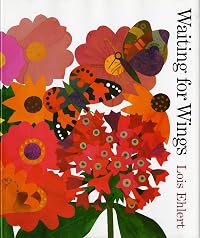
Waiting for Wings
by Lois Ehlert
On This Page
Description
Illustrates the life cycle of four common butterflies by featuring butterfly and flower facts, butterfly identification tips, and a guide to creating a butterfly garden.Tags
Recommendations




Member Reviews
Butterflies lay eggs on various plants. Little caterpillars hatch and grow, then spin chrysalises, emerge as butterflies and search for nectar to eat.
This is a rhyming book about the life cycle of the butterfly. The book itself is fairly simple, not going into detail about the anatomy of various stages of the life cycle. However, at the end of the book there are several pages of different butterflies and moths next to their corresponding caterpillar and chrysalis along with their favorite food. I like this book paired with some observation time out in nature. It can be a fun, quick read or you can use it for an in depth lesson. I also love the collage style of the illustrations.
This is a rhyming book about the life cycle of the butterfly. The book itself is fairly simple, not going into detail about the anatomy of various stages of the life cycle. However, at the end of the book there are several pages of different butterflies and moths next to their corresponding caterpillar and chrysalis along with their favorite food. I like this book paired with some observation time out in nature. It can be a fun, quick read or you can use it for an in depth lesson. I also love the collage style of the illustrations.
8. I enjoyed reading the book “Waiting for Wings” by Lois Ehlert. The first thing I liked about this book was that is very visually appealing and that entire pages were covered in bright pink and orange colors of butterflies and flowers. One textual feature that was interesting was that between the larger pages with illustrations on them were smaller pages that included both illustrations and text. The language is clear and descriptive, including information about how butterflies eat and where they live, while also including very large text, suitable for younger readers. At the end of the story, the book includes a vast amount of information about the different types of butterflies and flowers illustrated in the book, labeled show more pictures, and information on growing a butterfly garden. This book pushed children to think about the lifestyle and needs of other organisms in the environment besides themselves. It includes information on how to create and tend to a butterfly garden, which could also be helpful to developing children’s awareness of environmental responsibility. The main message of this book is to inform children of different types of flowers and butterflies, along with providing them with ways in which they can become more involved in their environment. show less
A very informative read on the caterpillar's journey to becoming a butterfly. This book has uneven pages that I love! It gives the book a bit of flare! At the end of the book you can look at the different types of butterflies and flowers. This helps tie this book into a science lesson or maybe an art lesson to draw a butterfly! The possibilities are endless.
Great book to talk about the lifecycle of butterflies. Lots of rhyme and vocabulary for children to learn. Not to mention beautiful illustration and clever, different sized paging!
We actually find Lois Ehlert to be kind of hit and miss for us, in spite of her popularity. I think that sometimes her color palatte is a little dark for us. This book, however, is one of our favorites. We love the book within a book design and the die cut pages.
I was already an Ehlert fan I feel so much closer to her work now. Waiting for Wings is a particularly lovely book -- and very cleverly constructed. The illustrations are just saturated with rich, vibrant color -- perfect for a book about flowers and butterflies! At the end of the book Ehlert takes care to identify all of the butterflies and flowers in the book. She even tells how to plant your own butterfly garden.
Lois Elhert’s book, “Waiting for Wings,” is a fun, colorful, engaging book that I really liked reading. The main purpose of this book was to introduce and inform the reader about the life cycle of four different butterflies, provide the reader with information about different flowers, and show the reader ways he or she can be more involved in the environment. To convey these messages, the author used text elements, such as word choice, text style, rhyming, illustrations, labels, and references.
The word choice that the author used made this book very engaging and easy to following along with. The author used language that was very clear and descriptive, which helps the reader to better understand what the important information show more was. Each page also had a very small amount of text that was printed largely. This gave the reader the opportunity to comprehend the content without being overwhelmed with too much information and losing interest. The size of the text also serves to catch the reader’s eye, keeping him or her engaged. Furthermore, the author also decided to have the story’s text rhyme between pages. For example, the sentence on one page rhymed with the sentence that was on the previous page. This gave the book a nice pace and flow, making it easy to follow along with and grasp the information.
Another text element that helped convey the story’s message is the layout of the illustrations. Each page was covered in collages containing bright pink and orange colors with butterflies and flowers included in the illustration. This made the book extremely visually appealing, keeping the reader engaged because the book is enjoyable to read and look it. For example, in between the pages that only contained illustrations, there were pages containing smaller illustrations with text. Lastly, this book includes detailed instructions of how to grow and take care of your own butterfly garden, which really gives the reader an opportunity to reinforce what they’ve learned in the book and expand their knowledge further. The author’s appealing, fun, and easy to read book effectively incorporates text elements, such as word choice, text style, rhyming, labels, and references to fulfill the book’s purpose of introducing and informing the reader about the life cycle of four different butterflies, providing information about different flowers, and showing the reader how he or she can be more involved in the environment. show less
The word choice that the author used made this book very engaging and easy to following along with. The author used language that was very clear and descriptive, which helps the reader to better understand what the important information show more was. Each page also had a very small amount of text that was printed largely. This gave the reader the opportunity to comprehend the content without being overwhelmed with too much information and losing interest. The size of the text also serves to catch the reader’s eye, keeping him or her engaged. Furthermore, the author also decided to have the story’s text rhyme between pages. For example, the sentence on one page rhymed with the sentence that was on the previous page. This gave the book a nice pace and flow, making it easy to follow along with and grasp the information.
Another text element that helped convey the story’s message is the layout of the illustrations. Each page was covered in collages containing bright pink and orange colors with butterflies and flowers included in the illustration. This made the book extremely visually appealing, keeping the reader engaged because the book is enjoyable to read and look it. For example, in between the pages that only contained illustrations, there were pages containing smaller illustrations with text. Lastly, this book includes detailed instructions of how to grow and take care of your own butterfly garden, which really gives the reader an opportunity to reinforce what they’ve learned in the book and expand their knowledge further. The author’s appealing, fun, and easy to read book effectively incorporates text elements, such as word choice, text style, rhyming, labels, and references to fulfill the book’s purpose of introducing and informing the reader about the life cycle of four different butterflies, providing information about different flowers, and showing the reader how he or she can be more involved in the environment. show less
Members
- Recently Added By
Lists

Brightly Beaming Curriculum Books
281 works; 8 members

Storytime
145 works; 2 members
Author Information

48+ Works 32,358 Members
Lois Ehlert was born November 9, 1934, in Beaver Dam, Wisconsin. She is a graduate of the University of Wisconsin, Milwaukee, and the Layton School of Art. She has also worked as an art teacher, freelance illustrator, and designer. She has created 38 books for young reader and is known for her colorful collage artwork. Her work as an author and an show more illustrator has appeared in countless publications and has received numerous awards and honors. In addition to creating books, Ehlert has produced toys, games, clothes for children, posters, brochures, catalogs, and banners. She has received the Caldecott Honor Book, 1989, for Color Zoo, a Publishers Weekly Best Book of the Year for Snowballs, the Booklist Editors' Choice for Cuckoo/Cucú: A Mexican Folktale/Un Cuento Folklórico Mexicano, the IRA Teachers' Choice and NCTE Notable Children's Trade Book in the Language Arts for Feathers for Lunch, the American Library Association Notable Children's Book and Boston Globe-Horn Book Honor Award for Chicka Chicka Boom Boom. The first book that she wrote and illustrated was Growing Vegetable Soup (1987). Some of her other works include Planting a Rainbow (2003), Feathers for Lunch (1996), Snowballs (1999), Leaf Man (2005), Moon Rope/ Un Lazo de Luna (2003), which is based on a Peruvian folktale, and Rrralph (2013), Rain Fish (2016), and Heart to Heart (2017). Lois Ehlert died in Milwaukee, Wisconsin on May 25, 2021. She was 86. (Bowker Author Biography) show less
Awards and Honors
Awards
Distinctions
Notable Lists
Classifications
Statistics
- Members
- 1,616
- Popularity
- 14,032
- Reviews
- 55
- Rating
- (4.15)
- Languages
- Chinese, English
- Media
- Paper, Audiobook, Ebook
- ISBNs
- 23
- ASINs
- 6