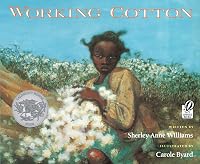
Working Cotton
by Sherley Anne Williams
On This Page
Description
A young black girl relates the daily events of her family's migrant life in the cotton fields of central California.Tags
Recommendations




Member Reviews
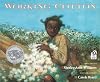
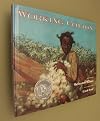
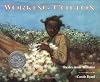
In my opinion, the book, “Working Cotton” is a fantastic historical fiction book that tells children about what it was like to be a slave in the United States. I like this book for three reasons: the plot, the illustrations, and the writing style. The plot engages readers as it tells about a young girl who takes a bus to work in a cotton field everyday with her family. They all leave early in the morning, and they pick cotton all day. At the end of the day, everyone carries a big sack filled with cotton. The writing style of this book is unique. The book is written from the point of view of the young African girl, Shelan. Readers can almost hear her talking because her language is written with errors. This makes it very easy for the show more reader to imagine what she sounds like. She uses a great deal of descriptive language. For example, she says, “We gets to the fields early, before it’s even light. Sometime I still be sleep. It be cold, cold, cold. The field fire send up a gray trail to the hazy sky. Everyone speak in smoky whispers, ‘Don’t get too close to the fire, Shelan’ they tell me.” The illustrations are comprised of bright, beautiful colors. These colors display vibrant tones of orange, blue, and red. The illustrations show the girl and her family picking cotton. The book also shows oversized images of the cotton so that readers can see what cotton looks like when it is ready to be harvested. The big idea of this story is to teach children a little bit about slavery so that they can get an idea of how difficult it was for African children. show less
From sun up till sun down, the life of those who pick cotton in order to eck out a living is told from the perspecitive of a young girl. As she tells the story of her family, this young black girl speaks the venacular of those whom she works with in the field of central California.
It is a difficult experience, and as she tells the story of her family and those who work with them, there is a sense of pride for her family and how very hard they work. In particular, she speaks of her father in such loving terms that show a great deal of respect for the fact that he is able to prouduce so much for his hard work.
The artistry is beautfiful, and this Caldecott winning book allows the reader to feel the pride, the love of family and the strong show more bond they share.">
It is a hard life made special by the bonds and the routine of migrant life.
Highly Recommended.
Four Stars show less
It is a difficult experience, and as she tells the story of her family and those who work with them, there is a sense of pride for her family and how very hard they work. In particular, she speaks of her father in such loving terms that show a great deal of respect for the fact that he is able to prouduce so much for his hard work.
The artistry is beautfiful, and this Caldecott winning book allows the reader to feel the pride, the love of family and the strong show more bond they share.">
It is a hard life made special by the bonds and the routine of migrant life.
Highly Recommended.
Four Stars show less
Working Cotton is a beautiful picture book about a not-so beautiful part of our nation's history. Through the eyes of a little girl, we are shown the day in the life of a slave family who must pick cotton in the fields from dawn to dusk. The voices of the people in this story are very clearly heard as the author, Sherley Anne Williams does an astounding job capturing the diction used by slaves at that time.
I found this to be a bit of a difficult read-not because of the level of reading, but because I felt it almost romanticized cotton picking. I have no real right to say if this was a healthy representation of slavery or not. My ancestors didn't go through such troubles as this and I've never had to deal with discrimination due to my show more race or ethnicity. Still, I was a little bothered by how much the young child seemed to be enjoying helping her family pick cotton. Maybe I missed something? Either way, I have no right to judge whether something is positive black historical representation or not. show less
I found this to be a bit of a difficult read-not because of the level of reading, but because I felt it almost romanticized cotton picking. I have no real right to say if this was a healthy representation of slavery or not. My ancestors didn't go through such troubles as this and I've never had to deal with discrimination due to my show more race or ethnicity. Still, I was a little bothered by how much the young child seemed to be enjoying helping her family pick cotton. Maybe I missed something? Either way, I have no right to judge whether something is positive black historical representation or not. show less
My favorite part about this book is the language. The language used is African American Vernacular English, a dialect of Standard English. Teaching in the Baltimore Area, where there is a prominent African American population, I think this book touches base on two important topics. What African Americans used to do for work many years ago and also how they speak. For example, “Sometimes I still be sleep” is not the usual way some children may say “Sometimes, I may still be asleep.” This book is very useful for introducing AAVE into a classroom. In addition, I think the perspective from the daughter’s point of view is interesting because she is “not big enough to have her own sack, just only to help pile cotton in the middle show more of the row for Momma to put in hers.” This is important because many cotton-picking stories are from the point of view of a full time worker rather than a child who wants to help but cannot. This point of view allows the readers to view all workers as important, worthy, and efficient; whereas many books from the white perspective may view black workers as not worthy or inefficient. Overall, this book is a great way to describe ways in which African Americans made money and how they spoke and speak today. show less
I lived in an area that had a largely agricultural economy for a couple of years, so I've known a number of migrant working children and I completely understand the point this book tries to make. It is fascinating how the migrant farm workers in our country are so often neglected as a source for major concern. I remember riding to school and passing school buses with people sitting and two and three people deep on the seats. At my school, the children of these families would be temporarily enrolled while their family was in the area only to disappear a few months later bound for somewhere to the north or south depending on the season. Even while they were enrolled, they would only come to school sporadically when they weren't needed to show more pick whatever was ripe. The migrant workers that I met were most often Hispanic rather than black as this book depicts and I lived on the east coast rather than the west, but the experience was otherwise a perfect echo of the observations I made during my middle school years. It's about time there was some literature that brought awareness to this unjust lifestyle. It is a unending cycle that will continue as long as no outside intervention brings it to light. show less
I was immediately struck by the beauty of the illustrations. Byard has created a stunning backdrop for the poetic narrative. I generally do not like impressionist style art, but the first adjective I thought of for the visual's (albeit perhaps cliche) was 'cottony'. It looks like the fluffiness of cotton and this effect is captivating in its shading and subtle detailing. The voice of Shelan is distinct and noticeable with her dialect. None of the ability to communicate and understand is taken away because of this poetic/textual choice.
I enjoyed reading this book bcause it was a lot different than the normal everyday children's picture book that I think of. The language used in this book was more of a broken English, as a slave might have spoken, because this story is about a slave family working all day picking cotton. It's told in the perspective of a child, and is surprisingly positive. The child is in awe of the hard work his dad does, and wants to be helpful. It shows a small window into the lives of slaves in America. I think more people should read more about this time in history.
Members
- Recently Added By
Lists

Caldecott Honor Books
296 works; 23 members

Books Read in 2023
5,638 works; 147 members
Author Information

6+ Works 1,099 Members
Awards and Honors
Awards
Common Knowledge
- Original publication date
- 1992
Classifications
Statistics
- Members
- 705
- Popularity
- 40,562
- Reviews
- 38
- Rating
- (3.81)
- Languages
- Chinese, English
- Media
- Paper
- ISBNs
- 11
- ASINs
- 6