Grant and Sherman: The Friendship That Won the Civil War
by Charles Bracelen Flood
On This Page
Description
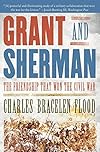
"We were as brothers," Sherman said, describing his relationship to Grant, a friendship forged on the battlefield. They were prewar failures--Grant, forced to resign from the Army because of his drinking, and Sherman, who held four different jobs during the four years before the Confederates fired on Fort Sumter. But heeding the call to save the Union, each struggled to join the war effort. And taking each other's measure at the Battle of Shiloh, ten months into the war, they began their show more unique collaboration. They shared the demands of family life and the heartache of loss, including the death of Sherman's favorite son. They supported each other in the face of criticism by press and politicians. Their growing mutual admiration and trust, which President Lincoln increasingly relied upon, would set the stage for the crucial final year of the war.--From publisher description. show lessTags
Recommendations












Member Reviews
Many historians have often characterized the relationship between Confederate generals Robert E. Lee and Stonewall Jackson as a close relationship, in which Lee trusted Jackson implicitly. Lee himself said that Jackson's death after the Battle of Chancellorsville was 'like losing my right arm.' For the remainder of the war, Lee lacked a similar relationship with any of the other Confederate generals.
Less publicized, probably because the Union war effort is seen in such blunt, unpoetic and non-mythologized terms, is the close relationship between Union generals U. S. Grant and William Tecumseh Sherman. Grant trusted Sherman completely, as is evident from his lack of concern when the subordinate general abandoned normal military tactics show more and procedure and marched through Georgia with no communication with the commanding general for weeks.
Charles Bracelen Flood has attempted to explore this unique relationship in "Grant and Sherman: The Friendship that Won the Civil War." Beginning with their backgrounds, he shows their similarities. He then goes on to demonstrate the growing trust between the two generals during the early years of the war, when both served in the western theater. He also strongly implies that, at different times, each one helped to preserve the other's military position in times of outside criticism.
The focus on these two individuals offers an interesting look at the Civil War, particularly the Union war effort, in terms of the relationships between the military and political leaders. Instead of focusing on battlefield tactics, it is interested in backroom tactics. What emerges is a portrait of an environment in which overcoming political obstacles is as important in the outcome of the war as defeating the opposing army. (This, of course, is not an unexplored area in other American conflicts: frequently George Washington's generalship in the American Revolution is studied in this way, as is Dwight Eisenhower's command of the multi-national allied forces in World War II.)
Unfortunately, Flood oversteps by describing the relationship as a friendship, rather than a partnership. Ultimately, he may be correct, but the description he provides, like that which is often provided of Lee and Jackson, is of a highly successful partnership rather than a friendship. A similar relationship could be described, using similar letters and other evidence, of the close relationship between Grant and Abraham Lincoln, but none would suggest that it was a friendship, despite its success.
As such, I found the book a frustrating read. Flood, who also wrote "Lee -- The Last Years," a book which I greatly admire, is convinced he is describing a friendship rather than a partnership. Page after page, I just did not see it, much as I might want to agree with the hypothesis in my heart. Still, there is value in the joint biography, in suggesting the importance of relationships and cooperation in overall Civil War strategy. show less
Less publicized, probably because the Union war effort is seen in such blunt, unpoetic and non-mythologized terms, is the close relationship between Union generals U. S. Grant and William Tecumseh Sherman. Grant trusted Sherman completely, as is evident from his lack of concern when the subordinate general abandoned normal military tactics show more and procedure and marched through Georgia with no communication with the commanding general for weeks.
Charles Bracelen Flood has attempted to explore this unique relationship in "Grant and Sherman: The Friendship that Won the Civil War." Beginning with their backgrounds, he shows their similarities. He then goes on to demonstrate the growing trust between the two generals during the early years of the war, when both served in the western theater. He also strongly implies that, at different times, each one helped to preserve the other's military position in times of outside criticism.
The focus on these two individuals offers an interesting look at the Civil War, particularly the Union war effort, in terms of the relationships between the military and political leaders. Instead of focusing on battlefield tactics, it is interested in backroom tactics. What emerges is a portrait of an environment in which overcoming political obstacles is as important in the outcome of the war as defeating the opposing army. (This, of course, is not an unexplored area in other American conflicts: frequently George Washington's generalship in the American Revolution is studied in this way, as is Dwight Eisenhower's command of the multi-national allied forces in World War II.)
Unfortunately, Flood oversteps by describing the relationship as a friendship, rather than a partnership. Ultimately, he may be correct, but the description he provides, like that which is often provided of Lee and Jackson, is of a highly successful partnership rather than a friendship. A similar relationship could be described, using similar letters and other evidence, of the close relationship between Grant and Abraham Lincoln, but none would suggest that it was a friendship, despite its success.
As such, I found the book a frustrating read. Flood, who also wrote "Lee -- The Last Years," a book which I greatly admire, is convinced he is describing a friendship rather than a partnership. Page after page, I just did not see it, much as I might want to agree with the hypothesis in my heart. Still, there is value in the joint biography, in suggesting the importance of relationships and cooperation in overall Civil War strategy. show less
The writer of a thesis paper is typically admonished to narrow the topic sufficiently so that it can both bring fresh perspective and be covered comprehensively in a finite number of pages. I would guess that when Charles Bracelen Flood conceived a book about the special relationship between Ulysses S. Grant and William Tecumseh Sherman during the Civil War, he felt that he had such a narrowed topic. As every thesis writer knows, the next step is to place that narrowed focus within the context of a wider arena that can be quite unfamiliar to the reader. Tough decisions must be made as to what to include to establish this contextual element while suitably limiting the overall scope. The problem with Grant and Sherman: The Friendship That show more Won the Civil War is that neither the author nor his editor seems to have made these critical decisions. The result is a book that in a mere four hundred pages attempts a dual biography of Grant and Sherman and the history of the American Civil War, which compels Flood to cherry-pick telling episodes and oversimplify the war in order to place his twin protagonists in the appropriate milieu to suit the narrative. Significantly, this structure also imperils a deeper character analysis of his subjects within and without their unique friendship.
I am fairly well-read in Civil War historiography, and I have some familiarity with Grant’s story. The primary reason I picked up Grant and Sherman was that I wanted to learn more about Sherman without reading an entire volume dedicated to his biography. This book was recommended to me by a fellow Civil War enthusiast, and I had read Flood before; his 1864: Lincoln at the Gates of History is an outstanding work in my estimation. The topic is indeed attractive: Grant and Sherman are the two most iconic Union generals and their successful collaboration was a chief ingredient to the final victory of the United States.
Both Sherman and Grant were essentially pre-war failures with West Point backgrounds, although on the eve of the war Grant’s future seemed far more dismal than Sherman’s. Still, the war made both of them, but not without some bumps in the road. Sherman, over-reacting to the size of enemy forces, was deemed insane. Grant was accused of drunkenness and dereliction of duty. Sherman had powerful political connections that included a brother in Congress which kept him from the abyss. Grant was stubborn and determined; he scored too many victories to be sidelined. The two men had much in common but also much that set them apart. Still, they bonded almost immediately and Sherman became Grant’s loyal subordinate throughout the war. Grant reciprocated that loyalty absolutely, and rescued Sherman when he went off course. Sherman’s famous quotation, taken from a letter he wrote to Grant, sums it up well: “I know wherever I was that you thought of me, and if I got in a tight place you would come – if alive.” Sherman was to get in more than one tight place, and Grant was indeed to come. The most significant episode was in the closing days of the war, after Appomattox and the Lincoln assassination, when Sherman stepped way beyond his bounds while accepting the surrender of Joe Johnston’s army by making unauthorized promises for the restoration of political rights to former Confederates. Overnight, Sherman’s political capital went from hero to zero, and without Grant’s tactful intervention he might have ended the war in disgrace.
I had always assumed that accusations of Sherman’s insanity were hyperbolic attacks by forces unfriendly to him, but Flood’s chronicle reveals friends and relations alike worried about a mental illness that apparently ran in the family manifesting itself. That Sherman sometimes jumped to conclusions, made rash judgments and occasionally saw enemies everywhere underscores the concerns of those who knew him best. He was indeed a brilliant general with often uncanny instincts in the field, but without Grant’s steady guidance one wonders what might have become of Sherman.
Flood is a gifted author and despite its flaws much of this book benefits from a well-written narrative that never grows dull. Those without a strong background in the Civil War and less acquaintance with the main characters will likely enjoy this effort more than I did. Still, I think it would have been far more effective had Flood taken a less macro approach and simply focused upon the specific aspects of the relationship between Grant and Sherman that contributed to ultimate Union victory. A deeper analysis of each of the men would have been welcome, as well. As it is, there is little new material here, just a new way perhaps to relate a familiar story. To those who already possess a strong foundation in Civil War studies, I would recommend skipping this book.
http://regarp.com/2015/10/16/review-of-grant-and-sherman-the-friendship-that-won... show less
I am fairly well-read in Civil War historiography, and I have some familiarity with Grant’s story. The primary reason I picked up Grant and Sherman was that I wanted to learn more about Sherman without reading an entire volume dedicated to his biography. This book was recommended to me by a fellow Civil War enthusiast, and I had read Flood before; his 1864: Lincoln at the Gates of History is an outstanding work in my estimation. The topic is indeed attractive: Grant and Sherman are the two most iconic Union generals and their successful collaboration was a chief ingredient to the final victory of the United States.
Both Sherman and Grant were essentially pre-war failures with West Point backgrounds, although on the eve of the war Grant’s future seemed far more dismal than Sherman’s. Still, the war made both of them, but not without some bumps in the road. Sherman, over-reacting to the size of enemy forces, was deemed insane. Grant was accused of drunkenness and dereliction of duty. Sherman had powerful political connections that included a brother in Congress which kept him from the abyss. Grant was stubborn and determined; he scored too many victories to be sidelined. The two men had much in common but also much that set them apart. Still, they bonded almost immediately and Sherman became Grant’s loyal subordinate throughout the war. Grant reciprocated that loyalty absolutely, and rescued Sherman when he went off course. Sherman’s famous quotation, taken from a letter he wrote to Grant, sums it up well: “I know wherever I was that you thought of me, and if I got in a tight place you would come – if alive.” Sherman was to get in more than one tight place, and Grant was indeed to come. The most significant episode was in the closing days of the war, after Appomattox and the Lincoln assassination, when Sherman stepped way beyond his bounds while accepting the surrender of Joe Johnston’s army by making unauthorized promises for the restoration of political rights to former Confederates. Overnight, Sherman’s political capital went from hero to zero, and without Grant’s tactful intervention he might have ended the war in disgrace.
I had always assumed that accusations of Sherman’s insanity were hyperbolic attacks by forces unfriendly to him, but Flood’s chronicle reveals friends and relations alike worried about a mental illness that apparently ran in the family manifesting itself. That Sherman sometimes jumped to conclusions, made rash judgments and occasionally saw enemies everywhere underscores the concerns of those who knew him best. He was indeed a brilliant general with often uncanny instincts in the field, but without Grant’s steady guidance one wonders what might have become of Sherman.
Flood is a gifted author and despite its flaws much of this book benefits from a well-written narrative that never grows dull. Those without a strong background in the Civil War and less acquaintance with the main characters will likely enjoy this effort more than I did. Still, I think it would have been far more effective had Flood taken a less macro approach and simply focused upon the specific aspects of the relationship between Grant and Sherman that contributed to ultimate Union victory. A deeper analysis of each of the men would have been welcome, as well. As it is, there is little new material here, just a new way perhaps to relate a familiar story. To those who already possess a strong foundation in Civil War studies, I would recommend skipping this book.
http://regarp.com/2015/10/16/review-of-grant-and-sherman-the-friendship-that-won... show less
Not a bad book for old Civil War buffs. The title is of course a tautology since it goes without saying that Grant and Sherman were the two best generals in the North and the North won. Very good on family life, early careers, and skill sets, gets bogged down after the war in the Sherman feuds. Tries to make a case for Grant as flexible and capable battlefield manager, instead of the usual meatgrinder view.
The most fascinating chapters are at the start, the successive professional failures of Grant and Sherman prior to the war and their more or less stumbling into positions of command. The mid-bits are a gloss of Civili War history, rehash for anyone who's already soaking in this stuff anyway. Picks up again at the end with a vivid picture of the last weeks of the war, the atmosphere in Washington following Lincoln's assassination and the Grand Review of the victorious Union armies. Rapid fire epilogue blasts through Grant/Sherman's post-war careers as an obligation. Makes me want to read their memoirs for more detail.
This brief book retells the highlights of the lives of Ulysses S. Grant and William Tecumseh Sherman. There’s no analysis, a few inaccuracies, and some major elisions, but it’s still a great story. You’ve got Grant, Sherman, Lincoln, the Civil War – it would be pretty hard to make it dull. And you can’t help but wonder what would become of men in today’s world who had to slog through all the setbacks Grant and Sherman had and still go on to push themselves to the top. The two men became friends, and their friendship helped to sustain each of them. As Sherman said of Grant later, "He stood by me when I was crazy and I stood by him when he was drunk, and now we stand by each other always."
I wouldn’t recommend this as the show more sole source of background on the Civil War or its northern generals, but it’s not a bad place to start. show less
I wouldn’t recommend this as the show more sole source of background on the Civil War or its northern generals, but it’s not a bad place to start. show less
Very interesting description of the friendship between Grant and Sherman during the Civil War, and their key roles in winning the war. Charles Bracelen Flood has attempted to explore this unique relationship in "Grant and Sherman: The Friendship that Won the Civil War." Beginning with their backgrounds, he shows their similarities. He then goes on to demonstrate the growing trust between the two generals during the early years of the war.
Union generals Grant and Sherman shared a similar background of failure and frustration, though at the beginning of the War Between the States, Grant was probably the bigger failure of the two. Both men were very dependent upon their families for support of one sort or another, be it as simple as Grant working in his father's leather shop or a bit more complicated like Sherman benefitting from the political influence of his politically-connected family.
Just four years later, the pair was largely credited with winning the war and preserving the Union. They would go on to worldwide and national fame, something they could hardly have imagined possible in 1860 when the coming war was still brewing. Grant, of course, would become president show more of the United States (although his presidency is seen as somewhat of a failure due to the scandals occurring during his years in office), and Sherman would become head of the U.S. Army and would remain a soldier for almost five decades before finally retiring on his 64th birthday.
Theirs was a special bond, one that involved true friendship and a melding of two very different military minds into one mindset that overwhelmed all the resistance that Robert E. Lee and the rest of the South could throw at them. They were exactly what the Union needed and they came along at precisely the right moment to save that Union. "Grant and Sherman" tells their story in just over 400 pages; it's a story well worth considering. show less
Just four years later, the pair was largely credited with winning the war and preserving the Union. They would go on to worldwide and national fame, something they could hardly have imagined possible in 1860 when the coming war was still brewing. Grant, of course, would become president show more of the United States (although his presidency is seen as somewhat of a failure due to the scandals occurring during his years in office), and Sherman would become head of the U.S. Army and would remain a soldier for almost five decades before finally retiring on his 64th birthday.
Theirs was a special bond, one that involved true friendship and a melding of two very different military minds into one mindset that overwhelmed all the resistance that Robert E. Lee and the rest of the South could throw at them. They were exactly what the Union needed and they came along at precisely the right moment to save that Union. "Grant and Sherman" tells their story in just over 400 pages; it's a story well worth considering. show less
Members
- Recently Added By
Author Information

14+ Works 1,585 Members
Charles Bracelen Flood is the author of twelve previous books, including the bestselling Lee: The Last Years and Grant and Sherman, which Salon com named one of the "Top 12 Civil War Books Ever Written." He is a past president of PEN American Center and has served on the governing bodies of the Authors League and the Authors Guild. Rood and his show more wife, Katherine, live in Richmond, Kentucky. show less
Awards and Honors
Distinctions
Common Knowledge
- Original publication date
- 2005-09-15
- People/Characters
- Ulysses S. Grant; William Tecumseh Sherman
- Important places
- USA; Chattanooga, Tennessee, USA; Georgia, USA; Hardin County, Tennessee, USA; Mississippi, USA; Savannah, Georgia, USA (show all 10); Shiloh National Military Park, Tennessee, USA; Tennessee, USA; Vicksburg, Mississippi, USA; Warren County, Mississippi, USA
- Important events
- American Civil War (1861 | 1865); Battle of Shiloh (1862-04-06 | 1862-04-07); Siege of Vicksburg, Mississippi (1863); Sherman's March to the Sea (1864)
- Epigraph
- As soon as real war begins, new men, heretofore unheard of, will emerge from obscurity, equal to any occasion.
--William Tecumseh Sherman, six weeks before Bull Run
I knew whereve I was that you thought of me... (show all), and if I got in a tight place you would come if alive.
--Sherman to Grant, March 10, 1864, summing up their successful Western campaigns
But what next? I suppose it will be safe if I leave General Grant and yourself to decide.
Abraham Lincoln to Sherman, after congratulating him on his capture of Savannah, Christmas 1864
He stoof by me when I was crazy and I stood by him when he was drunk, and now, sir, we stand by each other always.
--Sherman, speaking of Grant
I know him well as one of the greatest purest and best of men. He is poor and always will be, but he is great and magnanimous.
--Grant, praising Sherman in a letter to Jesse Grant, his father
We were as brothers, I the older man in years, he the higher in rank.
--Sherman, summing up their friendship - Dedication
- To my wife, Katherine Burnam Flood, and to our children, Caperton, Lucy, and Curtis
- First words
- In the early hours of April 7, 1862, after the terrible first day of the Battle of Shiloh, Brigadier General William Tecumseh Sherman came through the darkness to where his superior, Major General Ulysses S. Grant, stood in t... (show all)he rain.
- Last words
- (Click to show. Warning: May contain spoilers.)Whether they were campaigning together, or communicating by letter and telegraph at times when their headquarters were several hundred miles apart, each knew that they other made him more than what he was before they met.
- Blurbers
- Bunting, Josiah, III; Fleming, Thomas; Winik, Jay; Marszalek, John; Offit, Sidney; Roland, Charles P. (show all 7); Simon, John Y.
Classifications
Statistics
- Members
- 506
- Popularity
- 59,146
- Reviews
- 9
- Rating
- (4.21)
- Languages
- English, French
- Media
- Paper, Audiobook, Ebook
- ISBNs
- 9
- ASINs
- 5