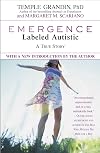
Emergence: Labeled Autistic
by Temple Grandin, Margaret M. Scariano
On This Page
Description
A true story that is both uniquely moving and exceptionally inspiring, Emergence is the first-hand account of a courageous autistic woman who beat the odds and cured herself. As a child, Temple Grandin was forced to leave her "normal" school and enroll in a school for autistic children. This searingly honest account captures the isolation and fears suffered by autistics and their families and the quiet strength of one woman who insisted on a miracle.Tags
Recommendations
























Member Reviews
What a striking story of growth and development! Temple Grandin, one of the most famous advocate for autism, retells her life in here - how the various people who contributed to raise her (her mum, her auntie, a teacher) by refusing to let her being locked into the restrictive label 'autistic', all contributed to her 'emergence', her blossoming into the amazing individual we now know.
Temple Grandin grew up in the fifties. Barely a decade after Leo Kanner's work, and still half a century before Asperger as we define it came to be fully recognised, autism used then to be perceived as a dark and hopeless cell. It was a terrible label to ascribe to a child, determining an awful fate: being send down into an institution - to be forgotten show more there. Only the stubbornness and dedicated love of her mum, later picked upon by other 'mentors', will avoid her such doom.
Of course, it's obvious to us now: autism is a spectrum as diverse as the people affected by it. It can be a serious, if not debilitating, impairment in many aspects, but, it can also be a set of features which, properly harnessed, can be turned into strengths. It's obvious to us now... It wasn't back when Temple Grandin grew up! How lucky was she then! Her obsession with details, intense and peculiar interests, and geeky engineering brain will all be nurtured to such a point that, against all expectation for a autistic person of her generation, she will come to live a normal life. In fact, branded a 'retard' as a child, she would actually accomplish more than most of us: getting a degree in Humanities, a Ph.D. in Animal Science, transform (as an engineer) livestock-handling facilities in the USA, shed a new light (as an animal scientist) on our understanding of cattle's behaviours, and, author of many books on autism, end up by being the strong advocate we all know (or should know!). Now, isn't that an amazing women? And here's the thing: her seductive quirkiness and abrasive intelligence shines throughout this book!
Interestingly, she does more than simply telling her life. She subjectively explains the over-sensitivity of autistic individuals, and its impact on their feelings and behaviours (eg. the pages about her very own 'squeezing machine' are more than funny, they are telling even if tentative...). She paints how it is to think visually (as opposed to verbally) - a theme she will later develop in another of her book (Thinking in Pictures: My Life with Autism ). She, above all, fully demonstrates that a condition doesn't define you; it's how you deal (and are encouraged to deal) with it that does:
'...the characteristics of autism can be modified and controlled... I feel strongly that I am living proof that they can.'
'I had come a long way from the non-verbal, tantrum-throwing, peer-hitting child.'
Emergence is a short but extraordinary read. Temple Grandin's story of battling against all odd and sheer determination is more than inspiring. It makes for a great understanding and acceptance of whose who, like her, are not 'neurotypicals'. Autism cannot be cured, but, for some affected by it, it surely can be turned into a strength. show less
Temple Grandin grew up in the fifties. Barely a decade after Leo Kanner's work, and still half a century before Asperger as we define it came to be fully recognised, autism used then to be perceived as a dark and hopeless cell. It was a terrible label to ascribe to a child, determining an awful fate: being send down into an institution - to be forgotten show more there. Only the stubbornness and dedicated love of her mum, later picked upon by other 'mentors', will avoid her such doom.
Of course, it's obvious to us now: autism is a spectrum as diverse as the people affected by it. It can be a serious, if not debilitating, impairment in many aspects, but, it can also be a set of features which, properly harnessed, can be turned into strengths. It's obvious to us now... It wasn't back when Temple Grandin grew up! How lucky was she then! Her obsession with details, intense and peculiar interests, and geeky engineering brain will all be nurtured to such a point that, against all expectation for a autistic person of her generation, she will come to live a normal life. In fact, branded a 'retard' as a child, she would actually accomplish more than most of us: getting a degree in Humanities, a Ph.D. in Animal Science, transform (as an engineer) livestock-handling facilities in the USA, shed a new light (as an animal scientist) on our understanding of cattle's behaviours, and, author of many books on autism, end up by being the strong advocate we all know (or should know!). Now, isn't that an amazing women? And here's the thing: her seductive quirkiness and abrasive intelligence shines throughout this book!
Interestingly, she does more than simply telling her life. She subjectively explains the over-sensitivity of autistic individuals, and its impact on their feelings and behaviours (eg. the pages about her very own 'squeezing machine' are more than funny, they are telling even if tentative...). She paints how it is to think visually (as opposed to verbally) - a theme she will later develop in another of her book (Thinking in Pictures: My Life with Autism ). She, above all, fully demonstrates that a condition doesn't define you; it's how you deal (and are encouraged to deal) with it that does:
'...the characteristics of autism can be modified and controlled... I feel strongly that I am living proof that they can.'
'I had come a long way from the non-verbal, tantrum-throwing, peer-hitting child.'
Emergence is a short but extraordinary read. Temple Grandin's story of battling against all odd and sheer determination is more than inspiring. It makes for a great understanding and acceptance of whose who, like her, are not 'neurotypicals'. Autism cannot be cured, but, for some affected by it, it surely can be turned into a strength. show less
Temple Grandin is a fascinating woman. Diagnosed autistic as a child, Grandin went on to become a PhD holding animal behavioralist who has designed a third of all the livestock-handling facilities in the U.S., including those used by McDonalds. She is a passionate advocate for the humane treatment of livestock, and she also lectures worldwide on autism, both from her own perspective and as a researcher. She has written five books, of which Emergence: Labeled Autistic was the first, published in 1986 and reissued in 2005.
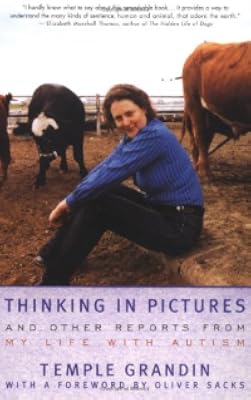
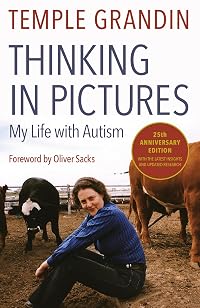
Emergence is an autobiography focusing primarily on her childhood and youth: how she was diagnosed, her mother’s advocacy for her, and the difficulties she encountered, particularly in adolescence. Nine years later, show more Grandin wrote a second autobiography Thinking in Pictures, and I found that to be the more interesting of the two. Thinking in Pictures reflects not only a more mature writing style, but also describes her thought processes and how she understands the people and animals around her. It includes the salient points from Emergence, so reading both is superfluous. Do read Thinking in Pictures, however, if you haven’t already. Her story transcends autism, the treatment of animals, and the Oscars, and adds another page to the story of humanity. show less
Emergence is an autobiography focusing primarily on her childhood and youth: how she was diagnosed, her mother’s advocacy for her, and the difficulties she encountered, particularly in adolescence. Nine years later, show more Grandin wrote a second autobiography Thinking in Pictures, and I found that to be the more interesting of the two. Thinking in Pictures reflects not only a more mature writing style, but also describes her thought processes and how she understands the people and animals around her. It includes the salient points from Emergence, so reading both is superfluous. Do read Thinking in Pictures, however, if you haven’t already. Her story transcends autism, the treatment of animals, and the Oscars, and adds another page to the story of humanity. show less
I loved the movie Temple Grandin and wanted to read the books on which the film was based. So for me, the interesting parts of the book are the narratives and vignettes of Ms. Grandin's life. But because this book was written to educate caregivers of autistic persons on how to educate and understand autistic behavior, there is a lot of explanations of what could have been the cause of autism, what treatments/therapies are effective....etc. Those sections I began to skip as I got further into the book. Ms. Grandin provided many first-hand documents from her life in the book. We got to read her diary, her mother's letters to her, a health report form her mother filled out....While these are valuable memos to Ms. Grandin's life story, I show more feel they dragged on the narrative rather than enhanced it because of their length. In terms of storytelling, the film did better. show less
Temple Grandin is an amazing inspiration for all of us. I think few of us could achieve such success in the face of the kind of obstacles Temple--and others with Austism Spectrum Disorders--had to overcome. I also admire her candor in sharing her experiences; her courage to tell her story, even incidents that were embarrassing or difficult for her, will help more people to understand what it is to live with ASD. I plan to read more of her books. Hers is a fascinating life worth exploring.
Temple Grandin is such an amazing person. I really enjoyed this book. It was well put-together and easy to follow. Grandin's insight into her experience with autism is awe-inspiring. Having read her book Thinking in Pictures: My Life with Autism first, this book clarified a lot of important concepts that I did not fully understand the importance of previously, such as the symbol of doors. If you are at all interested in Autism Spectrum Disorders, I highly recommend this book. It's a quick read and definitely worth it. Grandin goes through each stage of her life from early childhood to young adulthood and describes her own hardships and successes in living with autism. While no two individuals with ASDs are the same, Grandin gives show more insight into her own life, which may be beneficial to others. It is also an important tool in better understanding how some individuals with ASDs see the world show less
Emergence tells the story of a woman with autism. It is mostly a summary of her youth. She describes memories of being teased by other children, confused by their actions, and the reasons and feelings behind her own unusual behavior. She talks about teachers who mentored her, and how her own internal symbolism enabled her to make goals and finish high school and college. Included in this short book are letters by Grandin's psychiatrists and teachers (written to her mother), which give a different point of view; facts and data about autism, and the original checklist Grandin's mother filled out about her behavior when she was diagnosed. As it stands alone, this book can feel rather incomplete and brief. But read in conjunction with show more Thinking in Pictures, it completes the story, adding many new insights and details of this extraordinary woman's life.
From the Dog Ear Diary show less
From the Dog Ear Diary show less
Biographical account by a woman with autism of her childhood and development to become a successful professional.
Members
- Recently Added By
Lists

Disabled author's autobiography
36 works; 4 members
Author Information

46+ Works 9,547 Members
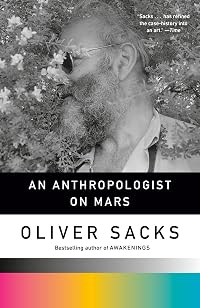
Temple Grandin was born August 29, 1947 in Boston, Massachusetts. She is a bestselling author, doctor and professor of Animal Science at Colorado State University, and leader of both the animal welfare and autism advocacy movements. Grandin was diagnosed with autism in 1950. She was immediately placed in a structured nursery, had speech therapy, show more and had a nanny spend hours playing turn-based games with her. At the age of four, she began talking and her progress continued. In 1970, Grandin received her bachelor's degree in psychology from Franklin Pierce College in Rindge, New Hampshire. She received her master's degree in animal science from Arizona State University in 1975, and in 1989, she received a Ph.D. in animal science from the University of Illinois at Urbana-Champaign. Grandin, being a high-functioning autistic, is widely-known for her work in autism advocacy. She has been featured on major televisions programs such as the Today Show and ABC's Primetime Live. She has also been featured in Time magazine, People magazine, Forbes, and the New York Times. Grandin was the subject of the Horizon documentary "The Woman Who Thinks Like a Cow" and was described by Oliver Sacks in the title of his narrative book: An Anthropologist on Mars. Grandin's bestselling book: Thinking in Pictures is scheduled to be released as an HBO film in 2009. Grandin's Animals in Translation and Animals Make Us Human have also been bestsellers. Grandin lives in Colorado, but has speaking engagements on autism and cattle handling around the world. show less
3 Works 440 Members
Work Relationships
Inspired
Common Knowledge
- Original publication date
- 1986
- People/Characters
- Temple Grandin
- Related movies
- Temple Grandin (2010 | IMDb)
- Dedication
- Dedicated to my family
with love - First words
- Introduction
I put the announcement down and poured myself another cup of tea.
Foreword [by Bernard Rimland]
Reading this book will be an adventure.
Preface [by William Carlock]
What a rare pleasure for a teacher! - Last words
- (Click to show. Warning: May contain spoilers.)With my ability for visual thinking, I "see" others "labeled autistic" gliding through their symbolic doors to their own successes.
- Blurbers
- King, Lorna Jean; Morrison, Del
Classifications
- Genres
- Biography & Memoir, Nonfiction, General Nonfiction
- DDC/MDS
- 616.89820092 — Applied science & technology Medicine & health Diseases, Allergies, Skin Conditions Nervous Disorders: Autism, Anorexia, OCD Mental disorders: bi-polar/schizophrenia Schizophrenia
- LCC
- RC553 .A88 .G73 — Medicine Internal medicine Internal medicine Neurosciences. Biological psychiatry. Neuropsychiatry Psychiatry Psychopathology
- BISAC
Statistics
- Members
- 434
- Popularity
- 70,623
- Reviews
- 8
- Rating
- (3.59)
- Languages
- English, German, Portuguese (Portugal)
- Media
- Paper
- ISBNs
- 7
- ASINs
- 2