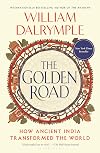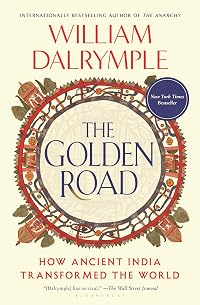
The Golden Road: How Ancient India Transformed the World
by William Dalrymple
On This Page
Description
"A soaring history of India's underrecognized role in producing the world as we know it. For a millennium and a half, India was a confident exporter of its diverse civilization, creating around it a vast empire of ideas. Indian art, religions, technology, astronomy, music, dance, literature, mathematics, and mythology blazed a trail across the world, along a Golden Road that stretched from the Red Sea to the Pacific. In The Golden Road, William Dalrymple draws from a lifetime of scholarship show more to highlight India's oft forgotten position as the heart of ancient Eurasia. For the first time, he gives a name to this spread of Indian ideas that transformed the world. From the largest Hindu temple in the world at Angkor Wat to the Buddhism of China, from the trade that helped fund the Roman Empire to the creation of the numerals we use today (including zero), India transformed the culture and technology of its ancient world -- and our world today as we know it"--Jacket flap. show lessTags
Recommendations


Member Reviews
William Dalrymple’s introduction to The Golden Road opens with the words of the seventh century Chinese Buddhist monk Xuanzhang: “People of distant places, with diverse customs,” he wrote, “generally designate the land they most admire as India.”
From there the author is off exploring the rise and influence of India on China, southeast Asia, the Roman empire, Muslim rulers from India itself to Spain, and from there into medieval Europe from 250 BC to 1200 AD. Indian ideas, culture, art, technology, religion, language, mathematics, architecture and astronomy spread widely and were adopted and innovated on by peoples throughout Europe and Asia.
Much of this soft-power “Indosphere” of influence (soft-power meaning not as a show more result of conquering) has its basis in the position of the Indian subcontinent in the middle of a sea route that facilitated the movement of goods, people and ideas. This sea route is the Golden Road of the book’s title. Dalrymple convincingly lays out the case for the Golden Road preceding, and far surpassing in importance, the so called “Silk Road”, the land route for trade between China and the West.
To the Roman Empire went jewels, spices. silk, cotton, teak and sandalwood from India, usually in exchange for gold. Roman coins, Dalrymple notes, “are found today by archeologists in their tens of thousands, as they have been since the eighteenth century when [the] East India Company…report[ed] the discovery of ‘five cooly-loads’ of Roman gold coins.” Sometimes the trade was carried on Roman ships, but many times it went on Indian ships. The largest ancient Indian ships were big enough to carry 1000 people or 3000 amphorae (the Greek / Roman clay jars that held trade goods (mainly wine) in those days).
To China went teachers and monks who inspired Buddhist converts to travel back to India for education and enlightenment at the monastery university of Nolanda, which at the time wasvprobably the greatest center of education in the world, with a library holding at least as many works as the famous one at Alexandria. Nolanda drew students not only from China but from throughout southeast Asia.
Dalrymple spends a good bit in the middle of the book exploring the Indian influence on the Khmer Empire of Cambodia, of particular interest to me as I had the opportunity to travel through Cambodia last year with my husband, and visit the Hindu / Buddhist temples at Angkor Wat, the largest religious complex in the world.
Also covered is the spread and adoption of the decimal number system and the concept of zero. Long thought in the west to be Muslim (particularly Arabic) innovations, these ideas in reality have their roots in Indian mathematics.
This is not a dry academic tome, instead its a quite readable and relatively short episodic history - just shy of 300 pages of narrative plus extensive notes. Anyone with interest in world history would find this to be a welcome work that expands our understanding of ancient cultures and gives India its due for its truly world-spanning ancient influence. show less
From there the author is off exploring the rise and influence of India on China, southeast Asia, the Roman empire, Muslim rulers from India itself to Spain, and from there into medieval Europe from 250 BC to 1200 AD. Indian ideas, culture, art, technology, religion, language, mathematics, architecture and astronomy spread widely and were adopted and innovated on by peoples throughout Europe and Asia.
Much of this soft-power “Indosphere” of influence (soft-power meaning not as a show more result of conquering) has its basis in the position of the Indian subcontinent in the middle of a sea route that facilitated the movement of goods, people and ideas. This sea route is the Golden Road of the book’s title. Dalrymple convincingly lays out the case for the Golden Road preceding, and far surpassing in importance, the so called “Silk Road”, the land route for trade between China and the West.
To the Roman Empire went jewels, spices. silk, cotton, teak and sandalwood from India, usually in exchange for gold. Roman coins, Dalrymple notes, “are found today by archeologists in their tens of thousands, as they have been since the eighteenth century when [the] East India Company…report[ed] the discovery of ‘five cooly-loads’ of Roman gold coins.” Sometimes the trade was carried on Roman ships, but many times it went on Indian ships. The largest ancient Indian ships were big enough to carry 1000 people or 3000 amphorae (the Greek / Roman clay jars that held trade goods (mainly wine) in those days).
To China went teachers and monks who inspired Buddhist converts to travel back to India for education and enlightenment at the monastery university of Nolanda, which at the time wasvprobably the greatest center of education in the world, with a library holding at least as many works as the famous one at Alexandria. Nolanda drew students not only from China but from throughout southeast Asia.
Dalrymple spends a good bit in the middle of the book exploring the Indian influence on the Khmer Empire of Cambodia, of particular interest to me as I had the opportunity to travel through Cambodia last year with my husband, and visit the Hindu / Buddhist temples at Angkor Wat, the largest religious complex in the world.
Also covered is the spread and adoption of the decimal number system and the concept of zero. Long thought in the west to be Muslim (particularly Arabic) innovations, these ideas in reality have their roots in Indian mathematics.
This is not a dry academic tome, instead its a quite readable and relatively short episodic history - just shy of 300 pages of narrative plus extensive notes. Anyone with interest in world history would find this to be a welcome work that expands our understanding of ancient cultures and gives India its due for its truly world-spanning ancient influence. show less
Quite an amazing work, obviously a labor of love for the author. While there are other works that document the achievements of ancient India in various fields, there aren't that many that lift the individual achievers out from the nameless mass, and this Dalrymple tries to do. While some fields like linguistics appear not to have been covered in depth, what is different in this account is the prominence given to Indian achievements in the sciences, especially mathematics and the development of the decimal system and use of the zero. Another striking feature of this book is the detail and depth with which the author treats the percolation of Indian knowledge and techniques to the greater world, through for example the Buddhist scholars show more and monks who travelled between Asia and the subcontinent, as well as through Muslim intermediaries, and thus on to the west and modern science. Another great contribution of the book, I feel, is the prominence given to south India, both as a geographical-political source and in terms of the actual individuals who sallied forth to central and eastern Asia. And before I forget, Dalrymple has expanded on the relations between the subcontinent and the civilizations of South-east Asia, things which are not brought out in many mainstream accounts.
Why should Indians be so receptive or sensitive to the opinions of outsiders? One reason could be that highly nationalistic Indians tend to ascribe more to the civilization than warranted by either the objective evidence, or indeed by the known laws of physics and common sense. This book amply reinforces the realization that we need not claim such fantastic things as space travel or nuclear weapons for our ancients, as the actual achievements in art, architecture, philosophy, science, medicine, and a myriad other fields are by themselves stupendous enough by any standards, making it quite unnecessary to bring in claims of supernatural or unnatural capabilities. It seems that more credence can be given to a rational assessment by a foreigner, than the off-the-cuff excesses of our own writers. And this is even true when we try to reconstruct our early history: we get more information from the surviving records left by Greek camp followers, Chinese pilgrims, Central Asian invaders, and others. Dalrymple pads out his account with a prolific section of footnotes, which could make a small book by themselves, and prolific lists of references and an index, which makes this an impressive, and essential, addition to even the scholars of Indology. show less
Why should Indians be so receptive or sensitive to the opinions of outsiders? One reason could be that highly nationalistic Indians tend to ascribe more to the civilization than warranted by either the objective evidence, or indeed by the known laws of physics and common sense. This book amply reinforces the realization that we need not claim such fantastic things as space travel or nuclear weapons for our ancients, as the actual achievements in art, architecture, philosophy, science, medicine, and a myriad other fields are by themselves stupendous enough by any standards, making it quite unnecessary to bring in claims of supernatural or unnatural capabilities. It seems that more credence can be given to a rational assessment by a foreigner, than the off-the-cuff excesses of our own writers. And this is even true when we try to reconstruct our early history: we get more information from the surviving records left by Greek camp followers, Chinese pilgrims, Central Asian invaders, and others. Dalrymple pads out his account with a prolific section of footnotes, which could make a small book by themselves, and prolific lists of references and an index, which makes this an impressive, and essential, addition to even the scholars of Indology. show less
The Golden Road is a sprawling, if disconnected account of the influence of Indian culture around the world from roughly 500 BC to 1300 AD. Dalrymple makes a convincing case for Indian influence. And while this may be a case of wanting another book, India itself is a void, glimpsed through its scientific, cultural, and material exports.
While evidence for links between Rome and China are rather sketchy, Rome and India were great trading partners, linked via the Red Sea and Egypt. Roman writers like Pliny and Tacitus complain about Roman gold flowing to India for frivolous luxuries like pepper and silk. Perhaps a third of the Imperial treasury was funded by duties on this trade. Meanwhile, hordes of Roman coins are common discoveries in show more Indian archeological sites, and Indian temples were decorated by sculptors with names like Justinian Flavius. While this trade was continued past the fall of the Western Roman empire, the Muslim conquest of Egypt resulted in a re-orientation of Indian trade to the east and north, through straits of Malacca and up to China.
Along with luxury goods, the other great concrete export of Indian was expertise. Indian astronomers, astrologers, mathematicians, and doctors were renown across the world. 'Arabic' numerals are in fact Indo-Arabic numerals, and the use of zero and the decimal point are both Indian innovations foundational to math. While Ancient Greeks are at the foundation of modern mathematics, evidence suggests that Indian mathematicians of the same period were equally, if not more sophisticated.
The third great export were religions. Buddhism and Hinduism are both Indian innovations, with some of their greatest accomplishments far from home. Borobudur and Angkor Wat are two of the greatest religious sites humanity has ever produced, Indian cultural wonders produced outside of the subcontinent. India was the pilgrimage site for Chinese Buddhist monks, who played an especially central role in the rule of Chinese Empress Wu Zetian. Of course, history is written by the victors, and the profoundly misogynistic Confucians who wrote the histories of her reign cast her as a great villain.
The Indosphere declined under the blows of Islamic invasion from what is now Afghanistan, and refugees from Mongol conquests. The Ghurid Empire and Delhi Sultanate were much less accommodating to religious diversity than previous Indian rulers, razing many ancient Buddhist libraries and monasteries. Unlike previous conquerors, they were uninterested in Sanskrit, and Persian became the court language. This trend was reinforced by Central Asian refugees speaking other Persian tongues, the hostility of the Mongol Empire to the north, and the creation of the Silk Road under the Pax Mongolia. And for various reasons (local prosperity, Hindu taboos, etc), Indian sailors never developed the globe spanning ships that saw Europeans arrive in the 17th and 18th centuries, with disastrous consequences detailed in The Anarchy.
There are some key gaps. While Dalrymple has quite a lot to say about the rise of Buddhism, the rise of Hinduism is basically elided. Visual arts are described with great care, written Sanskrit passed over. And I was personally annoyed that the claims of Buddhist holy men were taken at face value, even when they included things like "summoning an army of ghosts to defeat a very physical army of barbarians." This book is fine, but I learned less than I wanted to. show less
While evidence for links between Rome and China are rather sketchy, Rome and India were great trading partners, linked via the Red Sea and Egypt. Roman writers like Pliny and Tacitus complain about Roman gold flowing to India for frivolous luxuries like pepper and silk. Perhaps a third of the Imperial treasury was funded by duties on this trade. Meanwhile, hordes of Roman coins are common discoveries in show more Indian archeological sites, and Indian temples were decorated by sculptors with names like Justinian Flavius. While this trade was continued past the fall of the Western Roman empire, the Muslim conquest of Egypt resulted in a re-orientation of Indian trade to the east and north, through straits of Malacca and up to China.
Along with luxury goods, the other great concrete export of Indian was expertise. Indian astronomers, astrologers, mathematicians, and doctors were renown across the world. 'Arabic' numerals are in fact Indo-Arabic numerals, and the use of zero and the decimal point are both Indian innovations foundational to math. While Ancient Greeks are at the foundation of modern mathematics, evidence suggests that Indian mathematicians of the same period were equally, if not more sophisticated.
The third great export were religions. Buddhism and Hinduism are both Indian innovations, with some of their greatest accomplishments far from home. Borobudur and Angkor Wat are two of the greatest religious sites humanity has ever produced, Indian cultural wonders produced outside of the subcontinent. India was the pilgrimage site for Chinese Buddhist monks, who played an especially central role in the rule of Chinese Empress Wu Zetian. Of course, history is written by the victors, and the profoundly misogynistic Confucians who wrote the histories of her reign cast her as a great villain.
The Indosphere declined under the blows of Islamic invasion from what is now Afghanistan, and refugees from Mongol conquests. The Ghurid Empire and Delhi Sultanate were much less accommodating to religious diversity than previous Indian rulers, razing many ancient Buddhist libraries and monasteries. Unlike previous conquerors, they were uninterested in Sanskrit, and Persian became the court language. This trend was reinforced by Central Asian refugees speaking other Persian tongues, the hostility of the Mongol Empire to the north, and the creation of the Silk Road under the Pax Mongolia. And for various reasons (local prosperity, Hindu taboos, etc), Indian sailors never developed the globe spanning ships that saw Europeans arrive in the 17th and 18th centuries, with disastrous consequences detailed in The Anarchy.
There are some key gaps. While Dalrymple has quite a lot to say about the rise of Buddhism, the rise of Hinduism is basically elided. Visual arts are described with great care, written Sanskrit passed over. And I was personally annoyed that the claims of Buddhist holy men were taken at face value, even when they included things like "summoning an army of ghosts to defeat a very physical army of barbarians." This book is fine, but I learned less than I wanted to. show less
The Golden Road by William Dalrymple: A Journey Through Ancient India's Rich History
If you're fascinated by India's ancient heritage, The Golden Road by William Dalrymple is a must-read. As a first-time reader of this author, I was captivated by the experience, especially since the audiobook was narrated by Dalrymple himself. His compelling voice brings to life India's rich past, from the rise of Buddhism to the Colonial Era.
The book offers an in-depth look at India's wealth, culture, and scientific achievements during its golden age. One of the highlights for me was learning how India was a pioneer in science and mathematics, so advanced that even the Caliphs in the Arab world were in awe. However, the saddest moment came when show more Dalrymple narrated the destruction of Nalanda University during the Arab invasions, marking a tragic loss of knowledge and cultural heritage.
The Golden Road gives a unique perspective on India's history, culture, and contributions to the world, making it a truly mesmerizing listen. Whether you're a history buff or simply curious about India's past, this book is a powerful exploration of a nation once known for its intellect and prosperity. show less
If you're fascinated by India's ancient heritage, The Golden Road by William Dalrymple is a must-read. As a first-time reader of this author, I was captivated by the experience, especially since the audiobook was narrated by Dalrymple himself. His compelling voice brings to life India's rich past, from the rise of Buddhism to the Colonial Era.
The book offers an in-depth look at India's wealth, culture, and scientific achievements during its golden age. One of the highlights for me was learning how India was a pioneer in science and mathematics, so advanced that even the Caliphs in the Arab world were in awe. However, the saddest moment came when show more Dalrymple narrated the destruction of Nalanda University during the Arab invasions, marking a tragic loss of knowledge and cultural heritage.
The Golden Road gives a unique perspective on India's history, culture, and contributions to the world, making it a truly mesmerizing listen. Whether you're a history buff or simply curious about India's past, this book is a powerful exploration of a nation once known for its intellect and prosperity. show less
I learned a lot about Indian history, and the history of Buddhism, and the violent justice of some of the empires here. But this feels very one-sided, with announcements along the lines of "India created this so don't listen to anyone else" without discussion of evidence and refutation of other claims.
More specialised than usual, but as I was interested in the rise of the great religions I loved it.
More specialised than usual, but as I was interested in the rise of the great religions I loved it.
Members
- Recently Added By
Lists

Unread books
1,063 works; 87 members

Library Books
71 works; 1 member

Books Read in 2026
1,951 works; 66 members
Author Information

37+ Works 12,607 Members
William Dalrymple wrote the highly acclaimed British best-seller In Xanadu when he was twenty-two. It won the 1990 Yorkshire Post Best First Work Award and a Scottish Arts Council Spring Book Award; it was also shortlisted for the John Llewelyn Rhys Memorial Prize. His second book, City of Djinns, won the 1994 Thomas Cook Travel Book Award and the show more Sunday Times Young British Writer of the Year Award. From the Holy Mountain was awarded the Scottish Arts Council Autumn Book Award for 1997; it was also shortlisted for the 1998 Thomas Cook Award, the John Lewelyn Rhys Memorial Prize, and the Duff Cooper Prize. A collection of his essays on India, The Age of Kali, was published in 1998. Dalrymple is a fellow of the Royal Society of Literature and of the Royal Asiatic Society and in 2002 was awarded the Mungo Park Medal by the Royal Scottish Geographic Society for his "outstanding contribution to travel literature." He is married to the artist Olivia Fraser, and they have three children. They now divide their time between London and Delhi show less
Awards and Honors
Awards
Distinctions
Notable Lists
Common Knowledge
- Original language
- English
- Disambiguation notice
- 140886441X 2024 hardcover
1408864428 2024 softcover
1639734147 2025 hardcover
Classifications
Statistics
- Members
- 536
- Popularity
- 55,669
- Reviews
- 9
- Rating
- (3.97)
- Languages
- English, Spanish
- Media
- Paper, Audiobook, Ebook
- ISBNs
- 14
- ASINs
- 7