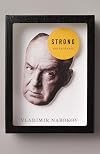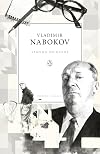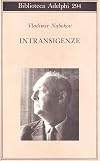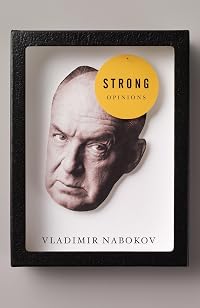
Strong Opinions
by Vladimir Nabokov
On This Page
Description
In this collection of interviews, articles, and editorials, Nabokov ranges over his life, art, education, politics, literature, movies, and modern times, among other subjects.nbsp;nbsp;Strong Opinions offers his trenchant, witty, and always engaging views on everything from the Russian Revolution to the correct pronunciation of Lolita.Tags
Recommendations











Member Recommendations

SnootyBaronet Fraught friendship of Edmund Wilson and Vladimir Nabokov
Member Reviews
"Strong Opinions" is a very fitting title for this meandering collection of Nabokov's interviews, essays and even a selection of his work in lepidoptery.
His distinctive aristocratic tone is easily heard - he speaks nostalgically of his life in White Russia, his facile musical comprehension of English-French-Russian, and he sneers down upon an astonishing array of writers, from Dostoyevsky to Hemingway to Pasternak to Pound. When he is asked on his opinions on the literary word, he remarks, without a hint of irony, "It's a wonderful view from up here."
Yet despite, or because of, these bull-dog snarls, there is still much to like about him. His fierce devotion to his twin crafts, writing and butterflies, and what little writing he does show more praise. He admires Borges, Anna Karenina, and some of Gogol, and adored Kubrick's adaptation of Lolita.
If you don't like Nabokov to begin with, this will make you despise him. If you're already a fan, you might have a change of heart anyway, but there is also the chance that you will recognize his faults, cherish them, and venture forwards anyway. V.N., of course, has to have the last word: "I can quite understand people wanting to know my writings, but I cannot sympathise with anybody wanting to know me." show less
His distinctive aristocratic tone is easily heard - he speaks nostalgically of his life in White Russia, his facile musical comprehension of English-French-Russian, and he sneers down upon an astonishing array of writers, from Dostoyevsky to Hemingway to Pasternak to Pound. When he is asked on his opinions on the literary word, he remarks, without a hint of irony, "It's a wonderful view from up here."
Yet despite, or because of, these bull-dog snarls, there is still much to like about him. His fierce devotion to his twin crafts, writing and butterflies, and what little writing he does show more praise. He admires Borges, Anna Karenina, and some of Gogol, and adored Kubrick's adaptation of Lolita.
If you don't like Nabokov to begin with, this will make you despise him. If you're already a fan, you might have a change of heart anyway, but there is also the chance that you will recognize his faults, cherish them, and venture forwards anyway. V.N., of course, has to have the last word: "I can quite understand people wanting to know my writings, but I cannot sympathise with anybody wanting to know me." show less
I read this mostly to supplement my reading and, I was hoping, my understanding of “Lolita,” which I’ve also recently read. “Strong Opinions” is a good choice if you want to get an idea of Nabokov’s ideas and preferences and where he’s coming from as a writer of fiction. And “strong opinions” is really no joke. The man has some of the most unorthodox opinions, especially concerning the relative merit of other writers, I’ve ever read. The last third contains several “Letters to the Editor” of various publications (most of which are negligible, in my much more pusillanimous opinion) and articles, a few of which cover his interest in Lepidoptera, which I assume most people will simply skip. I always read an entire show more book cover to cover before rating and reviewing it, but I openly admit to skimming over these contributions. In many of them, including an overly lengthy article on his opinion of Edmund Wilson’s relationship with and translation of “Eugene Onegin,” he delights in being particularly pedantic, tetchy, and cruel.
As I said, the most important part of this will be, for most people, the interviews. While the themes of the interviews tend to become a little repetitive, I found them important in thinking about Nabokov’s fiction. He hates the classical “novel of ideas” with a passion. He thinks many of his Russian novelist confreres have been guilty of the moralism that so often accompanies these ideas, especially in the cases of Gogol and Dostoyevsky. (He abhors Gogol’s fascination with religion, and Dostoyevsky’s clunky, bumbling characters.) He thinks that Hemingway and Conrad are “writers of books for boys,” and he thinks that Faulkner is horrible – and this is only the tip of the iceberg regarding authors on whom he has rather unusual opinions. He thinks that “Anna Karenina” can’t be understood apart from a thorough knowledge of the shape of a particular kind of trolley car, and “Ulysses” is meaningless if you don’t have a detailed mental map of Joyce’s Dublin at the ready. Ideas and history are for the birds as far as fiction is concerned; heightened, unadulterated aesthetic enjoy is what really fascinates him. His politics, if you’re interested in them at all, he describes as “liberal,” yet seems to be a rather ardent defender of intervention in Vietnam and American interests broadly speaking. He thinks Freud is a joke, and constantly makes him of him in his fiction. (Okay, perhaps at least a few people can agree on that last point.)
What’s most surprising about this collection is that the pieces were chosen by Nabokov himself, and he obviously couldn’t care less about coming off as a caviling, bitchy curmudgeon, or advertising that he didn’t mind ending a decades-long friend over differences in translating a nineteenth-century Russian poem. If you don’t share his opinions, he has no problem calling you a philistine. But why should he care? “What’s your position in the world of letters, Mr. Nabokov?” “The view is pretty good from up here,” he replies. It’s good to be the king. show less
As I said, the most important part of this will be, for most people, the interviews. While the themes of the interviews tend to become a little repetitive, I found them important in thinking about Nabokov’s fiction. He hates the classical “novel of ideas” with a passion. He thinks many of his Russian novelist confreres have been guilty of the moralism that so often accompanies these ideas, especially in the cases of Gogol and Dostoyevsky. (He abhors Gogol’s fascination with religion, and Dostoyevsky’s clunky, bumbling characters.) He thinks that Hemingway and Conrad are “writers of books for boys,” and he thinks that Faulkner is horrible – and this is only the tip of the iceberg regarding authors on whom he has rather unusual opinions. He thinks that “Anna Karenina” can’t be understood apart from a thorough knowledge of the shape of a particular kind of trolley car, and “Ulysses” is meaningless if you don’t have a detailed mental map of Joyce’s Dublin at the ready. Ideas and history are for the birds as far as fiction is concerned; heightened, unadulterated aesthetic enjoy is what really fascinates him. His politics, if you’re interested in them at all, he describes as “liberal,” yet seems to be a rather ardent defender of intervention in Vietnam and American interests broadly speaking. He thinks Freud is a joke, and constantly makes him of him in his fiction. (Okay, perhaps at least a few people can agree on that last point.)
What’s most surprising about this collection is that the pieces were chosen by Nabokov himself, and he obviously couldn’t care less about coming off as a caviling, bitchy curmudgeon, or advertising that he didn’t mind ending a decades-long friend over differences in translating a nineteenth-century Russian poem. If you don’t share his opinions, he has no problem calling you a philistine. But why should he care? “What’s your position in the world of letters, Mr. Nabokov?” “The view is pretty good from up here,” he replies. It’s good to be the king. show less
“I have never seen a more lucid, more lonely, better balanced mad mind than mine.”
― Vladimir Nabokov, Strong Opinions
Vladimir Nabokov lets us know directly that his every word recorded in these interviews was carefully and thoughtfully written out after having received, in writing, specific questions from the respective interviewers. In other words, in typical Nabokov fashion, his answers are the result of much reflection and written in solitude. The topics covered range from his childhood in Russia to Hollywood films, from his literary critics to beauties of language. To share a sample of what a reader will find in Nabokov's provocative answers to interviewer questions, below are a number of VN quotes along with my modest show more comments:
“I pride myself on being a person with no public appeal. I have never been drunk in my life. I never use schoolboy words of four letters. I have never worked in an office or in a coal mine. I have never belonged to any club or group. No creed or school has had any influence on me whatsoever. Nothing bores me more than political novels and the literature of social intent." ---------- No wonder Nabokov enjoyed chess problems, since, unlike an actual game of chess with an opponent, a chess problem permits a person to work out a solution in solitude. Personally, I very much enjoy the fact he preferred to live his life without direct public involvement or a clamoring to be in the limelight, he was never drunk or never had to resort to using four letter schoolboy words, he was never a joiner or ever once affiliated himself with a group or movement.
On writing his novels: “I find now that index cards are really the best kind of paper that I can use for the purpose. I don’t write consecutively from the beginning to the next chapter and so on to the end. I just fill in the gaps of the picture, of this jigsaw puzzle which is quite clear in my mind, picking out a piece here and a piece there and filling out part of the sky and part of the landscape and part of the – I don’t know, the carousing hunters.” ---------- Such a unique approach – I can visualize VN penning a highly artful sentence on an index card and then, like an expert lepidopterist painstakingly pinning a butterfly correctly on a board, carefully placing the card at exactly the right spot in his card box. Observing how a great novelist developed his own highly personalized methodology in writing his novels can perhaps open us up to discover unconventional approaches to our own writing and art.
“I don’t think that an artist should bother about his audience. His best audience is the person he sees in his shaving mirror every morning. I think that the audience an artist imagines, when he imagines that kind of a thing, is a room filled with people wearing his own mask.” --------Echoes of the Bard: “This above all else. To thy own self be true.” Ultimately, we have to live with our own writing, our own creation. If we take even a first step in abandoning our vision to placate, accommodate or please others, according to VN, we are no longer a serious artist.
“A creative writer must study carefully the works of his rivals, including the Almighty. He must possess the inborn capacity not only of recombining but of re-creating the given world. In order to do this adequately, avoiding duplication of labor, the artist should know the given world. Imagination without knowledge leads no farther than the back yard of primitive art, the child’s scrawl on the fence, and the crank’s message in the market place. Art is never simple.” ---------- It has been said again and again, if we want to be good writers, we must be good readers, reading widely and deeply. I recall even Stephen King in his book On Writing emphatically insists, as a first step in becoming a writer seeking publication and an appreciative audience, we need to make a lifetime practice of daily reading.
“I have no ear for music, a shortcoming I deplore bitterly. When I attend a concert – which happens about once in five years – I endeavor gamely to follow the sequence and relationship of sounds but cannot keep it up for more than a few minutes. Visual impressions, reflections of hands in lacquered wood, a diligent bald spot over a fiddle, these take over and soon I am bored beyond measure by the motions of the musicians.” --------- If you are committed to literature and the arts and have a weakness or two or three in any particular area, no need to despair as even the great Vladimir Nabokov didn’t have it all his own way in the world of the arts.
“I could never explain adequately to certain students in my literature classes, the aspects of good reading – the fact that you read an artist’s book not with your heart (the heart is a remarkably stupid reader), and not with your brain alone, but with your brain and spine. “Ladies and gentlemen, the tingle in the spine really tells you what the author felt and wished you to feel.” ---------- Food for thought. I suspect the heart can play a large part, even a huge part, for many readers of fiction. My sense is Nabokov was warning his students of being overly sentimental in their assessment of literature.
“There are some varieties of fiction that I never touch – mystery stories, for instance, which I abhor, and historical novels. I also detest the so-called “powerful” novel – full of commonplace obscenities and torrents of dialogue.” ---------- Tastes are so individual. Kiss of the Spider Woman by Manuel Puig is written almost entirely in dialogue. Does this disqualify it from being an excellent work of literature? My own judgement is “no” as each work should be assessed individually.
“I have never been able to see any generic difference between poetry and artistic prose. As a matter of fact, I would be inclined to define a good poem of any length as a concentrate of good prose, with or without the addition of recurrent rhythm and rhyme. The magic of prosody may improve upon what we call prose by bringing out the full flavor of meaning, but in plain prose there are also certain rhythmic patterns, the music of precise phrasing, the beat of thought rendered by recurrent peculiarities of idiom and intonation.” ---------- Anyone familiar with Lolita, especially read by Jeremy Irons, knows Nabokov’s novel is pure poetry.
"Galsworthy, Dreiser, a person called Tagore, another called Maxim Gorky, a third called Romain Rolland, used to be accepted as geniuses, I have been perplexed and amused by fabricated notions about so-called “great books”. That, for instance, Mann’s asinine Death in Venice or Pasternak’s melodramatic and vilely written Zhivago or Faulkner’s corncobby chronicles can be considered “masterpieces,” or at least what journalists call “great books,” is to me an absurd delusion, as when a hypnotized person makes love to a chair.”---------- Strong opinions, anyone? Ouch! That can really sting, Vladimir. William Faulkner’s bold innovations, including his novelistic construction and weaving of time, has provided inspiration for many first-rate authors, including a number of Latin American writers of magical realism. I included this VN quote as an example of just how lively and contentious his views and opinions.
White to play and mate in three. Nabokov enjoyed the icy solitude of chess problems. show less
“I have never seen a more lucid, more lonely, better balanced mad mind than mine.”
― Vladimir Nabokov, Strong Opinions
Vladimir Nabokov lets us know directly that his every word recorded in these interviews was carefully and thoughtfully written out after having received, in writing, specific questions from the respective interviewers. In other words, in typical Nabokov fashion, his answers are the result of much reflection and written in solitude. The topics covered range from his childhood in Russia to Hollywood films, from his literary critics to beauties of language. To share a sample of what a reader will find in Nabokov's provocative answers to interviewer questions, below are a number of VN quotes along with my modest show more comments:
“I pride myself on being a person with no public appeal. I have never been drunk in my life. I never use schoolboy words of four letters. I have never worked in an office or in a coal mine. I have never belonged to any club or group. No creed or school has had any influence on me whatsoever. Nothing bores me more than political novels and the literature of social intent." ---------- No wonder Nabokov enjoyed chess problems, since, unlike an actual game of chess with an opponent, a chess problem permits a person to work out a solution in solitude. Personally, I very much enjoy the fact he preferred to live his life without direct public involvement or a clamoring to be in the limelight, he was never drunk or never had to resort to using four letter schoolboy words, he was never a joiner or ever once affiliated himself with a group or movement.
On writing his novels: “I find now that index cards are really the best kind of paper that I can use for the purpose. I don’t write consecutively from the beginning to the next chapter and so on to the end. I just fill in the gaps of the picture, of this jigsaw puzzle which is quite clear in my mind, picking out a piece here and a piece there and filling out part of the sky and part of the landscape and part of the – I don’t know, the carousing hunters.” ---------- Such a unique approach – I can visualize VN penning a highly artful sentence on an index card and then, like an expert lepidopterist painstakingly pinning a butterfly correctly on a board, carefully placing the card at exactly the right spot in his card box. Observing how a great novelist developed his own highly personalized methodology in writing his novels can perhaps open us up to discover unconventional approaches to our own writing and art.
“I don’t think that an artist should bother about his audience. His best audience is the person he sees in his shaving mirror every morning. I think that the audience an artist imagines, when he imagines that kind of a thing, is a room filled with people wearing his own mask.” --------Echoes of the Bard: “This above all else. To thy own self be true.” Ultimately, we have to live with our own writing, our own creation. If we take even a first step in abandoning our vision to placate, accommodate or please others, according to VN, we are no longer a serious artist.
“A creative writer must study carefully the works of his rivals, including the Almighty. He must possess the inborn capacity not only of recombining but of re-creating the given world. In order to do this adequately, avoiding duplication of labor, the artist should know the given world. Imagination without knowledge leads no farther than the back yard of primitive art, the child’s scrawl on the fence, and the crank’s message in the market place. Art is never simple.” ---------- It has been said again and again, if we want to be good writers, we must be good readers, reading widely and deeply. I recall even Stephen King in his book On Writing emphatically insists, as a first step in becoming a writer seeking publication and an appreciative audience, we need to make a lifetime practice of daily reading.
“I have no ear for music, a shortcoming I deplore bitterly. When I attend a concert – which happens about once in five years – I endeavor gamely to follow the sequence and relationship of sounds but cannot keep it up for more than a few minutes. Visual impressions, reflections of hands in lacquered wood, a diligent bald spot over a fiddle, these take over and soon I am bored beyond measure by the motions of the musicians.” --------- If you are committed to literature and the arts and have a weakness or two or three in any particular area, no need to despair as even the great Vladimir Nabokov didn’t have it all his own way in the world of the arts.
“I could never explain adequately to certain students in my literature classes, the aspects of good reading – the fact that you read an artist’s book not with your heart (the heart is a remarkably stupid reader), and not with your brain alone, but with your brain and spine. “Ladies and gentlemen, the tingle in the spine really tells you what the author felt and wished you to feel.” ---------- Food for thought. I suspect the heart can play a large part, even a huge part, for many readers of fiction. My sense is Nabokov was warning his students of being overly sentimental in their assessment of literature.
“There are some varieties of fiction that I never touch – mystery stories, for instance, which I abhor, and historical novels. I also detest the so-called “powerful” novel – full of commonplace obscenities and torrents of dialogue.” ---------- Tastes are so individual. Kiss of the Spider Woman by Manuel Puig is written almost entirely in dialogue. Does this disqualify it from being an excellent work of literature? My own judgement is “no” as each work should be assessed individually.
“I have never been able to see any generic difference between poetry and artistic prose. As a matter of fact, I would be inclined to define a good poem of any length as a concentrate of good prose, with or without the addition of recurrent rhythm and rhyme. The magic of prosody may improve upon what we call prose by bringing out the full flavor of meaning, but in plain prose there are also certain rhythmic patterns, the music of precise phrasing, the beat of thought rendered by recurrent peculiarities of idiom and intonation.” ---------- Anyone familiar with Lolita, especially read by Jeremy Irons, knows Nabokov’s novel is pure poetry.
"Galsworthy, Dreiser, a person called Tagore, another called Maxim Gorky, a third called Romain Rolland, used to be accepted as geniuses, I have been perplexed and amused by fabricated notions about so-called “great books”. That, for instance, Mann’s asinine Death in Venice or Pasternak’s melodramatic and vilely written Zhivago or Faulkner’s corncobby chronicles can be considered “masterpieces,” or at least what journalists call “great books,” is to me an absurd delusion, as when a hypnotized person makes love to a chair.”---------- Strong opinions, anyone? Ouch! That can really sting, Vladimir. William Faulkner’s bold innovations, including his novelistic construction and weaving of time, has provided inspiration for many first-rate authors, including a number of Latin American writers of magical realism. I included this VN quote as an example of just how lively and contentious his views and opinions.
White to play and mate in three. Nabokov enjoyed the icy solitude of chess problems. show less
First half--collected interviews--was most interesting to me, though the interviews did tend to repeat information from the others (not surprisingly).
An eclectic collection for sycophants. The ideal reader is trying to capture a certain smell from VN's discarded toiletries and bottled bathwater.
Non so perché mi ero messa in testa che, a differenza di Véra, sua moglie, Nabokov fosse molto poco simpatico come persona. Un preconcetto come un altro, senza reale fondamento, sul quale mi sono dovuta ricredere (ma non su Véra!).
Questa raccolta di interviste e scritti vari, per lo più brevi, fa emergere una personalità molto schietta, severa con gli altri, ma anche con se stesso. Nabokov non nasconde le sue debolezze, per esempio l’incapacità di sostenere un confronto orale e la conseguente necessità di basarsi sempre - a lezione, come per le interviste - su un testo scritto: una forma evidente di insicurezza, chiaramente ammessa, che contrasta con la presunta immagine di autore geniale, supponente e arrogante.
Certo N. è show more consapevole del proprio valore come scrittore, ma riconosce (persino con eccessiva severità) i propri limiti per esempio quelli derivanti dall’uso di una lingua acquisita che peraltro ha padroneggiato con eccezionale maestria. Il confronto tra russo e inglese è stato fonte per lui di continuo rimpianto.
I suoi giudizi su scrittori e figure eminenti della cultura novecentesca sono drastici e taglienti, ma, condivisibili o meno, nascono da conoscenza e non da pregiudizi.
Nelle interviste ci sono inevitabili ripetizioni, perché evidentemente gli sono state spesso poste le stesse domande da intervistatori di scarsa fantasia, e la qualità delle interviste stesse dipende non tanto da Nabokov quanto dall’intelligenza e dal livello culturale dei suoi intervistatori (una delle migliori e più originali è quella di un suo ex-allievo a Cornell).
Deplorevole in un testo di questo tipo, e per di più targato Adelphi, l’assenza di un indice dei nomi se non anche di un indice analitico. show less
Questa raccolta di interviste e scritti vari, per lo più brevi, fa emergere una personalità molto schietta, severa con gli altri, ma anche con se stesso. Nabokov non nasconde le sue debolezze, per esempio l’incapacità di sostenere un confronto orale e la conseguente necessità di basarsi sempre - a lezione, come per le interviste - su un testo scritto: una forma evidente di insicurezza, chiaramente ammessa, che contrasta con la presunta immagine di autore geniale, supponente e arrogante.
Certo N. è show more consapevole del proprio valore come scrittore, ma riconosce (persino con eccessiva severità) i propri limiti per esempio quelli derivanti dall’uso di una lingua acquisita che peraltro ha padroneggiato con eccezionale maestria. Il confronto tra russo e inglese è stato fonte per lui di continuo rimpianto.
I suoi giudizi su scrittori e figure eminenti della cultura novecentesca sono drastici e taglienti, ma, condivisibili o meno, nascono da conoscenza e non da pregiudizi.
Nelle interviste ci sono inevitabili ripetizioni, perché evidentemente gli sono state spesso poste le stesse domande da intervistatori di scarsa fantasia, e la qualità delle interviste stesse dipende non tanto da Nabokov quanto dall’intelligenza e dal livello culturale dei suoi intervistatori (una delle migliori e più originali è quella di un suo ex-allievo a Cornell).
Deplorevole in un testo di questo tipo, e per di più targato Adelphi, l’assenza di un indice dei nomi se non anche di un indice analitico. show less
Sep 3, 2017Italian
Members
- Recently Added By
Published Reviews
ThingScore 38
Strong Opinions is a miscellany of the texts of interviews Nabokov has given, and caustic letters he has written to the press. “You are superficially linked to writers like Beckett and Borges, Mr. Nabokov. Do you feel…?” “Slow minds, hasty typewriters,” the master replies: a send-up of what is ungrammatically called the media. The only interesting thing in the collection is the essay show more in which Nabokov opens up his guns on Edmund Wilson’s vulnerable Russian. But, as a critic if not as a linguist, Wilson survives the duel. show less
added by SnootyBaronet
Strong Opinions reminds one to what extent the author is still very much a part of the American academic machine. Certainly the best bit of material in this ragbag of a book is a description of giving an examination to a large class at Cornell on a winter's day. Although sensibly stern about "the symbolism racket in schools [which] attracts computerised minds but destroys plain intelligence as show more well as poetical sense," Nabokov himself has become just the sort of writer the racketeers most like to teach. Not only is his prose full of trilingual puns and word-play but "as I just like composing riddles with elegant solutions," there are bound to be symbols galore and much, much more beneath those Tartar arbors, amongst those Scythian mists...
Despite occasional pleasures, this is not a book for those who admire Nabokov's novels. But for students who will write about him in American universities, it is probably useful to have all this twaddle in one volume. For myself, I am rereading Transparent Things, that perfect radiogram of found objects, precisely set in the artists own Time. show less
Despite occasional pleasures, this is not a book for those who admire Nabokov's novels. But for students who will write about him in American universities, it is probably useful to have all this twaddle in one volume. For myself, I am rereading Transparent Things, that perfect radiogram of found objects, precisely set in the artists own Time. show less
added by SnootyBaronet
Author Information

432+ Works 96,354 Members
Vladimir Vladimirovich Nobokov was born April 22, 1899 in St. Petersburg, Russia to a wealthy family. He attended Trinity College, Cambridge. When he left Russia, he moved to Paris and eventually to the United States in 1940. He taught at Wellesley College and Cornell University. Nobokov is revered as one of the great American novelists of the show more 20th Century. Before he moved to the United States, he wrote under the pseudonym Vladimir Serin. Among those titles, were Mashenka, his first novel and Invitation to a Beheading. The first book he wrote in English was The Real Life of Sebastian Knight. He is best know for his work Lolita which was made into a movie in 1962. In addition to novels, he also wrote poetry and short stories. He was a finalist for the National Book Award for Fiction seven times, but never won it. Nabokov died July 2, 1977. show less
Series
Belongs to Publisher Series
Common Knowledge
- Canonical title
- Strong Opinions
- Original publication date
- 1973
- People/Characters
- Vladimir Nabokov
- Dedication
- to Véra
- First words
- FOREWORD
I think like a genius, I write like a distinguished author, and I speak like a child.
On the morning of June 5, 1962, the Queen Elizabeth brought my wife and me from Cherbourg to New York for the film première of Lolita. - Quotations
- During my years of teaching literature at Cornell and elsewhere I demanded of my students the passion of science and the patience of poetry. As an artist and scholar I prefer the specific detail to the generalization, images ... (show all)to ideas, obscure facts to clear symbols, and the discovered wild fruit to the synthetic jam.
Whether, from the viewpoint of literature, La Nausée was worth translating at all is another question. It belongs to that tense-looking but really very loose type of writing, which has been popularized by many second-ratersâ... (show all)€”Barbusse, Céline, and so forth. Somewhere behind looms Dostoevski at his worst, and still farther back there is old Eugène Sue, to whom the melodramatic Russian owed so much. - Last words
- (Click to show. Warning: May contain spoilers.)The feat of assembling all those Spanish and African beauties in one book is not the least glory of Higgins’ and Riley’s unique and indispensable manual.
Classifications
Statistics
- Members
- 548
- Popularity
- 54,425
- Reviews
- 7
- Rating
- (3.78)
- Languages
- 6 — English, French, Italian, Portuguese, Russian, Spanish
- Media
- Paper, Ebook
- ISBNs
- 18
- ASINs
- 5