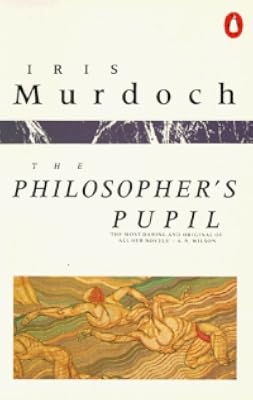
The Philosopher's Pupil
by Iris Murdoch 
On This Page
Description
A mysterious accident drives the inhabitants of a quiet town to face their darkest obsessionsWhen George McCaffrey's car plunges into a canal with his wife still inside, nobody knows whether George is to blame. Nobody, that is, except an Anglican priest who happened to witness the whole thing. And when George's former teacher, the charismatic philosopher Rozanov, returns to town, George's life begins to spin wildly out of control.Set in the English spa town of Ennistone, The Philosopher's show more Pupil is a darkly comic story of love, redemption, and the complex nature of the human condition. show lessTags
Recommendations




















Member Recommendations
P_S_Patrick Long, immersive, magic, philosophical novels to fully breathe the atmosphere of.
Member Reviews
What sucked me in was the opening, first, all dialog, effectively capturing the bitterness and insanity of a marital quarrel between George and Stella McCaffrey, followed by the introduction of N, the narrator-- that authorial sleight of hand, shifting abruptly from Edward Albee to Barchester Towers. Some elements that seem of the period (late 70s?) may require some acclimation, however: one could surely read the Stella-George relationship as a classic abuse pattern that does not seem to be acknowledged; and this is Trollope territory, not the multicultural London of Zadie Smith. The only non-Anglo characters of significance are the 3 "gipsy" sisters Ruby, Pearl, and Diamond (Diane), a maid, a companion for a schoolgirl, and a show more prostitute-- not treated as equals in this society. There's clearly an underlying set of ideas, symbolized by the spa machinery, but unlike Ayn Rand, Murdoch has the ability to create wacky, hilarious Dickensian characters-- the syncretic Father Bernard, the McCaffreys: Brian (George's brother) and Gabriel, Brian's classic British rudeness married to his "wet" wife who's always bursting into tears -- Alex mother of George, Brian, & Tom (callow bisexual youth). Alex has one Flora Finching turn where you see how Dickens influenced James Joyce-- George himself more of a Dostoyevsky buffoon. A virtuoso bit where the POV is from Zed, a Paris Hilton-type dog, with Zed confronting his Other, a fox. The philosopher John Robert Rozanov (who killed JRR?) a sort of loose and baggy monster with a relationship to his granddaughter Hattie (Pearl is her companion) that takes the Dickens father/daughter pattern (the Father of the Marshalsea and Little Dorrit) into something much more explicit but at the same time doesn't overdramatize the situation into a Lifetime special. The author proceeds to entangle the cast in a series of misunderstandings recalling Shakespeare comedies: twelfth night revelry, ambiguous sexuality (echoed by the assignment of "male" names to women and "female" names to men-- Emma, Alex, Gabriel), sudden reversals into aggressive rage, authority turned upside down, marriage and reconciliation, the reconciliation effected by expelling the philosopher from the world of art. A tantalizing loose end: N tells us that there are only two names known outside of Ennistone, the locale of the story: Rozanov and Ivor Sefton, a psychiatrist. The psychiatrist is alluded to throughout, but in the end never plays a part; does N deliberately exclude him by taking over the role of Ennistone's shrink? Possible negative: the amount of descriptive "irrelevant" detail may contribute to the loose and baggy impression (nearly 600 pages), but maybe consider it as part of a dialectic with the Platonic tendencies of the author: the materiality of the world holding the Idea in check, preventing it from bursting out like the boiling hot jets from Little Teaser. show less
Opening in the spirit of Who's afraid of Virginia Woolf? and closing with a kind of pastiche murder-mystery, this late-Murdoch romp is set in a claustrophobically-fictitious small town (think Barchester-Middlemarch-Tilling, but in the 1980s and with a spa) where all social life seems to revolve around Murdoch's favourite pastime, swimming. And, as you would expect, it's populated with larger than life characters who are all locked into terrible existential tangles which the reader is neither allowed to take completely seriously, nor to dismiss out of hand.
Brain-bending and entertaining at the same time, it reminded me very strongly - but anachronistically - of one of my favourite Murdoch-inspired novelists, Patrick Gale. This is so show more exactly the novel Murdoch would have written if she'd wanted to do a pastiche of Gale: complete with LGBT interest, Quaker meeting, music, and modern art. All that's lacking is a prison and a mention of Cornwall...! show less
Brain-bending and entertaining at the same time, it reminded me very strongly - but anachronistically - of one of my favourite Murdoch-inspired novelists, Patrick Gale. This is so show more exactly the novel Murdoch would have written if she'd wanted to do a pastiche of Gale: complete with LGBT interest, Quaker meeting, music, and modern art. All that's lacking is a prison and a mention of Cornwall...! show less
This is my 21st of Iris Murdoch's 26 novels, and reading them is always a pleasure. This one alternates between the serious and the farcical - one of the main characters is an eminent philosopher which allows Murdoch to indulge in plenty of philosophical and religious conversation and speculation, but the human comedy is never far away.
The book is narrated by the mysterious N, who plays a minor role in the story but seems to exist mostly to witness events and absorb gossip. He calls the setting Ennistone (from N's town), and although this sounds Irish as do many of the characters' surnames, the setting is a spa town in South East England.
The pupil of the title is George McCaffrey. In the opening scene George has an argument while show more driving with his wife, prompting an apparent accident in which the car ends up in the canal. He escapes before the car falls, but his wife is trapped inside, and George may have pushed the car in, but is unable to remember clearly. So he is something of a local demon figure.
George's old professor John Robert Rozanov, a former Ennistone resident now resident in America, returns to the town, but wants nothing to do with George, who he has told to abandon philosophy, a blow which George never recovers from.
Much of the story revolves around Rozanov's plot to get George's younger half-brother Tom to marry his young granddaughter Hattie, who has been installed in a house belonging to and in the garden of George's mother Alex. [Alex is one of several characters whose names are sexually ambiguous, others include George's sister-in-law Gabriel and Tom's male friend Emma (short for Emmanuel)].
Among the other weirder elements are a bizarre escapade in which Alex becomes trapped in the bowels of the spa, and a flying saucer which several characters see above a stone circle on the town's common.
Overall I found this one of Murdoch's more entertaining novels. show less
The book is narrated by the mysterious N, who plays a minor role in the story but seems to exist mostly to witness events and absorb gossip. He calls the setting Ennistone (from N's town), and although this sounds Irish as do many of the characters' surnames, the setting is a spa town in South East England.
The pupil of the title is George McCaffrey. In the opening scene George has an argument while show more driving with his wife, prompting an apparent accident in which the car ends up in the canal. He escapes before the car falls, but his wife is trapped inside, and George may have pushed the car in, but is unable to remember clearly. So he is something of a local demon figure.
George's old professor John Robert Rozanov, a former Ennistone resident now resident in America, returns to the town, but wants nothing to do with George, who he has told to abandon philosophy, a blow which George never recovers from.
Much of the story revolves around Rozanov's plot to get George's younger half-brother Tom to marry his young granddaughter Hattie, who has been installed in a house belonging to and in the garden of George's mother Alex. [Alex is one of several characters whose names are sexually ambiguous, others include George's sister-in-law Gabriel and Tom's male friend Emma (short for Emmanuel)].
Among the other weirder elements are a bizarre escapade in which Alex becomes trapped in the bowels of the spa, and a flying saucer which several characters see above a stone circle on the town's common.
Overall I found this one of Murdoch's more entertaining novels. show less
What to say? What to say? I absolutely decline to follow IM's tantalizing paths through philosophical, symbolic, thematic wildernesses in The Philosopher's Pupil. A person could get lost. I do look forward to discussions of this book, my favorite Iris Murdoch, in the biographies that I plan to read. I might even pick up some general criticism.
Told by an observant narrator, N who steps into the story from time to time, the book is set in Ennistown (Get it?), an English village with a restructured circle of standing stones and a very active hot spring. The whole town is crazy for swimming, and this is a very watery book. If people are not swimming at the baths, they are at the ocean or it is raining or about to rain or the rain is just show more stopping. There are suggestions of baptisms of one kind and another and one rescue from drowning and one death, maybe. Tom, the archetypal Fool, goes underground to find the Source of the springs and returns to the surface a man able to act decisively. And there you have a hint of the complexities that I refuse to follow one step further.
Well. The story revolves around the McCaffrey family: brothers George and Brian, their wives and mother and their half-brother Tom and Brian's son Adam. George is a wild man whose attempted murder (or maybe not) of his wife Stella opens the book; Brian, something of a nonentity, is married to Gabriel, who is fascinated by George. Into this seething mix of relationships returns John Robert Rozanov, the philosopher of the title, who has ruined George's life by ending their teacher-student relationship. Alex, their mother, would like to explore a relationship of her own with John Robert, who had married her college friend to her own great disgust. John Robert rents the Slipper House, a sort of live-in folly on the McCaffrey property, but to Alex's disappointment he plans to install his granddaughter and her companion there rather than live in it himself. The companion, Pearl, is sister - or is it cousin? - to Alex's own companion and servant Ruby and George's mistress, Diane (originally Diamond).
This begins, and only begins, to describe the widening net of characters who twine and intertwine in a mosh of emotions and intellect gone mad. IM must have had so much fun writing this. The plot twists are over the top; I shrieked, "Oh NO, you didn't!" more than once before dissolving in helpless laughter. On the other hand, as always, IM is examining the nature of Good and religion and non-religion, so this has to be a serious work, right? Whatever it is, it will bear rereading and thinking on. I'll do both. show less
Told by an observant narrator, N who steps into the story from time to time, the book is set in Ennistown (Get it?), an English village with a restructured circle of standing stones and a very active hot spring. The whole town is crazy for swimming, and this is a very watery book. If people are not swimming at the baths, they are at the ocean or it is raining or about to rain or the rain is just show more stopping. There are suggestions of baptisms of one kind and another and one rescue from drowning and one death, maybe. Tom, the archetypal Fool, goes underground to find the Source of the springs and returns to the surface a man able to act decisively. And there you have a hint of the complexities that I refuse to follow one step further.
Well. The story revolves around the McCaffrey family: brothers George and Brian, their wives and mother and their half-brother Tom and Brian's son Adam. George is a wild man whose attempted murder (or maybe not) of his wife Stella opens the book; Brian, something of a nonentity, is married to Gabriel, who is fascinated by George. Into this seething mix of relationships returns John Robert Rozanov, the philosopher of the title, who has ruined George's life by ending their teacher-student relationship. Alex, their mother, would like to explore a relationship of her own with John Robert, who had married her college friend to her own great disgust. John Robert rents the Slipper House, a sort of live-in folly on the McCaffrey property, but to Alex's disappointment he plans to install his granddaughter and her companion there rather than live in it himself. The companion, Pearl, is sister - or is it cousin? - to Alex's own companion and servant Ruby and George's mistress, Diane (originally Diamond).
This begins, and only begins, to describe the widening net of characters who twine and intertwine in a mosh of emotions and intellect gone mad. IM must have had so much fun writing this. The plot twists are over the top; I shrieked, "Oh NO, you didn't!" more than once before dissolving in helpless laughter. On the other hand, as always, IM is examining the nature of Good and religion and non-religion, so this has to be a serious work, right? Whatever it is, it will bear rereading and thinking on. I'll do both. show less
I've made the mistake of waiting too long to write this and the details are now sketchy in my head. I loved the setting of this one, in a spa town where a lot of action happens in the spa building aroud a pool. As usual everyone in the book is entangled with everyone else in the most unlikely ways. I really enjoyed this one, its a bit dreamlike and odd, but with some great settings and some classic Murdoch themes
Re-read this book for the first time in a couple of years. The setting is a slightly fantastical one, slightly not of the world we live in – a middle-class community with its own fads and fetishes, where everyone knows everyone else. The plot is excellent, if a little contrived at the end. Murdoch manages to get inside the heads of her characters, male and female, to an incredibly detailed extent, and it's possible to believe in them all, though none of them is "normal". The jarring note is the dialogue, which tends towards an over-analytical pedantic philosophical style, even when no philosophy is being directly discussed.
A novel to be thoroughly entranced and absorbed in. In many ways like Thomas Mann’s Magic Mountain, but set in a cross between Bath and East Grinstead. Iris Murdoch is one of those valuable rarities – someone who can write unique and momentous novels as well as philosophy, and cross pollinate the one with the allurements of the other.
Members
- Recently Added By
Lists

Books Read in 2023
5,638 works; 147 members

Academia in Fiction
158 works; 23 members
Talk Discussions
Past Discussions
The Philosopher's Pupil in Iris Murdoch readers (April 2013)
Author Information

100+ Works 29,312 Members
Iris Murdoch was one of the twentieth century's most prominent novelists, winner of the Booker Prize for The Sea. She died in 1999. (Publisher Provided) Iris Murdoch was born in Dublin, Ireland on July 15, 1919. She was educated at Badminton School in Bristol and Oxford University, where she read classics, ancient history, and philosophy. After show more several government jobs, she returned to academic life, studying philosophy at Newnham College, Cambridge. In 1948, she became a fellow and tutor at St. Anne's College, Oxford. She also taught at the Royal College of Art in London. A professional philosopher, she began writing novels as a hobby, but quickly established herself as a genuine literary talent. She wrote over 25 novels during her lifetime including Under the Net, A Severed Head, The Unicorn, and Of the Nice and the Good. She won several awards including the James Tait Black Memorial Prize for The Black Prince in 1973 and the Booker Prize for The Sea, The Sea in 1978. She died on February 8, 1999 at the age of 79. (Bowker Author Biography) show less
Iris Murdoch has a Legacy Library. Legacy libraries are the personal libraries of famous readers, entered by LibraryThing members from the Legacy Libraries group.
Some Editions
Awards and Honors
Awards
Distinctions
Work Relationships
Common Knowledge
- Canonical title
- The Philosopher's Pupil
- Original title
- The Philosopher's Pupil
- Original publication date
- 1983
- People/Characters*
- John Robert Rozanov; George McCaffrey
- Important places*
- Ennistone, Engeland, Groot-Brittannië (fictief)
- Dedication
- TO
ARNALDO MOMIGLIANO - First words
- A few minutes before his brainstorm, or whatever it was, took place, George McCaffrey was having a quarrel with his wife.
- Quotations
- Stella had moved into her own room the little collection of Japanese netsuke, gifts from her father, which had once stood upon the sitting-room mantelpiece.... She treasured them as tokens of her father's love.
- Last words
- (Click to show. Warning: May contain spoilers.)The end of a tale is arbitrarily determined. As I now end this one, somebody may say: but how on earth do you know all this things about all these people? Well, where does one person end and another person begin? It is my role in life to listen to stories. I also had the assistance of a certain lady.
- Original language*
- Engels
*Some information comes from Common Knowledge in other languages. Click "Edit" for more information.
Classifications
Statistics
- Members
- 710
- Popularity
- 40,130
- Reviews
- 15
- Rating
- (3.80)
- Languages
- 5 — Dutch, English, French, Spanish, Swedish
- Media
- Paper, Audiobook, Ebook
- ISBNs
- 13
- ASINs
- 8