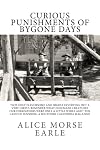
Curious Punishments of Bygone Days
by Alice Morse Earle
On This Page
Description
Alice Morse Earle was a social historian of great note at the turn of the century, and many of her books have lived on as well-researched and well-written texts of everyday life in Colonial America. Curious Punishments of Bygone Days was published in 1896. It is a catalog of early American crimes and their penalties, with chapters on the pillories, stocks, the scarlet letter, the ducking stool, discipline of authors and books (egad!), and four other horrifying examples of ways in which those show more who transgressed the laws of Colonial America were made to pay for their sins. show lessTags
Recommendations
























Member Reviews
Now utterly outdated, but still a noteworthy anecdotal and by no means particularly thoroughgoing history of crimes and punishments in the early English colonies (as well as a few cases from Britain). It's amazing to see how often this book is (still!) cited in new books and articles, without confirmation that Earle's examples were actually recounted accurately.
When reading accounts like those recalled in this book, one can't help but feel relieved to be living in this century! To think that there was a time when a person could be whipped for lying, or put in the stocks for being drunk or swearing, seems incredible from a twenty-first-century perspective. In fact it seemed incredible from the author of this book when it was published in 1896.
Some of the old punishments were shocking - barbaric even. Many petty criminals had their ears cut off before the beginning of the 1800s. Others had their tongues burned and branding was common.
This book mainly covers punishments administered in England and even more so in America, often comparing how these two nations dealt with criminals. In some cases show more a person was subjected to severe ordeals just because they were *suspected* of committing a crime - I imagine those later proved innocent were most aggrieved.
The author quotes many actual accounts from yesteryear exactly as they were written, but I think this book would've been a better read had she translated the old English spellings to the modern, as I found myself having to focus on what was being stated, rather than just absorbing the info. Other than that, this work is a good reference of how our forebears dealt with so-called criminals & actual criminals. show less
Some of the old punishments were shocking - barbaric even. Many petty criminals had their ears cut off before the beginning of the 1800s. Others had their tongues burned and branding was common.
This book mainly covers punishments administered in England and even more so in America, often comparing how these two nations dealt with criminals. In some cases show more a person was subjected to severe ordeals just because they were *suspected* of committing a crime - I imagine those later proved innocent were most aggrieved.
The author quotes many actual accounts from yesteryear exactly as they were written, but I think this book would've been a better read had she translated the old English spellings to the modern, as I found myself having to focus on what was being stated, rather than just absorbing the info. Other than that, this work is a good reference of how our forebears dealt with so-called criminals & actual criminals. show less
Reading a book written in the nineteenth century about punishments doled out in the sixteenth century, is an interesting experience. Basically just a list of painful (physically and mentally) punishments from the days of yore, including the Scarlet Letter, maiming of body parts and being placed in stocks in the public square. Ideally, I'd prefer to read a more recent version of a book of curious punishments of bygone days.
Ratings
Members
- Recently Added By
Author Information

33+ Works 1,308 Members
Common Knowledge
- First words
- There is no doubt that our far-away grandfathers, whether of English, French, Dutch, Scotch or Irish blood, were much more afraid of ridicule than they were even of sinning, and far more than we are of extreme derision or moc... (show all)kery to-day.
- Quotations
- There are plenty of other ways to shut a woman's mouth and to still a woman's tongue, as all sensible men know.
- Last words
- (Click to show. Warning: May contain spoilers.)It is certainly surprising and even mortifying to know that in Maryland setting fire to a hay-rick is to this day punishable by death.
Classifications
- Genres
- Nonfiction, History, General Nonfiction, Politics and Government
- DDC/MDS
- 364.6 — Society, government, & culture Social problems and social services Crime Punishment
- LCC
- HV8532 .U5 .E3 — Social sciences Social pathology. Social and public welfare. Criminology Social pathology. Social and public welfare. Criminal justice administration Penology. Prisons. Corrections
- BISAC
Statistics
- Members
- 86
- Popularity
- 372,498
- Reviews
- 3
- Rating
- (3.31)
- Languages
- English
- Media
- Paper, Ebook
- ISBNs
- 23
- ASINs
- 4