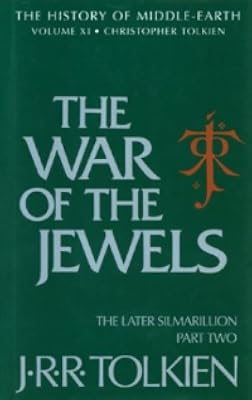
The War of the Jewels: The Later Silmarillion, Part Two
by J. R. R. Tolkien
The History of Middle-Earth (11)
On This Page
Description
In volumes ten and eleven of The History of Middle-earth, Christopher Tolkien recounts from the original texts the evolution of his father's work on The Silmarillion, the legendary history of the Elder Days or First Age, from the completion of the Lord of the Rings in 1949 until J.R.R. Tolkien's death. In volume ten, Morgoth's Ring, the narrative was taken only as far as the natural dividing point in the work, when Morgoth destroyed the Trees of Light and fled from Valinor bearing the stolen show more Silmarils. In The War of the Jewels, the story returns to Middle-earth and the ruinous conflict of the High Elves and the Men who were their allies with the power of the Dark Lord. With the publication in this book of all of J.R.R. Tolkien's later narrative writing concerned with the last centuries of the First Age, the long history of The Silmarillion, from its beginnings in The Book of Lost Tales, is completed; the enigmatic state of the work at his death can now be understood. A chief element in The War of the Jewels is a major story of Middle-earth, now published for the first time - a continuation of the great "saga" of Turin Turambar and his sister Nienor, the children of Hurin the Steadfast. This is the tale of the disaster that overtook the forest people of Brethil when Hurin came among them after his release from long years of captivity in Angband, the fortress of Morgoth. The uncompleted text of the Grey Annals, the primary record of the War of the Jewels, is given in full; the geography of Beleriand is studied in detail, with redrawings of the final state of the map; and a long essay on the names and relations of all the peoples of Middle-earth shows more clearly than any writing yet published the close connection between the language and history in Tolkien's world. The text also provides new information, including some knowledge of the divine powers, the Valar. show lessTags
Recommendations







Member Reviews
http://nwhyte.livejournal.com/2007516.html
The War of the Jewels brings together some final notes from the Silmarillion and a few other essays. The first chunk, the Grey Annals, is yet another attempt to retell the Silmarillion stories but this time taking a year-by-year approach; it also has much more detail on the Dark-Elf Ëol and his fathering of Maeglin than I remember before. There's also a long section on the tragic wanderings of Húrin after the deaths of his children which I don't remember from elsewhere, though it may have been in the Tale of the Children of Húrin. Various essays include some reflections on the origins of the races other than Elves and Men, more Elvish linguistics and the story of the Elves' awakening. Several show more comments from Tolkien junior reflecting on how he now wishes he had done the Silmarillion a bit differently. show less
The War of the Jewels brings together some final notes from the Silmarillion and a few other essays. The first chunk, the Grey Annals, is yet another attempt to retell the Silmarillion stories but this time taking a year-by-year approach; it also has much more detail on the Dark-Elf Ëol and his fathering of Maeglin than I remember before. There's also a long section on the tragic wanderings of Húrin after the deaths of his children which I don't remember from elsewhere, though it may have been in the Tale of the Children of Húrin. Various essays include some reflections on the origins of the races other than Elves and Men, more Elvish linguistics and the story of the Elves' awakening. Several show more comments from Tolkien junior reflecting on how he now wishes he had done the Silmarillion a bit differently. show less
Vol. 11. Christopher Tolkien systematizes his father's papers.
Members
- Recently Added By
Lists

LOTR wishlist
9 works; 1 member
Author Information

605+ Works 517,853 Members
A writer of fantasies, Tolkien, a professor of language and literature at Oxford University, was always intrigued by early English and the imaginative use of language. In his greatest story, the trilogy The Lord of the Rings (1954--56), Tolkien invented a language with vocabulary, grammar, syntax, even poetry of its own. Though readers have show more created various possible allegorical interpretations, Tolkien has said: "It is not about anything but itself. (Certainly it has no allegorical intentions, general, particular or topical, moral, religious or political.)" In The Adventures of Tom Bombadil (1962), Tolkien tells the story of the "master of wood, water, and hill," a jolly teller of tales and singer of songs, one of the multitude of characters in his romance, saga, epic, or fairy tales about his country of the Hobbits. Tolkien was also a formidable medieval scholar, as evidenced by his work, Beowulf: The Monster and the Critics (1936) and his edition of Anciene Wisse: English Text of the Anciene Riwle. Among his works published posthumously, are The Legend of Sigurd and Gudrún and The Fall of Arthur, which was edited by his son, Christopher. In 2013, his title, TheHobbit (Movie Tie-In) made The New York Times Best Seller List. (Bowker Author Biography) show less
All Editions
Some Editions
Series

Work Relationships
Is contained in
Common Knowledge
- Canonical title
- The War of the Jewels: The Later Silmarillion, Part Two
- Original publication date
- 1994-09
- People/Characters
- Túrin Turambar; Nienor; Hurin; Morgoth Bauglir
- Important places
- Middle-earth; Brethil; Angband; Beleriand
- Original language
- English
- Disambiguation notice
- Originally published in English as v. 7 of The history of Middle-earth
Classifications
Statistics
- Members
- 1,063
- Popularity
- 24,189
- Reviews
- 3
- Rating
- (4.02)
- Languages
- English, Spanish
- Media
- Paper, Ebook
- ISBNs
- 9
- UPCs
- 1
- ASINs
- 10