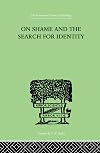
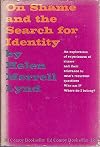
On Shame and the Search for Identity
by Helen Merrell Lynd
On This Page
Description
First published in 1999. Routledge is an imprint of Taylor & Francis, an informa company.Tags
Recommendations







































Member Reviews
I bought this book while writing about Guilt-avoidance and I discovered this wonderfully indexed book on Shame! Her ventilation of the subject includes a lot of Aristotle, and other social scientists such as anthropologists and novelists. She develops a theory of personality around a guilt/shame axis. Well, makes perfect sense!
Niebuhr and theologians often find inadequacies in the secular theories and claim that Guilt is one of the reasons for our present plight. Freudians believe that guilt/shame pervade life. [17] Dr Lynd seeks to fill the insufficiency.
The word "shame" is no longer much used. For example, in Tolstoy, or in the middle east, it appears as both noun and verb - society actively shames individuals. Whether external show more shame, or self-reproach guilt, it is a failure to live up to expectations. Citing the work of Freud and Ruth Benedict, the anthropologist.
Dr Lynd compares the English/German single word for shame (in one's own eyes and in the eyes of others) [50], with French and Greek dualities. Compare too, "guiltless" is an honorific, but "shameless" is an opprobrium. [24]
Shakespeare uses the "shame" family of concepts nine times more than the guilt cluster. Shame is dramatically close to the Self.[26]
The author links awareness to identity. There is of course, a very strong link between awareness, and the feeling of "being responsible", which is the growing seed of Guilt.
The book provides stepping stones -- the dialectic of the amazing array of thinkers she cites -- for achieving the ability to transcend the paradoxes and traps of shame. Here is an example: "If we conceive that pride can be, not arrogance as compensation for uncertainty, but a quality of honor and self-respect, we come closer to a central, inescapable question: How can an individual reach his full statute without committing the sin of pride, attempting to reach beyond man's li,iations?" [254] She flips that to the converse--acknowledge the universe is greater without abasing himself, and then gives a brilliant summary of Nietzsche's experience with this beast: "Nietzsche in the assertion of individual strength felt man allied to the universe, but for him this meant contempt for most men and for any kind of society." [254]
She introduces Fromm, with his critique of Calvinism's condemnation of us as sinners, and the idea of self-respect as the basis of morality. To tie this up, she transcends the paradox between pride and humility "by resting in irony as a substitute" for the confrontation. Logical contradictions can be resolved. Only Paradox which is contradiction that inheres in the nature of things cannot be resolved. "It can only be transcended, in Hegel's terms, aufgehoben." show less
Niebuhr and theologians often find inadequacies in the secular theories and claim that Guilt is one of the reasons for our present plight. Freudians believe that guilt/shame pervade life. [17] Dr Lynd seeks to fill the insufficiency.
The word "shame" is no longer much used. For example, in Tolstoy, or in the middle east, it appears as both noun and verb - society actively shames individuals. Whether external show more shame, or self-reproach guilt, it is a failure to live up to expectations. Citing the work of Freud and Ruth Benedict, the anthropologist.
Dr Lynd compares the English/German single word for shame (in one's own eyes and in the eyes of others) [50], with French and Greek dualities. Compare too, "guiltless" is an honorific, but "shameless" is an opprobrium. [24]
Shakespeare uses the "shame" family of concepts nine times more than the guilt cluster. Shame is dramatically close to the Self.[26]
The author links awareness to identity. There is of course, a very strong link between awareness, and the feeling of "being responsible", which is the growing seed of Guilt.
The book provides stepping stones -- the dialectic of the amazing array of thinkers she cites -- for achieving the ability to transcend the paradoxes and traps of shame. Here is an example: "If we conceive that pride can be, not arrogance as compensation for uncertainty, but a quality of honor and self-respect, we come closer to a central, inescapable question: How can an individual reach his full statute without committing the sin of pride, attempting to reach beyond man's li,iations?" [254] She flips that to the converse--acknowledge the universe is greater without abasing himself, and then gives a brilliant summary of Nietzsche's experience with this beast: "Nietzsche in the assertion of individual strength felt man allied to the universe, but for him this meant contempt for most men and for any kind of society." [254]
She introduces Fromm, with his critique of Calvinism's condemnation of us as sinners, and the idea of self-respect as the basis of morality. To tie this up, she transcends the paradox between pride and humility "by resting in irony as a substitute" for the confrontation. Logical contradictions can be resolved. Only Paradox which is contradiction that inheres in the nature of things cannot be resolved. "It can only be transcended, in Hegel's terms, aufgehoben." show less
Members
- Recently Added By
Author Information
4 Works 381 Members
Classifications
Statistics
- Members
- 24
- Popularity
- 1,114,088
- Reviews
- 1
- Rating
- (4.50)
- Languages
- English
- Media
- Paper, Ebook
- ISBNs
- 5
- ASINs
- 4