On This Page
Description
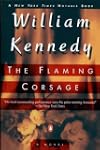
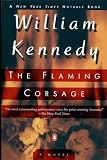
A turbulent mixed marriage in New York State at the turn of the century. He is Edward, a low-class Irish-Catholic, she is Katrina from a wealthy and established Protestant family and she converts to Catholicism. It doesn't help that on becoming a famous playwright he flaunts his new wealth.Tags
Recommendations







Member Reviews
The Flaming Corsage is my favorite of Kennedy's novels. I'll not argue that it's the best, the most important, or the most fully realized. I haven't the space or the desire to make such strong claims.
With that said, part of what pushes Corsage to the forefront of Kennedy's collected works is its well developed main character, Edward Daugherty. Of all Kennedy's protagonists, Daugherty is the one with whom educated folk can most fully empathize. Daugherty is an intellectual rather than a politician, a bum, or a crooked lawyer. While he has personal failings, he strikes the reader as an essentially decent, if upwardly mobile, human being.
Daugherty is a second generation Irish-American living in a time and place where Irishness was still show more thought to be tantamount to perpetual slovenliness. His world is governed by the Dutch patroons and high church Episcopalians of which the 19th century NY elite was comprised. Through a twist of fate and the enlightened generosity of one of the ruling class families, Edward is given a stipend, an upper-crust education, and all the sundry privileges that come with elite endorsement. It is this background that allows him to pursue his intellectual calling and thus to achieve fame, wealth, a spate of good reviews as an play-write and erstwhile novelist/journalist/miscellaneous man of letters. His youthful cultivation, along with perhaps his legitimate adult achievements, also allow him to marry Kathrine.
Kathrine is the granddaughter of his principle benefactor and also a kind of outsider's personification of the good life; she is beautiful, intelligent, and interesting...and yet at her core there is a deep kind of malaise given to rot. Having attained her, those qualities that make up her allure are no protection from the cold reality that there is no way to unconditionally achieve what is most desired. Even when we get what we set out for, even when we gain entrance into the good society or meet those standards that seem to precipitate the good life, we often discover a certain hollowness. When such achievements divorce us from our pasts the hollowness is exacerbated.
And so the marriage serves as the catalyst for Daugherty's descent back into the Irishness he'd escaped and thus as the focal point for Kennedy's vivid, inspired, and thought-provoking musing on an age old theme: the conflict between aspiration and cultivation, between love and class background.
Although the American experience puts a unique spin on these themes (where else might a Black Jew marry a Polish Catholic) they're as old as literature itself. From our forebears we inherit a constellation of beliefs, concepts, dispositions, inclinations, aspirations, and so forth. Our background bequeaths to us a way of seeing the world. Conflict emerges when we take our own intellectual inheritance out into a world in which others have emerged from rather different circumstances. Thus we encounter in Edward the psychological strain of balancing a patrician education with a decidedly working class upbringing. We see the paralysis produced when one's aims are no longer commensurate with those of one's forebears and yet cannot be easily reoriented to overlap with the aims of any other group. Daugherty, caught between two worlds, is, for a man with plenty of friends, quite alone.
I found it unsurprising when Kennedy referenced Ibsen, for this is a tale rife with the same sort of conflict the informed much of Ibsen's writing. To wit, Corsage is Kennedy's uniquely Albanian take on the perennial battle between the individual who sets off on his own course and the society which he is attempting to escape, improve, or otherwise subvert. show less
With that said, part of what pushes Corsage to the forefront of Kennedy's collected works is its well developed main character, Edward Daugherty. Of all Kennedy's protagonists, Daugherty is the one with whom educated folk can most fully empathize. Daugherty is an intellectual rather than a politician, a bum, or a crooked lawyer. While he has personal failings, he strikes the reader as an essentially decent, if upwardly mobile, human being.
Daugherty is a second generation Irish-American living in a time and place where Irishness was still show more thought to be tantamount to perpetual slovenliness. His world is governed by the Dutch patroons and high church Episcopalians of which the 19th century NY elite was comprised. Through a twist of fate and the enlightened generosity of one of the ruling class families, Edward is given a stipend, an upper-crust education, and all the sundry privileges that come with elite endorsement. It is this background that allows him to pursue his intellectual calling and thus to achieve fame, wealth, a spate of good reviews as an play-write and erstwhile novelist/journalist/miscellaneous man of letters. His youthful cultivation, along with perhaps his legitimate adult achievements, also allow him to marry Kathrine.
Kathrine is the granddaughter of his principle benefactor and also a kind of outsider's personification of the good life; she is beautiful, intelligent, and interesting...and yet at her core there is a deep kind of malaise given to rot. Having attained her, those qualities that make up her allure are no protection from the cold reality that there is no way to unconditionally achieve what is most desired. Even when we get what we set out for, even when we gain entrance into the good society or meet those standards that seem to precipitate the good life, we often discover a certain hollowness. When such achievements divorce us from our pasts the hollowness is exacerbated.
And so the marriage serves as the catalyst for Daugherty's descent back into the Irishness he'd escaped and thus as the focal point for Kennedy's vivid, inspired, and thought-provoking musing on an age old theme: the conflict between aspiration and cultivation, between love and class background.
Although the American experience puts a unique spin on these themes (where else might a Black Jew marry a Polish Catholic) they're as old as literature itself. From our forebears we inherit a constellation of beliefs, concepts, dispositions, inclinations, aspirations, and so forth. Our background bequeaths to us a way of seeing the world. Conflict emerges when we take our own intellectual inheritance out into a world in which others have emerged from rather different circumstances. Thus we encounter in Edward the psychological strain of balancing a patrician education with a decidedly working class upbringing. We see the paralysis produced when one's aims are no longer commensurate with those of one's forebears and yet cannot be easily reoriented to overlap with the aims of any other group. Daugherty, caught between two worlds, is, for a man with plenty of friends, quite alone.
I found it unsurprising when Kennedy referenced Ibsen, for this is a tale rife with the same sort of conflict the informed much of Ibsen's writing. To wit, Corsage is Kennedy's uniquely Albanian take on the perennial battle between the individual who sets off on his own course and the society which he is attempting to escape, improve, or otherwise subvert. show less
Not my favorite Kennedy book, but a very good read. Characters that have ambitions, ambitions complicated by social and familial baggage, are central to the book. Succumbing to personal desires and disenchantment with the personal desires and decisions of others creating a complicated tragic mystery, a mystery explained in various ways by various characters - never fully resolved or disentangled. In the end, the reality of unfulfilled promise and potential is harsh. One of the few Kennedy books that did not convey a sense of redemption amid the personal pain.
don't quite know what to say about this. is it about the despair and unfullfilment of aging? is it that the charm and beauty of youth can hide real wackiness? or we never really know anyone or what really happened? or what?
The story was interesting but the structure made it hard to follow. The dialogue was stilted. I wouldn't read any other books by this author.
Ratings
Members
- Recently Added By
Author Information

19+ Works 5,648 Members
Series

Belongs to Publisher Series
Otavan kirjasto (144)
Work Relationships
Is contained in
Common Knowledge
- Original title
- The Flaming Corsage
- Original publication date
- 1996
Classifications
Statistics
- Members
- 277
- Popularity
- 116,003
- Reviews
- 4
- Rating
- (3.52)
- Languages
- English, Finnish
- Media
- Paper, Audiobook, Ebook
- ISBNs
- 8
- ASINs
- 4