The Sceptical Chymist
by Robert Boyle
On This Page
Description
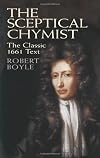
This classic of scientific reporting by English chemist Robert Boyle, first published in 1661, is the best known of his many works. In this volume, Boyle defines the term "element," asserting that all natural phenomena can be explained by the motion and organization of primary particles.Tags
Recommendations













Member Reviews
Robert Boyle’s dense, stilted language takes great patience and devotion to navigate, but the rewards are many. To read him is to time-travel, to live inside and experience a different era and a mind-set truly different from the one we assume today.
Five friends meet in a garden for a civilized chat about the “constituents of the mixt bodies.” Their fictional conversation, published in 1649, is a landmark of the new “enlightened” philosophy that will complicate and forever change the way people relate to the physical world. The conversation continues today, but conducted in a much less civilized manner.
The five:
Carneades, host and Skeptic - Enlightened philosopher, dedicated to experiential chymical exploration;
Philoponus, show more Sober Chymist [as opposed to the uneducated, common “Vulgar Chymist”] - adherent of Paracelsus’ Spagyrist Doctrine of three Principles: Mercury, Sulphur, Salt;
Themistius, Aristotelian - adherent of the classical Doctrine of four “Peripatetick” Elements: Earth, Air, Fire, Water;
Eleutherius, impartial Judge;
unnamed narrator, secretary - records the exchange.
Themistius presciently anticipates the Uncertainty Principle. He advocates for a world view based upon established “Reason.” Aristotle’s Doctrine is “Obvious,” stable, and an expression of eternal “Truth.” Laboratory experiments are done in order to support the truth of that Doctrine, not the other way around where experimental results determine Doctrine. That way, he notes with horror, one never settles on “Truth” at all. Doctrine must be modified and changed with each new discovery.
Themistius explains, “For this [Aristotelian] Doctrine is very different from the whimseys of Chymists and other Modern Innovators, of whose Hypotheses we may observe, as Naturalists do of less perfect Animals, that as they are hastily form'd, so they are commonly short liv'd. For so these, as they are often fram'd in one week, are perhaps thought fit to be laughed at the next ; and being built perchance but upon two or three Experiments are destroyed by a third or fourth, whereas the doctrine of the four Elements was fram'd by Aristotle after he had leasurely considered those Theories of former Philosophers, which are now with great applause revived, as discovered by these latter ages ; And had so judiciously detected and supplyed the Errors and defects of former Hypotheses concerning the Elements, that his Doctrine of them has been ever since deservedly embraced by the letter'd part of Mankind.”
In “The Myth of the Eternal Return” Mircea Eliade names this dread of relativity and ambiguity. He calls it the Terror of History.
https://www.librarything.com/work/37685/book/25101668 show less
Five friends meet in a garden for a civilized chat about the “constituents of the mixt bodies.” Their fictional conversation, published in 1649, is a landmark of the new “enlightened” philosophy that will complicate and forever change the way people relate to the physical world. The conversation continues today, but conducted in a much less civilized manner.
The five:
Carneades, host and Skeptic - Enlightened philosopher, dedicated to experiential chymical exploration;
Philoponus, show more Sober Chymist [as opposed to the uneducated, common “Vulgar Chymist”] - adherent of Paracelsus’ Spagyrist Doctrine of three Principles: Mercury, Sulphur, Salt;
Themistius, Aristotelian - adherent of the classical Doctrine of four “Peripatetick” Elements: Earth, Air, Fire, Water;
Eleutherius, impartial Judge;
unnamed narrator, secretary - records the exchange.
Themistius presciently anticipates the Uncertainty Principle. He advocates for a world view based upon established “Reason.” Aristotle’s Doctrine is “Obvious,” stable, and an expression of eternal “Truth.” Laboratory experiments are done in order to support the truth of that Doctrine, not the other way around where experimental results determine Doctrine. That way, he notes with horror, one never settles on “Truth” at all. Doctrine must be modified and changed with each new discovery.
Themistius explains, “For this [Aristotelian] Doctrine is very different from the whimseys of Chymists and other Modern Innovators, of whose Hypotheses we may observe, as Naturalists do of less perfect Animals, that as they are hastily form'd, so they are commonly short liv'd. For so these, as they are often fram'd in one week, are perhaps thought fit to be laughed at the next ; and being built perchance but upon two or three Experiments are destroyed by a third or fourth, whereas the doctrine of the four Elements was fram'd by Aristotle after he had leasurely considered those Theories of former Philosophers, which are now with great applause revived, as discovered by these latter ages ; And had so judiciously detected and supplyed the Errors and defects of former Hypotheses concerning the Elements, that his Doctrine of them has been ever since deservedly embraced by the letter'd part of Mankind.”
In “The Myth of the Eternal Return” Mircea Eliade names this dread of relativity and ambiguity. He calls it the Terror of History.
https://www.librarything.com/work/37685/book/25101668 show less
This Classics of Science Library edition (1997) is a beautifully bound volume that one can read with turning the book to scraps. The binding is fake leather and the edges are gilded, making it both attractive and robust. Original published in 1661.
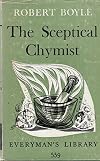
Volume number 559 in Everyman's Library with dust cover still intact.
Price in pounds
Ratings
Members
- Recently Added By
Author Information

74+ Works 329 Members
Born in Munster, Ireland, of English parents, Robert Boyle was among the earliest scientists who studied nature and drew conclusions justified by experiments. A son of a wealthy man, he received a good education. In 1654 he set up a laboratory in Oxford, England, and hired Robert Hooke (1634-1703) as his laboratory assistant. Boyle and Hooke show more designed a greatly improved air pump, which enabled them to study the behavior of air by creating a sufficient vacuum. In 1660 Boyle published Spring and Weight of the Air in which he articulated Boyle's Law, describing the inverse relationship between the temperature and the pressure of a gas. In 1661 Boyle published The Sceptical Chymist in which he challenged the alchemists' belief in the four elements of earth, air, fire, and water. He also attacked the three principles of Paracelsus: salt, sulfur, and mercury. Boyle also studied the relationship between air and combustion and the respiration of animals, and reported his findings in Suspicions about Some Hidden Qualities of the Air (1674). However, the discovery of oxygen would wait for Joseph Priestley. Boyle experimented with the calcination of tin in a sealed container, but, because he weighed only the resultant tin oxide, he did not get sufficient data to interpret the results accurately. When the tin oxide weighed more than the original tin, he theorized that a substance had passed into the glass container. Lavoisier later repeated the experiment, weighed the container, and realized that something in the air had combined with the tin. With his discovery of Boyle's Law, Boyle became somewhat of a celebrity and enjoyed the favor of King Charles II. Boyle contributed to the founding of the Royal Society of London for Improving Natural Knowledge in 1662. Boyle died in London in 1691. (Bowker Author Biography) show less
Series
Belongs to Publisher Series
Common Knowledge
- Canonical title
- The Sceptical Chymist
- Alternate titles
- Sceptical Chymist
- Original publication date
- 1661
Classifications
- Genres
- Science & Nature, Nonfiction, History, Philosophy
- DDC/MDS
- 540 — Natural sciences & mathematics Chemistry Chemistry and allied sciences
- LCC
- QD27 — Science Chemistry Chemistry General
- BISAC
Statistics
- Members
- 125
- Popularity
- 261,625
- Reviews
- 4
- Rating
- (4.20)
- Languages
- English, German, Italian, Spanish
- Media
- Paper, Ebook
- ISBNs
- 25
- ASINs
- 15