
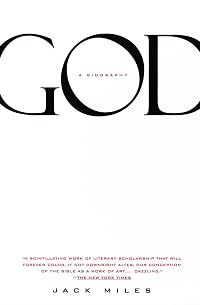
God: A Biography
by Jack Miles
On This Page
Description
Miles shows us God in the guise of a great literary character, the hero of the Old Testament. In a close, careful, and inspired reading of that testament - book by book, verse by verse - God is seen from his first appearance as Creator to his last as Ancient of Days. The God whom Miles reveals to us is a warrior whose greatest battle is with himself. We see God torn by conflicting urges. To his own sorrow, he is by turns destructive and creative, vain and modest, subtle and naive, ruthless show more and tender, lawful and lawless, powerful yet powerless, omniscient and blind. As we watch him change amazingly, we are drawn into the epic drama of his search for self-knowledge, the search that prompted him to create mankind as his mirror. In that mirror he seeks to examine his own reflection, but he also finds there a rival. We then witness God's own perilous passage from power to wisdom. For generations our culture's approach to the Bible has been more a reverential act than a pursuit of knowledge about the Bible's protagonist; and so, through the centuries the complexity of God's being and "life" has been diluted in our consciousness. In this book we find - in precisely chiseled relief - the infinitely complex God who made infinitely complex man in his image. Here, we come closer to the essence of that literary masterpiece that has shaped our culture no less than our religious life. In God: A Biography, Jack Miles addresses his great subject with imagination, insight, learning, daring, and dazzling originality, giving us at the same time an illumination of the Old Testament as a work of consummate art and a journey to the secret heart of God. show lessTags
Recommendations


Member Recommendations
Member Reviews
Using the Hebrew Bible as his text, Miles shows us a God who evolves through his relationship with man, the image who in time becomes his rival. Here is the Creator who nearly destroys his chief creation; the bloodthirsty warrior and the protector of the downtrodden; the lawless law-giver; the scourge and the penitent. Profoundly learned, stylishly written, the resulting work illuminates God and man alike and returns us to the Bible with a sense of discovery and wonder.
What sort of person is God? What is his life story? Is it possible to approach him not as an object of religious reference, but as the protagonist of the world's greatest book -- as a character who possesses all the depths, contradictions, and ambiguities of a Hamlet? This is the task that Jack Miles, a former Jesuit trained in religious studies and near Eastern languages, accomplishes with such brilliance and originality in this book.
Miles shows us God in the guise of a great literary character, the hero of the Old Testament. In a close, careful, and inspired reading of that testament - book by book, verse by verse - God is seen from his first appearance as Creator to his last as Ancient of Days. The God whom Miles reveals to us is a warrior whose greatest battle is with himself. We see God torn by conflicting urges. To his own sorrow, he is by turns destructive and creative, vain and modest, subtle and naive, ruthless and tender, lawful and lawless, powerful yet powerless, omniscient and blind. As we watch him change amazingly, we are drawn into the epic drama of his search for self-knowledge, the search that prompted him to create mankind as his mirror. In that show more mirror he seeks to examine his own reflection, but he also finds there a rival. We then witness God's own perilous passage from power to wisdom. For generations our culture's approach to the Bible has been more a reverential act than a pursuit of knowledge about the Bible's protagonist; and so, through the centuries the complexity of God's being and "life" has been diluted in our consciousness. In this book we find - in precisely chiseled relief - the infinitely complex God who made infinitely complex man in his image. Here, we come closer to the essence of that literary masterpiece that has shaped our culture no less than our religious life. In God: A Biography, Jack Miles addresses his great subject with imagination, insight, learning, daring, and dazzling originality, giving us at the same time an illumination of the Old Testament as a work of consummate art and a journey to the secret heart of God. show less
My Rabbi lent me the book, after a member of my Torah Study (don't worry I'm not that religious) group inspired me to read it. I'll admit due to my lack of training it was a slog to read, but worth the effort. And that is despite the fact that the book contains one serious omission. This omission is the silence as to the civil society that G-d created, and that we exercise literally every day. This society, probably the greatest that has ever been created, has been partially incorporated in Christianity and is the foundation of what has become the U.S., Canada, Australia and other "new world" societies.
Unlike Miles, I do not trace G-d progress from a roaring, false start to a fading conclusion. I agree that the Hebrews constantly show more back-slid into paganism. Our Cantor (basically a singing spiritual leader, but in this case beyond brilliant) posits, I think accurately, that in the Hebrews' early years there was "monolatry" or G-d being the first among other peer divine figures. As a history buff myself I trace the Hebrews' halting progress not to G-d's initial enthusiasm followed by loss of interest, as the successful creation of a society that decried "placing stumbling blocks before the blind", that mandated fair weights and measures, that directed leaving the corners of fields uncut and, most importantly for my profession, the periodic forgiveness of debts.
As a lawyer in that field I believe that the forgiveness was necessarily situational, based upon need and not occuring on a blanket basis. I see the seven years as a ceiling on how often a person or family could utilize the "debt holiday." That timeline was enshrined into bankruptcy legislation starting either in 1898 or 1938, and included in the 1978 Bankruptcy Reform Act. It was heartlessly extended to eight years by a cruel Congress, but the "seven" year figure was of Biblical origin.
On a positive note I learned a lot about the later books in the Tanakh (sp) that I didn't know. I found it necessary to read intermittently, indeed alternately with a book I am reading about John Adams' representation of British soldiers after the Boston Massacre, John Adams Under Fire: The Founding Father's Fight for Justice in the Boston Massacre, by Dan Abrams and David Fisher.
So I give it a "four" because of its uniqueness and novelty, despite my serious disagreement with parts of the book. show less
Unlike Miles, I do not trace G-d progress from a roaring, false start to a fading conclusion. I agree that the Hebrews constantly show more back-slid into paganism. Our Cantor (basically a singing spiritual leader, but in this case beyond brilliant) posits, I think accurately, that in the Hebrews' early years there was "monolatry" or G-d being the first among other peer divine figures. As a history buff myself I trace the Hebrews' halting progress not to G-d's initial enthusiasm followed by loss of interest, as the successful creation of a society that decried "placing stumbling blocks before the blind", that mandated fair weights and measures, that directed leaving the corners of fields uncut and, most importantly for my profession, the periodic forgiveness of debts.
As a lawyer in that field I believe that the forgiveness was necessarily situational, based upon need and not occuring on a blanket basis. I see the seven years as a ceiling on how often a person or family could utilize the "debt holiday." That timeline was enshrined into bankruptcy legislation starting either in 1898 or 1938, and included in the 1978 Bankruptcy Reform Act. It was heartlessly extended to eight years by a cruel Congress, but the "seven" year figure was of Biblical origin.
On a positive note I learned a lot about the later books in the Tanakh (sp) that I didn't know. I found it necessary to read intermittently, indeed alternately with a book I am reading about John Adams' representation of British soldiers after the Boston Massacre, John Adams Under Fire: The Founding Father's Fight for Justice in the Boston Massacre, by Dan Abrams and David Fisher.
So I give it a "four" because of its uniqueness and novelty, despite my serious disagreement with parts of the book. show less
Is it too jejune to call something magisterial these days? Not if by that, I think, you mean a work that strides confidently, uniquely, charismatically, and is as resplendent in its execution as this. The manner of this book is one of those ideas that is so simple and effective, its a wonder it hasn't been done before this: analyze and present God as a literary character, in the manner of literary analysis; God as Hamlet, if you will. Jack Miles really pulls it off, and brings fresh perspective to even the most well worn biblical territory by his adroit and lucid application of this approach. This work won a Pulitzer Prize; but I'm not just jumping on the bandwagon, nor plumping my own feathers for having enjoyed it; if you're remotely show more interested in this type of thing, it's a page turner filled with insight and revelation. show less
Jack Miles has an interesting concept. In order to write a biography on God he had to first consider him as a character in the Old Testament. He had to analyze the "character development" and bear witness to the relationships between God and the other primary "characters" of the Bible. One has to think of God and Lord as different. God takes on a variety of roles (including animal husbandry counselor). Miles's philosophy is strong and pragmatically sound, even for an agnostic like me. It works. Somehow, it really works. Others must agree because God: a Biography won Miles a Pulitzer.
This book -- and it's companion, Christ: A Crisis in the Life of God -- offer a completely original perspective on the Bible, simply as a story, with God as the protagonist. By shedding the usual dogmatic assumption that God is unchanging, the author is able to highlight some remarkably fresh insights about our understanding of God. As a believer, I can read it as a history of developments in the human comprehension of God. The author is a former Jesuit, with a doctorate in Near Eastern languages from Harvard, who went on to serve as literary editor for the Los Angeles Times: a scholar who writes beautifully. I count him a genius. I recommend the book to anyone who has the slightest interest in the Bible. Prepare to have your show more assumptions challenged. show less
Members
- Recently Added By
Published Reviews
PORTRAIT DE DIEU LUI-MÊME. — Dieu se raconte-t-il" Quels sentiments, à défaut de visage, lui prêter" Bien que de toute éternité son histoire ne commence qu'avec la Création, son "oeuvre maîtresse et unique au sein de laquelle l'homme se taille la meilleure part.
Dieu se raconte-t-il? Quels sentiments, à défaut de visage, lui prêter? Bien que de toute éternité son histoire ne show more commence qu'avec la Création, son oeuvre maîtresse et unique au sein de laquelle l'homme se taille la meilleure part. D'ailleurs, c'est par rapport à lui, conçu à sa ressemblance, dit la Genèse, que se forge son destin. Sans l'homme, Dieu s'abandonnerait à un ennui sans fin.
Contrairement aux panthéons antiques où l'on se bousculait, il n'a pas à se mêler à d'autres dieux ou déesses avec lesquels il nouerait des affaires sordides et compliquées. La grandeur du monothéisme tient à ce splendide isolement qui se renforce dans son face-à-face avec une créature qu'il a façonnée de ses mains et de son souffle mais qui lui échappe, pour son plus grand malheur, sans délai.
C'est donc le portrait de ce personnage - encore que le mot, à la limite du blasphème, soit ontologiquement inexact - que Jack Miles, un ancien jésuite qui a gardé une foi intacte, s'est attaché à dresser en relisant pour nous l'Ancien Testament ou plutôt le Tanakh, la Bible hébraïque. Entre le Pentateuque et les textes des prophètes, entre le Cantique des Cantiques et l'Ecclésiaste, Dieu se révèle tel qu'en lui-même, c'est-à-dire passablement humain, souvent animé d'une colère que l'on évitera de qualifier de jupitérienne, plus rarement de compassion. On fera la moue et on ne trouvera guère charitable le Dieu d'Abraham, d'Isaac et de Jacob.
Jusqu'au bout il cultive une ambiguïté fondamentale. Il parle d'amour mais ressent-il de la souffrance aux tourments de Job, de la joie à la délivrance du peuple juif? Là-dessus les Ecritures font silence. Et si l'homme ne le satisfait pas pleinement, pourquoi ne le change-t-il pas du tout au tout? A croire qu'il s'accommode de cette imperfection consubstantielle à la nature humaine. Au fait, ne l'aurait-il pas voulue? Et la morale dans tout ça?
Jack Miles n'en finit pas d'interroger Dieu au travers de sa Création. Il le fait avec un mélange d'ironie et de profondeur, de distance et d'acuité qui laisse songeur. Toujours est-il que cette biographie a ceci de rassurant qu'elle nous en apprend encore beaucoup sur un Etre aussi peu romanesque qu'il est possible mais dont un roman n'épuiserait pas l'infini mystère. show less
Dieu se raconte-t-il? Quels sentiments, à défaut de visage, lui prêter? Bien que de toute éternité son histoire ne show more commence qu'avec la Création, son oeuvre maîtresse et unique au sein de laquelle l'homme se taille la meilleure part. D'ailleurs, c'est par rapport à lui, conçu à sa ressemblance, dit la Genèse, que se forge son destin. Sans l'homme, Dieu s'abandonnerait à un ennui sans fin.
Contrairement aux panthéons antiques où l'on se bousculait, il n'a pas à se mêler à d'autres dieux ou déesses avec lesquels il nouerait des affaires sordides et compliquées. La grandeur du monothéisme tient à ce splendide isolement qui se renforce dans son face-à-face avec une créature qu'il a façonnée de ses mains et de son souffle mais qui lui échappe, pour son plus grand malheur, sans délai.
C'est donc le portrait de ce personnage - encore que le mot, à la limite du blasphème, soit ontologiquement inexact - que Jack Miles, un ancien jésuite qui a gardé une foi intacte, s'est attaché à dresser en relisant pour nous l'Ancien Testament ou plutôt le Tanakh, la Bible hébraïque. Entre le Pentateuque et les textes des prophètes, entre le Cantique des Cantiques et l'Ecclésiaste, Dieu se révèle tel qu'en lui-même, c'est-à-dire passablement humain, souvent animé d'une colère que l'on évitera de qualifier de jupitérienne, plus rarement de compassion. On fera la moue et on ne trouvera guère charitable le Dieu d'Abraham, d'Isaac et de Jacob.
Jusqu'au bout il cultive une ambiguïté fondamentale. Il parle d'amour mais ressent-il de la souffrance aux tourments de Job, de la joie à la délivrance du peuple juif? Là-dessus les Ecritures font silence. Et si l'homme ne le satisfait pas pleinement, pourquoi ne le change-t-il pas du tout au tout? A croire qu'il s'accommode de cette imperfection consubstantielle à la nature humaine. Au fait, ne l'aurait-il pas voulue? Et la morale dans tout ça?
Jack Miles n'en finit pas d'interroger Dieu au travers de sa Création. Il le fait avec un mélange d'ironie et de profondeur, de distance et d'acuité qui laisse songeur. Toujours est-il que cette biographie a ceci de rassurant qu'elle nous en apprend encore beaucoup sur un Etre aussi peu romanesque qu'il est possible mais dont un roman n'épuiserait pas l'infini mystère. show less
added by Joop-le-philosophe
Author Information

25+ Works 3,200 Members
He has been a Regents Lecturer at the University of California & a professor of humanities at Claremont Graduate University. He is currently senior adviser to the president of the J. Paul Getty Trust. He lives in Pasadena, California. (Bowker Author Biography)
Awards and Honors
Awards
Notable Lists
Common Knowledge
- Canonical title*
- Gott
- Original title
- God
- Alternate titles*
- God : een biografie
- Original publication date
- 1995
- People/Characters
- God
- Dedication
- To Jacqueline and for Kathleen
- First words
- That God created mankind, male and female, in his own image is a matter of faith. That our forebears strove for centuries to perfect themselves in the image of their God is a matter of historical fact.
- Last words
- (Click to show. Warning: May contain spoilers.)"The intellect of man is forced to choose / Perfection of the life, or of the work," W. B. Yeats wrote. In its poignancy, the line seems quintessentially modern, but it has everything to do with the ancient buried memory of a God who needed to choose but could not. That God is the divided original whose divided image we remain. His is the restless breathing we still hear in our sleep.
- Blurbers
- Kermode, Frank; Johnson, Paul; Potok, Chaim
- Original language*
- Anglais (Etats-Unis) (Etats-Unis)
- Canonical DDC/MDS
- 231
- Canonical LCC
- BS1192.6
*Some information comes from Common Knowledge in other languages. Click "Edit" for more information.
Classifications
Statistics
- Members
- 2,080
- Popularity
- 9,900
- Reviews
- 30
- Rating
- (3.84)
- Languages
- 11 — Danish, Dutch, English, French, German, Italian, Japanese, Polish, Portuguese, Spanish, Swedish
- Media
- Paper, Audiobook, Ebook
- ISBNs
- 33
- ASINs
- 6