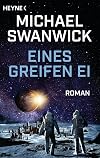
Griffin's Egg [short fiction]
by Michael Swanwick
On This Page
Description
Two people fall in love and a community fights for its life against a backdrop of thermonuclear war and a hi-tech repressive government in this science-fiction story written by the author of In the Drift and Vacuum Flowers.Tags
Recommendations























Member Reviews
Of the various Swanwick books I've read, this longish novella is the only one I haven't much liked. There's lots of skiffy goodness in it, but the tale telling -- the aspect of Swanwick's art that's usually impeccable -- and the story construction seem rickety; perhaps this was something that should have been a full-length novel but instead was worked as a novella when UK publisher Century commissioned it for their Legend Novellas line. I dunno.
The story's set on a lunar colony during a period when nuclear war suddenly breaks out on earth; there's a very real possibility that humanity may exterminate itself or at the very least civilization may collapse, leaving the colonists, who are not quite self-sufficient, to face a lingering show more demise for the lack of supplies from the home planet. To increase the irony of the situation, nanotechnology research being carried out on the moon has just revealed the path to enabling what may be our species' next evolutionary step -- the one where we become, by today's standards, superhuman. Through all this runs a curiously skewed love story whose conclusion seems just tacked on in a hurry.
But all of these dramas seemed to me to be happening at a distance. In part this was because a lot of the time I didn't really understand quite what was going on (not just in the geekly jargon but, for example, in some of the motivations of the characters); yet, when this happens to me in William Gibson's novels, I nonetheless feel as if I'm right in the middle of things, that my lack of complete comprehension is an exhilarating facet of the fact that I am, after all, visiting the future. In Griffin's Egg, by contrast, I felt more as if I were trying to follow a movie being shown on a screen far enough away that I couldn't hear the sound.
What I did like very much was the subtle way in which Swanwick conveys that the international political setup back on earth has shifted quite considerably by the time of his tale. He never ups and says this, but gradually you become aware that some countries regarded as relatively unimportant today have become major players on the world stage while (for example) the US is barely mentioned and is by now clearly a declined power. This sort of change is far too often ignored in sf novels about the future, even though we've had the example of the breakup of the Soviet Union not so very long ago to show us that such transformations do indeed occur in real life. show less
The story's set on a lunar colony during a period when nuclear war suddenly breaks out on earth; there's a very real possibility that humanity may exterminate itself or at the very least civilization may collapse, leaving the colonists, who are not quite self-sufficient, to face a lingering show more demise for the lack of supplies from the home planet. To increase the irony of the situation, nanotechnology research being carried out on the moon has just revealed the path to enabling what may be our species' next evolutionary step -- the one where we become, by today's standards, superhuman. Through all this runs a curiously skewed love story whose conclusion seems just tacked on in a hurry.
But all of these dramas seemed to me to be happening at a distance. In part this was because a lot of the time I didn't really understand quite what was going on (not just in the geekly jargon but, for example, in some of the motivations of the characters); yet, when this happens to me in William Gibson's novels, I nonetheless feel as if I'm right in the middle of things, that my lack of complete comprehension is an exhilarating facet of the fact that I am, after all, visiting the future. In Griffin's Egg, by contrast, I felt more as if I were trying to follow a movie being shown on a screen far enough away that I couldn't hear the sound.
What I did like very much was the subtle way in which Swanwick conveys that the international political setup back on earth has shifted quite considerably by the time of his tale. He never ups and says this, but gradually you become aware that some countries regarded as relatively unimportant today have become major players on the world stage while (for example) the US is barely mentioned and is by now clearly a declined power. This sort of change is far too often ignored in sf novels about the future, even though we've had the example of the breakup of the Soviet Union not so very long ago to show us that such transformations do indeed occur in real life. show less
A maverick moon jockey and his adventures on the moon. Reprimands, solar flares, unlikely romantic encounters, thrermonluclear war and brain-altering chemicals make life difficult in general and in particular.
Ratings
Members
- Recently Added By
Author Information

455+ Works 8,471 Members
Michael Swanwick has received the Hugo, Nebula, Theodore Sturgeon, and World Fantasy Awards for his work
Awards and Honors
Awards
Series
Belongs to Publisher Series
Work Relationships
Is contained in
Common Knowledge
- Canonical title
- Griffin's Egg [short fiction]
Classifications
Statistics
- Members
- 131
- Popularity
- 249,212
- Reviews
- 3
- Rating
- (3.27)
- Languages
- English, German
- Media
- Paper, Ebook
- ISBNs
- 6
- ASINs
- 2