What is Philosophy?
by Martin Heidegger
On This Page
Description
The writings of Martin Heidegger are fundamental to any understanding of contemporary philosophic problems and movements. Heidegger is considered the most original and profound philosopher of our age. He addresses himself to the contemporary world, attempting to interpret it and telling us what our place in the world is. He calls for a new awareness of freedom and he searches for the uniqueness of the human reality. Heidegger speaks of a new humanism; his philosophy is a fundamental show more re-evaluation of the relation of man to the world. Aristotle, whose influence on Heidegger's philosophy was pivotal. Important and detailed discussions of phenomenological research, philosophical definition, formal indication, the relationship between philosophy and the sciences, facticity, the surrounding world, questionability, and temporality emerge from this provocative text. As an early articulation of Heidegger's thought, show lessTags
Recommendations




























Member Reviews
Heidegger could be marked as a Greekofiel without much arguing. He states that the love for wisdom, philosophy, is a typical Greek endeavor. Since a lot of cultures have words for wisdom (sophia), like 'chokhmah' in Hebrew, such a statement can not be made before comparing content of this concept in different cultures.
That being said and clear in mind, it is a rather exciting little text. In answering the question 'what is - philosophy?' he goes back to the incentive why the Greeks start philosophizing, the 'pathos' of the philosophy. According to Heidegger this pathos was the wondering about the being of beings. That being is.
The question he asks us, what makes us start philosophizing now. He places emphasis on the modern turn to show more uncertainty as pathos for philosophizing, so that the practice became a search for certain knowledge, illustrated by Decartes cogito ergo sum as answer in the search for absolute certainty.
This modern pathos of uncertainty has two results. On the one hand you get stubborn fundamentalist, on the other hand people become apathetic. That sounds like a good description of the difference between two dominant groups in modern day culture.
And that is why I like Heidegger. He has the power to go from the most abstract and genealogical way of thinking right to the point of how we think today. The question - What is - philosophy? can only be answered when we know our pathos. show less
That being said and clear in mind, it is a rather exciting little text. In answering the question 'what is - philosophy?' he goes back to the incentive why the Greeks start philosophizing, the 'pathos' of the philosophy. According to Heidegger this pathos was the wondering about the being of beings. That being is.
The question he asks us, what makes us start philosophizing now. He places emphasis on the modern turn to show more uncertainty as pathos for philosophizing, so that the practice became a search for certain knowledge, illustrated by Decartes cogito ergo sum as answer in the search for absolute certainty.
This modern pathos of uncertainty has two results. On the one hand you get stubborn fundamentalist, on the other hand people become apathetic. That sounds like a good description of the difference between two dominant groups in modern day culture.
And that is why I like Heidegger. He has the power to go from the most abstract and genealogical way of thinking right to the point of how we think today. The question - What is - philosophy? can only be answered when we know our pathos. show less
Heidegger is like Noam Chomsky, in that he should be read regularly in order to refresh your capacity for critical and reflective thought.
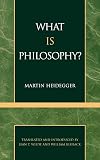
This particular edition is translated by Jean T. Wilde and William Kluback, and includes the German (and Greek/Latin/French) original on the left hand side, and the English translation on the right. Without presuming to be competent to judge the quality of the translation, the terminology seems to be generally in line with what I've read elsewhere, though the Greek thaumazein is translated by 'astonishment' rather than the more common (in my readings) 'wonder'.
My other quibble with the translation is that the German title "Was ist das--die Philosophie?" is not adequately translated by "What is show more philosophy" as the former seeks to explicitly convey a focus on the way the question is framed--i.e., in the Greek manner of "what is that which we call a tree?"
I found footnote 3 in the introduction, which begins "Heidegger's interpretation of Plato and Aristotle implies a misunderstanding of the position of both," to be out of place and even a bit uppity. Without suggesting that Heidegger is beyond criticism (obviously not the case), to throw in a little jab in an otherwise exclusively expository introduction struck me as peevish, disrespectful to Heidegger's endeavour, and even revealing of a fundamental misunderstanding of what Heidegger is up to.
That said, I believe the idea that the "being-moved" that Heidegger analyzes in relation to what the question of "what is philosophy?" does to us has "nothing whatsoever to do with that which is usually called feelings and emotions" (p. 27) is junk. show less
This particular edition is translated by Jean T. Wilde and William Kluback, and includes the German (and Greek/Latin/French) original on the left hand side, and the English translation on the right. Without presuming to be competent to judge the quality of the translation, the terminology seems to be generally in line with what I've read elsewhere, though the Greek thaumazein is translated by 'astonishment' rather than the more common (in my readings) 'wonder'.
My other quibble with the translation is that the German title "Was ist das--die Philosophie?" is not adequately translated by "What is show more philosophy" as the former seeks to explicitly convey a focus on the way the question is framed--i.e., in the Greek manner of "what is that which we call a tree?"
I found footnote 3 in the introduction, which begins "Heidegger's interpretation of Plato and Aristotle implies a misunderstanding of the position of both," to be out of place and even a bit uppity. Without suggesting that Heidegger is beyond criticism (obviously not the case), to throw in a little jab in an otherwise exclusively expository introduction struck me as peevish, disrespectful to Heidegger's endeavour, and even revealing of a fundamental misunderstanding of what Heidegger is up to.
That said, I believe the idea that the "being-moved" that Heidegger analyzes in relation to what the question of "what is philosophy?" does to us has "nothing whatsoever to do with that which is usually called feelings and emotions" (p. 27) is junk. show less
Ratings
Members
- Recently Added By
Lists

Filosofía - Clásicos
217 works; 1 member

Art of Reading
188 works; 5 members
Author Information

457+ Works 23,530 Members
Martin Heidegger was born in Messkirch, Baden, Germany on September 22, 1889. He studied Roman Catholic theology and philosophy at the University of Frieburg before joining the faculty at Frieburg as a teacher in 1915. Eight years later Heidegger took a teaching position at Marburg. He taught there until 1928 and then went back to Frieburg as a show more professor of philosophy. As a philosopher, Heidegger developed existential phenomenology. He is still widely regarded as one of the most original philosophers of the 20th century. Influenced by other philosophers of his time, Heidegger wrote the book, Being in Time, in 1927. In this work, which is considered one of the most important philosophical works of our time, Heidegger asks and answers the question "What is it, to be?" Other books written by Heidegger include Basic Writings, a collection of Heidegger's most popular writings; Nietzsche, an inquiry into the central issues of Friedrich Nietzsche's philosophy; On the Way to Language, Heidegger's central ideas on the origin, nature and significance of language; and What is Called Thinking, a systematic presentation of Heidegger's later philosophy. Since the 1960s, Heidegger's influence has spread beyond continental Europe and into a number of English-speaking countries. Heidegger died in Messkirch on May 26, 1976. (Bowker Author Biography) show less
Some Editions
Common Knowledge
- Original title
- Was ist das Die Philosophie?
- Original publication date
- 1956
Classifications
Statistics
- Members
- 195
- Popularity
- 168,055
- Reviews
- 3
- Rating
- (3.50)
- Languages
- 8 — Dutch, English, German, Greek, Italian, Portuguese (Portugal), Spanish, Turkish
- Media
- Paper, Ebook
- ISBNs
- 15
- ASINs
- 9