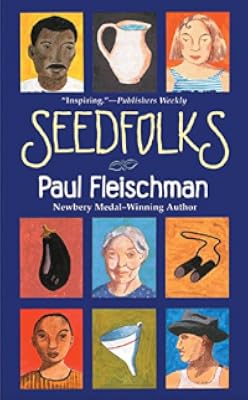
Seedfolks
by Paul Fleischman
On This Page
Description
One by one, a number of people of varying ages and backgrounds transform a trash-filled inner-city lot into a productive and beautiful garden, and in doing so, the gardeners are themselves transformed.Tags
Recommendations







Member Reviews
Maybe the author had good intentions with this story of a multicultural community coming together to grow a garden. But the racial insensitivity it traffics in was painful - each chapter is written in a different characters voice, but only the Asian character is written with an obvious accent. The political and economic assumption is that all these people could build a better community if they just worked a little harder. One of the final chapters includes a line “ It had been such a wonderful change to see people making something for themselves instead of waiting for a welfare check.”
There’s so much to unpack in these 70 pages, and I don’t think this novella deserves that much work.
There’s so much to unpack in these 70 pages, and I don’t think this novella deserves that much work.
Using the multiple voices that made Bull Run (1995) so absorbing, Fleischman takes readers to a modern inner-city neighborhood and a different sort of battle, as bit by bit the handful of lima beans an immigrant child plants in an empty lot blossoms into a community garden, tended by a notably diverse group of local residents. It's not an easy victory: Toughened by the experience of putting her children through public school, Leona spends several days relentlessly bulling her way into government offices to get the lot's trash hauled away; others address the lack of readily available water, as well as problems with vandals and midnight dumpers; and though decades of waging peace on a small scale have made Sam an expert diplomat, he's show more unable to prevent racial and ethnic borders from forming. Still, the garden becomes a place where wounds heal, friendships form, and seeds of change are sown. Readers won't gain any great appreciation for the art and science of gardening from this, but they may come away understanding that people can work side by side despite vastly different motives, attitudes, skills, and cultural backgrounds. It's a worthy idea, accompanied by Pedersen's chapter-heading black-and-white portraits, providing advance information about the participants' races and, here and there, ages. (Fiction. 9-11)
-Kirkus Review show less
-Kirkus Review show less
I got this book based on a colleague's recommendation and ended up liking it more than I thought I might. It tells the story of a vacant lot that is transformed by the members of neighboring apartments into a community garden. I guess I was put off by the expectation of a feel-good, we’re-all-in-this-together story but it didn’t read that way and I especially liked how individuals were given some development rather than being just stereotyped characters from any urban neighborhood. I was told but had to see for myself.
This shares a community's story of an apartment complex of individuals with diverse backgrounds who come together to grow a community garden. Each individual has their own set of problems and cultural dialects, but the community garden allows the problems and cultures to subside and allow the neighbors to find common ground and become just like one another.
I personally love the development of each character in this novel as well as the organization of the book. I also loved the dialect of each character, as the reader is able to truly gain an appreciation for the culture of each character.
Reading this book has introduced me to a wonderful author, who I look forward to reading more literature by Paul Fleischman.
I personally love the development of each character in this novel as well as the organization of the book. I also loved the dialect of each character, as the reader is able to truly gain an appreciation for the culture of each character.
Reading this book has introduced me to a wonderful author, who I look forward to reading more literature by Paul Fleischman.
This is a lovely tale of what makes humans, humans. It tells us that we have so much in common and we all have a story to tell. The story connects us to each other and to the Earth. It tells us that the most simple and basic act of growing a garden can bring people of all backgrounds together for a common goal. It is a quick, but satisfying read. The individual stories are rich and layered without being preachy and one-dimensional. A great read for any age.
Cute little story - a neighborhood of (mostly) immigrants coming together thanks to a guerrilla garden. Nice hopeful ending. That's about all there is to it, though.
Very good book that incorporates several different narrators from different races and cultures and surprisingly brings them all together with the goal of a flourishing garden. I enjoyed reading the different perspectives from each narrator.
Members
- Recently Added By
Published Reviews
ThingScore 100
Margaret Jackson (Children's Literature)
With Seedfolks, Newbery Medal winner Paul Fleischman has written a kind of modern-day folk tale about disconnected urban dwellers coming together one-by-one to join in a rather accidental community garden. It all starts with the simple act of a young immigrant girl honoring her dead father by planting a few lima beans in vacant lot in her downtrodden show more Cleveland neighborhood. She tells her story in chapter one and the chapters that follow are the voices of the other gardeners--spanning all ages and many nationalities--and how they came to be a part of the garden and the new community spirit that blossomed there. Seedfolks is just a slip of a book but a very interesting story well told. 1997, Joanna Cotler Books/HarperCollins, $13.95 and $13.89. Ages 10 up. show less
With Seedfolks, Newbery Medal winner Paul Fleischman has written a kind of modern-day folk tale about disconnected urban dwellers coming together one-by-one to join in a rather accidental community garden. It all starts with the simple act of a young immigrant girl honoring her dead father by planting a few lima beans in vacant lot in her downtrodden show more Cleveland neighborhood. She tells her story in chapter one and the chapters that follow are the voices of the other gardeners--spanning all ages and many nationalities--and how they came to be a part of the garden and the new community spirit that blossomed there. Seedfolks is just a slip of a book but a very interesting story well told. 1997, Joanna Cotler Books/HarperCollins, $13.95 and $13.89. Ages 10 up. show less
added by kthomp25
Lists

4th Grade Books
312 works; 5 members

Community or Social Activism
14 works; 1 member

Garden
23 works; 2 members
Talk Discussions
Past Discussions
Found: Fiction book about a community garden, Switching POVs in Name that Book (November 2024)
Author Information

57+ Works 15,943 Members
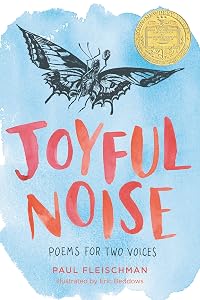
Paul Fleischman was born in Monterey, California on September 5, 1952. His father is fellow children's author, Sid Fleischman. He attended the University of California at Berkeley for two years, from 1970 to 1972. He dropped out to go on a cross-country train/bicycle trip and along the way took care of a 200-year-old house in New Hampshire. He show more eventually earned a Bachelor of Arts Degree from the University of New Mexico in 1977. Fleischman has written over 25 books for children and young adults including award winners such as Joyful Noise: Poems for Two Voices, Newberry Medal in 1989; Graven Images, Newberry Honor; Bull Run, Scott O'Dell Award for Historical Fiction; Breakout, Finalist for the National Book Award in 2003; Saturnalia, Boston Globe-Horn Book Fiction Honor. He has also garnered numerous awards and recognitions from the American Library Association, School Library Journal, Publisher's Weekly, Booklist, and NCTE. He founded the grammar watchdog groups ColonWatch and The Society for the Prevention of Cruelty to English. (Bowker Author Biography) show less
Awards and Honors
Awards
Distinctions
Notable Lists
Work Relationships
Has as a student's study guide
Has as a teacher's guide
Common Knowledge
- Canonical title
- Seedfolks
- Original publication date
- 1997
- People/Characters
- Kim; Ana; Wendell; Maricela; Gonzalo; Leona (show all 12); Sam; Florence; Virgil; Sae Young; Nora; Amir
- Important places
- Cleveland, Ohio, USA; The Garden
- First words
- I stood before our family altar. It was dawn. No one else in the apartment was awake. I stared at my father's photograph - his thin face stern, lips latched tight, his eyes peering permanently to the right. I was nine yea... (show all)rs old and still hoped that perhaps his eyes might move. Might notice me.
- Quotations
- If we happened to miss, two or three days, people stopped by to ask about Mr. Myles' health. We, like our seeds, were now planted in the garden.
Nora, British nurse
The object in America is to avoid contact, to treat all as foes unless they're known to be friends. Here you have a million crabs living in a million crevices.
But the garden's greatest benefit, I feel, was not relief... (show all) to the eyes, but to make the eyes see our neighbors.
Amir, Indian manager of a fabric store
My grandmother's sampler from when she was a girl, said "Be Not Solitary, Be Not Idle." That was easy all those years in the library. Being retired, it's harder.
Florence - Last words
- (Click to show. Warning: May contain spoilers.)It was the little Oriental girl, with a trowel and a plastic bag of lima beans. I didn't recognize her. It didn't matter. I felt as happy inside as if I'd just seen the first swallow of spring. Then I looked up. There was the man in the rocker.
We waved and waved to each other.
Classifications
Statistics
- Members
- 2,601
- Popularity
- 7,322
- Reviews
- 162
- Rating
- (4.14)
- Languages
- Chinese, English, German, Spanish
- Media
- Paper, Audiobook, Ebook
- ISBNs
- 22
- UPCs
- 1
- ASINs
- 14