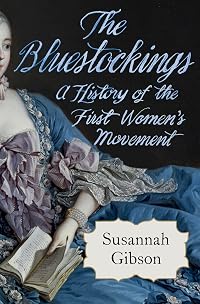
The Bluestockings: A History of the First Women's Movement
by Susannah Gibson
On This Page
Description
This illuminating group portrait delves into the lives of a circle of 18th-century women called the Bluestockings, who came together in glittering salons to discuss and debate as intellectual equals with men, fighting for women to be educated and have a public role in society.Tags
Recommendations










Member Reviews
In the 19th c. a Bluestocking was a derisive term for a learned woman, but where did it come from? Ironically from a man's fashion choice at the glamorous salon of Elizabeth Montagu. As a wealthy patroness, Elizabeth encouraged various "interesting" women to come through her doors and speak their minds. Like-minded hostess Hester Thrale created her own salon in Streatham, introducing novelist Frances Burney. Montagu's sister, Sarah Scott, dreamt of a female-run society, while literary success Hannah More "discovers" rural poetess Ann Yearsley. There's Mary Delaney who served as an inspiration for the "rational" Hester Mulso, the career-oriented Elizabeth Carter, Sarah Fielding, the lovely Sophia Streatfield, Catharine Macaulay and show more Elizabeth Griffith.
I wouldn't refer to the Bluestockings Society as the first women's movement. While they certainly did subvert patriarchal norms, this small interconnected circle still answered to social hierarchy and respectability. Gibson's initial description of a salon as a "place where women could show their true selves" simply doesn't hold up. Commoner Yearsley was kept at arm's length, and Burney's appearance is by invitation only. The independent Scott pursued the "acceptable" work of charity but dismissed a friend for choosing family over her community. Thrale blames Streatfield for her husband's attraction to her and actress Griffith "was not as closely tied to the group as others," most likely due to her profession. Macaulay is shunned for her sexual freedom. That "lesser" or women of color went unheard and unwelcomed should've also been addressed. However, we do see the first inklings of independence to overcome marital servitude. Would've preferred a more honest narrative, but I still recommend it! It certainly convinced me to check out the works of these important ladies! show less
I wouldn't refer to the Bluestockings Society as the first women's movement. While they certainly did subvert patriarchal norms, this small interconnected circle still answered to social hierarchy and respectability. Gibson's initial description of a salon as a "place where women could show their true selves" simply doesn't hold up. Commoner Yearsley was kept at arm's length, and Burney's appearance is by invitation only. The independent Scott pursued the "acceptable" work of charity but dismissed a friend for choosing family over her community. Thrale blames Streatfield for her husband's attraction to her and actress Griffith "was not as closely tied to the group as others," most likely due to her profession. Macaulay is shunned for her sexual freedom. That "lesser" or women of color went unheard and unwelcomed should've also been addressed. However, we do see the first inklings of independence to overcome marital servitude. Would've preferred a more honest narrative, but I still recommend it! It certainly convinced me to check out the works of these important ladies! show less
The problem with 18th-century women, for the feminist public historian, is that they just won’t fit the narrative. We all know about the Suffragettes, so the thinking goes, and we are fairly sure that their forerunner Mary Wollstonecraft can be called a proto-feminist. Surely, a generation or two before Wollstonecraft, there were also brilliant women organising to topple the patriarchy?
Such a narrative underpins Susannah Gibson’s Bluestockings. The book argues exactly what its title suggests: that the group of female intellectuals loosely associated with the metropolitan salons of Elizabeth Montagu made up, collectively, ‘the first women’s liberation movement’. Across an interlinked series of biographical case studies, Gibson show more attempts to cast women writers ranging from Elizabeth Carter and Hannah More to Frances Burney and Hester Thrale Piozzi as proto-feminists who ‘laid the foundations for a whole new worldview’. While many full-length biographies of the key individuals are already available, an accessible group study such as this one is long overdue. Gibson is an engaging writer, with a good eye for entertaining detail. I am grateful, for example, to learn that Hannah More’s cats were named Passive Obedience and Non-Resistance.
But Gibson’s core aim – to present her subjects as a grouping both progressive and cohesive – is only credible if one takes a very selective approach. The problem with characterising the Bluestockings as a new beacon of feminist progressivism is apparent from the first few pages when, in order for her story to make sense, Gibson needs to show that the society upon which the Bluestockings exploded was entirely unenlightened on questions of women’s capabilities. ‘Women were held in low regard in the eighteenth century’, she informs us. Well, yes, by some people, such as the author of the 1739 pamphlet ‘MAN SUPERIOR TO WOMAN’, one of three sources cited as evidence of universal low regard. It is not mentioned, however, that the author was responding to an earlier pamphlet by ‘Sophia, a Person of Quality’ entitled ‘WOMAN NOT INFERIOR TO MAN’, and that his sally was quickly matched by another called ‘WOMAN’S SUPERIOR EXCELLENCE OVER MAN’. Such a curious omission prompts reflection on the many works published by both men and women before or around this time which celebrate female learning, virtue and skill. But to acknowledge such works would complicate the narrative: and so they go unacknowledged.
Read the rest of the review at HistoryToday.com.
Sophie Coulombeau is Senior Lecturer in 18th-century English Literature at the University of York. show less
Such a narrative underpins Susannah Gibson’s Bluestockings. The book argues exactly what its title suggests: that the group of female intellectuals loosely associated with the metropolitan salons of Elizabeth Montagu made up, collectively, ‘the first women’s liberation movement’. Across an interlinked series of biographical case studies, Gibson show more attempts to cast women writers ranging from Elizabeth Carter and Hannah More to Frances Burney and Hester Thrale Piozzi as proto-feminists who ‘laid the foundations for a whole new worldview’. While many full-length biographies of the key individuals are already available, an accessible group study such as this one is long overdue. Gibson is an engaging writer, with a good eye for entertaining detail. I am grateful, for example, to learn that Hannah More’s cats were named Passive Obedience and Non-Resistance.
But Gibson’s core aim – to present her subjects as a grouping both progressive and cohesive – is only credible if one takes a very selective approach. The problem with characterising the Bluestockings as a new beacon of feminist progressivism is apparent from the first few pages when, in order for her story to make sense, Gibson needs to show that the society upon which the Bluestockings exploded was entirely unenlightened on questions of women’s capabilities. ‘Women were held in low regard in the eighteenth century’, she informs us. Well, yes, by some people, such as the author of the 1739 pamphlet ‘MAN SUPERIOR TO WOMAN’, one of three sources cited as evidence of universal low regard. It is not mentioned, however, that the author was responding to an earlier pamphlet by ‘Sophia, a Person of Quality’ entitled ‘WOMAN NOT INFERIOR TO MAN’, and that his sally was quickly matched by another called ‘WOMAN’S SUPERIOR EXCELLENCE OVER MAN’. Such a curious omission prompts reflection on the many works published by both men and women before or around this time which celebrate female learning, virtue and skill. But to acknowledge such works would complicate the narrative: and so they go unacknowledged.
Read the rest of the review at HistoryToday.com.
Sophie Coulombeau is Senior Lecturer in 18th-century English Literature at the University of York. show less
I don't know what I expected of this book but it wasn't what I got. I had always believed the Bluestockings were associated with the suffragist movement in early 20th c.England.I am grateful to have my understanding corrected. The original Bluestockings were 18th c. female intellectuals who elevated the education and abilities of women while continuing to maintain the respectability required by the social mores of the day. The salons they created offered opportunities for many of them to become published and identified for their work. Using letters from a number of the members, Gibson built the backstory for key participants so that the reader had a good representation of the life and restrictions of wealthy, educated women in the mid show more 1700s. I did find the narrative lacking in cohesion and I found the author’s habit of “guessing” at the reactions of her subjects disconcerting in a researched biography. The movement disappeared during the Victorian era only to reappear at the end of the 19th c.as a moniker for the suffragist movement. show less
*very well-written and powerful
*strong character development
*kept my interest from cover to cover
*highly recommend
*strong character development
*kept my interest from cover to cover
*highly recommend
Ratings
Members
- Recently Added By
Lists

Phi Beta Kappa reading list
260 works; 8 members
Author Information
4 Works 200 Members
Awards and Honors
Distinctions
Common Knowledge
- People/Characters
- Elizabeth Montagu; Anne-Marie Fiquet du Boccage; Elizabeth Carter; Hannah More; Hester Mulso Chapone; Frances Burney (show all 31); Margaret Cavendish Harley; Mary Delany; Anne Donnellan; Catherine Dashwood; Mary Catherine Knollys; Edward Montagu; Conyers Middleton; Hester Thrale; Samuel Johnson; Queeney Thrale; David Garrick; Joshua Reynolds; Charles Burney; Frances Boscawen; Elizabeth Vesey; Ann Yearsley; Sarah Scott; Sarah Fielding; Henry Thrale; Sophia Streatfield; Oliver Goldsmith; Catherine Macaulay; George Macaulay; Alexander Pendarves; Elizabeth Cutts
- Important places
- Streatham, London, England, UK; Bulstrode, Buckinghamshire, England, UK; Hill Street, London, England, UK
- Epigraph
- She rises, conscious of her worth; And, at her new-found powers elated, Thanks them not rous'd, but new created. - Hannah More, 'The Bas Bleu', 1783
- Dedication
- For Irene - friend, inspiration and fellow bluestocking
- First words
- When Elizabeth Montagu first visited Hill Street in 1746, it was barely a street at all.
- Quotations
- ...the world does not mind our intrinsic worth so much as the fashion of us, and will not easily forgive our not pleasing...in a woman's education little but outward accomplishment is regarded. - Elizabeth Montagu
- Last words
- (Click to show. Warning: May contain spoilers.)As Hester Mulso Chapone wrote to Frances Burney when she heard that her young friend was in town - come and see me, 'put on your blue stockings.'
- Blurbers
- Gordon, Lyndall; Todd, Janet; Lipscomb, Benjamin J.B.
Classifications
- Genres
- Sexuality and Gender Studies, History, General Nonfiction, Nonfiction, Biography & Memoir
- DDC/MDS
- 305.30942 — Society, government, & culture Social sciences, sociology & anthropology Social group - Age, Gender, Ethnicity People by gender or sex Biography and History by Region Europe
- LCC
- HQ1075.5 .E5 .G53 — Social sciences The family. Marriage, Women and Sexuality The Family. Marriage. Women Sex role
- BISAC
Statistics
- Members
- 153
- Popularity
- 214,880
- Reviews
- 4
- Rating
- (3.89)
- Languages
- English
- Media
- Paper, Audiobook, Ebook
- ISBNs
- 4
- ASINs
- 2