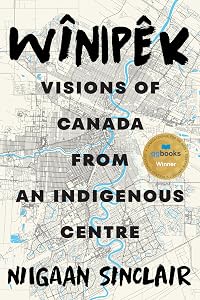
Wînipêk: Visions of Canada from an Indigenous Centre
by Niigaan Sinclair
On This Page
Description
"The story of a people told through the story of a city. Niigaan Sinclair is often accused of being angry in his columns. But how can he not be? In a collection of writing that spans the discovery of hundreds of unmarked graves at residential school sites, the murder of young Indigenous girls, and the indifference towards the basic human rights of his family members, this book is inspired by his award-winning columns 'from the centre.' Niigaan examines the state of urban Indigenous life and show more legacy. At a crucial moment in Canada's reckoning with its crimes against the Indigenous peoples of the land, one of our most essential writers begins at the centre, capturing a web spanning centuries of community, art, and resistance. Based on years' worth of columns in the Winnipeg Free Press, CBC, and elsewhere, Niigaan Sinclair delivers a defining essay collection on the resilience of Indigenous peoples. Here, we meet the creators, leaders, and everyday people preserving the beauty of their heritage one day at a time. But we also meet the ugliest side of settler colonialism, and the communities who suffer most from its atrocities. Sinclair uses the story of Winnipeg to illuminate the reality of Indigenous life all over what is called Canada. This is a book that demands change and celebrates those fighting for it, that reminds us of what must be reconciled and holds accountable those who must do the work. It's a book that reminds us of the power that comes from loving a place, even as that place is violently taken away from you, and the magic of fighting your way back to it."-- show lessTags
Recommendations












Member Reviews
Winipek: Visions of Canada from an Inigenous Centre contains a group of short essays by Nigaan Sinclair, Indigenous writer and Professor of Indigenous Studies at the University of Manitoba, concerning the relationship between First Nations and Canada. He uses Winipek ie Winnipeg because that is where the greatest percentage of Indigenous live in Canada and because it is representative of how Indigenous are treated throughout the country. This includes the horrors of and cross-generational effects of the residential school system linked to high rates of abuse, addiction, and homelessness among Indigenous. He talks of the large numbers of missing and murdered Indigenous women and two- spirit people and the refusal of the Winnipeg Police show more Board to authorize the search of a landfill for bodies siting high cost. He discusses the yearly flooding of many Reserves resulting in the displacement of their populations and leaving their homes unsafe.And he writes about the overarching problem caused by the Indian Act and the slow process of the Truth and Reconciliation Act. And he discusses how all of this is exacerbated by the high rates of racism against First Nations in Canada.
But it is not all bad. He also talks about changes that give him hope for the future for First Nations and for Canada as a whole including the revival of Indigenous languages and cultural practices. He shows how Indigenous especially youth have taken a lead in the fight against climate change as Water Protectors although, even here, the Canadian government and police forces always seem to side with the oil and logging companies. He also points to the recent election of Wab Kinew as the Premier of Manitoba, the first Indigenous Premier ever elected in Canada
The issues discussed in Winipek are complex and important but Sinclair discusses them clearly while avoiding the pedantry or legalese too often used to outline Canada's treatment of Indigenous. He also doesn’t pretend to be an objective observer which is, frankly, a good thing. These are and should be treated as ethical issues, too long put aside as in the past and no longer relevant. Too often issues like the ongoing search for unmarked graves of Indigenous children who died at Residential Schools has led to debates in which Residential School denial is treated as valid. This is a very interesting, very informative, very important and very readable book and should be taught in schools not only in Winnipeg and Manitoba but all across Canada and, really, in all settler colonial countries no matter where.
I received an ARC of this book from Netgalley and Penguin Random House Canada in exchange for an honest review show less
But it is not all bad. He also talks about changes that give him hope for the future for First Nations and for Canada as a whole including the revival of Indigenous languages and cultural practices. He shows how Indigenous especially youth have taken a lead in the fight against climate change as Water Protectors although, even here, the Canadian government and police forces always seem to side with the oil and logging companies. He also points to the recent election of Wab Kinew as the Premier of Manitoba, the first Indigenous Premier ever elected in Canada
The issues discussed in Winipek are complex and important but Sinclair discusses them clearly while avoiding the pedantry or legalese too often used to outline Canada's treatment of Indigenous. He also doesn’t pretend to be an objective observer which is, frankly, a good thing. These are and should be treated as ethical issues, too long put aside as in the past and no longer relevant. Too often issues like the ongoing search for unmarked graves of Indigenous children who died at Residential Schools has led to debates in which Residential School denial is treated as valid. This is a very interesting, very informative, very important and very readable book and should be taught in schools not only in Winnipeg and Manitoba but all across Canada and, really, in all settler colonial countries no matter where.
I received an ARC of this book from Netgalley and Penguin Random House Canada in exchange for an honest review show less
Ratings
Members
- Recently Added By
Lists

Globe and Mail | Canadian Non-Fiction: June 8, 2024
10 works; 1 member
Globe and Mail | Canadian Non-Fiction: June 15, 2024
10 works; 1 member

Globe and Mail | Canadian Non-Fiction: September 7, 2024
10 works; 1 member
Author Information
2+ Works 48 Members
Awards and Honors
Classifications
- Genres
- Nonfiction, Anthropology, General Nonfiction, History, Biography & Memoir
- DDC/MDS
- 305.897071 — Society, government, & culture Social sciences, sociology & anthropology Social group - Age, Gender, Ethnicity Ethnic and national groups Other ethnic and national groups North American native peoples
- LCC
- E78 .C2 .S56 — History of the United States America Indians of North America
- BISAC
Statistics
- Members
- 47
- Popularity
- 637,438
- Reviews
- 1
- Rating
- (4.58)
- Languages
- English
- Media
- Paper, Audiobook, Ebook
- ISBNs
- 4
- ASINs
- 3