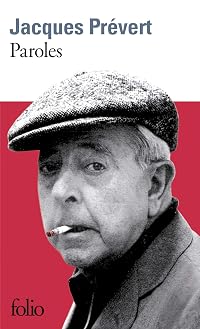
Paroles
by Jacques Prévert
On This Page
Description
In the years immediately following World War II, Jacques Prevert spoke directly to and for the French who had come of age during the German Occupation. First published in 1946 by Les Editions de Minuit, a press with its origins in the Underground, Paroles met with enormous success, and there were several hundred thousand copies in print by the time these first translations in English were published by City Lights in 1958. Today Prevert speaks out in a voice still attuned to our times, for show more the human condition (which is always his focus) has not changed. In fact, man's inhumanity to man would seem to have intensified, making these poems ever more touching, ever more prescient. show lessTags
Recommendations


















Member Reviews
Paroles is Prévert's best-known collection, containing pieces dating from the early thirties to the end of the war. There are a couple of longer prose pieces, the satire "Tentative de déscription d'un diner de têtes à Paris-France" and the quasi-autobiographical "Souvenirs de Famille ou L'Ange Garde-Chiourme", but otherwise the collection is mostly poems and songs, including a short-story-length "feuilleton" in free verse, "La crosse en l'air".
Lots of political engagement, as you'd expect in the thirties: Prévert knew a thing or two about being hungry and unemployed himself, and he takes up the cause of victims of the economic crisis in many of the pieces here, and there is also plenty of ammunition to spare for Mussolini, Hitler, show more Franco and the Roman Catholic Church. ("La crosse en l'air", which opens with a bishop drunk in the gutter, covers just about all these satirical bases in one place.) Anti-war poems feature heavily as well, also as you'd expect. Lots of lists, too, Prévert's favourite structural device, lots of wordplay, and quite a few absurd leaps of logic. Altogether good fun, even if he goes a bit too far here and there. show less
Lots of political engagement, as you'd expect in the thirties: Prévert knew a thing or two about being hungry and unemployed himself, and he takes up the cause of victims of the economic crisis in many of the pieces here, and there is also plenty of ammunition to spare for Mussolini, Hitler, show more Franco and the Roman Catholic Church. ("La crosse en l'air", which opens with a bishop drunk in the gutter, covers just about all these satirical bases in one place.) Anti-war poems feature heavily as well, also as you'd expect. Lots of lists, too, Prévert's favourite structural device, lots of wordplay, and quite a few absurd leaps of logic. Altogether good fun, even if he goes a bit too far here and there. show less
Cada poesía que hace parte del libro nos lleva a un universo totalmente distinto. Es un libro dinámico, divertido y diferente.
Wonderful cynical anti-establishment, and even funny poems
Not a great poet but helpful to someone learning to read French.
La que tuve y leí hasta gastarla, hasta que se me descuajeringó toda, era la versión en castellano.
Rappelle-toi Barbara
Il pleuvait sans cesse sur Brest ce jour-là
Et tu marchais souriante
Epanouie ravie ruisselante
Sous la pluie
Rappelle-toi Barbara...
Oh Barbara
Quelle connerie la guerre
Qu'es-tu devenue maintenant
Sous cette pluie de fer
De feu d'acier de sang
Et celui qui te serrait dans ses bras
Amoureusement
Est-il mort disparu ou bien encore vivant...
Fatras/succession Jacques Prévert, droits numériques réservés.
Né en 1900 à Neuilly, Jacques Prévert est à la fois, par ses poèmes et ses chansons, le poète le plus populaire et le scénariste de L'affaire est dans le sac, du Crime de monsieur Lange, de Drôle de drame, de Quai des brumes, du jour se lève, des Visiteurs du soir, des Enfants du paradis.
Il pleuvait sans cesse sur Brest ce jour-là
Et tu marchais souriante
Epanouie ravie ruisselante
Sous la pluie
Rappelle-toi Barbara...
Oh Barbara
Quelle connerie la guerre
Qu'es-tu devenue maintenant
Sous cette pluie de fer
De feu d'acier de sang
Et celui qui te serrait dans ses bras
Amoureusement
Est-il mort disparu ou bien encore vivant...
Fatras/succession Jacques Prévert, droits numériques réservés.
Né en 1900 à Neuilly, Jacques Prévert est à la fois, par ses poèmes et ses chansons, le poète le plus populaire et le scénariste de L'affaire est dans le sac, du Crime de monsieur Lange, de Drôle de drame, de Quai des brumes, du jour se lève, des Visiteurs du soir, des Enfants du paradis.
Members
- Recently Added By
Lists

Poetry Corner
187 works; 15 members

Harold Bloom - The Western Canon: D. The Chaotic Age
833 works; 24 members

Favourite Books
1,819 works; 308 members

Books Read in 2017
4,249 works; 130 members

1940s
221 works; 25 members

Poetry Collections
79 works; 6 members

Favourite Surrealist Poetry
36 works; 1 member
20th Century Literature
1,161 works; 55 members
Le Monde - Les 100 livres du siècle
121 works; 25 members

Europe
205 works; 6 members

Les 50 meilleurs livres de langue française de 1900 à aujourd’hui
69 works; 2 members

Las mejores obras literarias leídas en 2020 -- Magistrales (R. D.)
14 works; 1 member
Author Information

Jacques Prévert, born February 4, 1900, was a French poet and screenwriter. His poems became and remain very popular in the French-speaking world, particularly in schools. Some of the movies he wrote are extremely well regarded, with Les Enfants du Paradis considered one of the greatest films of all time. He grew up in Paris and quit school at a show more young age. He was called to military service in 1918. His poems are often about life in Paris and life after the Second World War. He died in Omonville-la-Petite, on 11 April 1977. (Bowker Author Biography) show less
Some Editions
Awards and Honors
Series
Belongs to Publisher Series
Work Relationships
Is abridged in
Has as a student's study guide
Common Knowledge
- Canonical title*
- Paroles
- Original title
- Paroles
- Original publication date
- 1946
- First words*
- Ceux qui pieusement...
Ceux qui copieusement...
Ceux qui tricolorent
Ceux qui inaugurent
Ceux qui croient
Ceux qui croient croire
Ceux qui croa-croa
Ceux qui ont des plumes
Ceux qui grignotent - Quotations
- Rappelle-toi, Barbara
Il pleuvait sans cesse sur Brest ce jour-là
Et tu marchais souriante
Epanouie ravie ruisselante
Sous la pluie - Last words*
- (Click to show. Warning: May contain spoilers.)D'un monde sans savoir-vivre mais plein de joie de vivre
D'un monde sobre et ivre
D'un monde triste et gai
Tendre et cruel
Réel et surréel
Terrifiant et marrant
Nocturne et diurne
Solite et insolite
Beau comme tout. - Original language*
- Français
*Some information comes from Common Knowledge in other languages. Click "Edit" for more information.
Classifications
Statistics
- Members
- 1,103
- Popularity
- 23,000
- Reviews
- 13
- Rating
- (4.18)
- Languages
- 5 — English, French, German, Italian, Spanish
- Media
- Paper, Ebook
- ISBNs
- 22
- ASINs
- 23