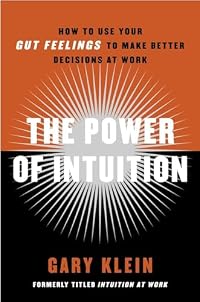
The Power of Intuition: How to Use Your Gut Feelings to Make Better Decisions at Work
by Gary Klein
On This Page
Description
Business. New Age. Self-Improvement. Nonfiction. HTML:At times in our careers, we've all been aware of a "gut feeling" guiding our decisions. Too often, we dismiss these feelings as "hunches" and therefore untrustworthy. But renowned researcher Gary Klein reveals that, in fact, 90 percent of the critical decisions we make is based on our intuition. In his new book, THE POWER OF INTUITION, Klein shows that intuition, far from being an innate "sixth sense," is a learnable—and show more essential—skill.Based on interviews with senior executives who make important judgments swiftly, as well as firefighters, emergency medical staff, soldiers, and others who often face decisions with immediate life-and-death implications, Klein demonstrates that the expertise to recognize patterns and other cues that enable us—intuitively—to make the right decisions—is a natural extension of experience.
Through a three-tiered process called the "Exceleration Program," Klein provides readers with the tools... show less
Tags
Recommendations








Member Reviews
I enjoy Gary Klein's work because it resonates with my own experiences in decision making. What makes it useful is that he has spent a great deal of time in analyzing these processes and organizing them into a consistent thesis. He provides many examples and practical exercises to illustrate and reinforce the principles that he has identified.
The material in this book is excellent, and I particularly benefited from the the discussion on Recognition Primed Decisions (RPD), the use of decision games as a tool to foster and analyze intuitive decision making and the aspect of "executive intent" which is important for defining the scope and goals of intuitive decision makers.
The book is replete with examples, in fact there were so many in show more some cases that I found them to be irritating because they do tend to interrupt the flow of thought, but this was, perhaps, their intent. The many practical exercises would make this a useful manual in a workshop on decision making. show less
The material in this book is excellent, and I particularly benefited from the the discussion on Recognition Primed Decisions (RPD), the use of decision games as a tool to foster and analyze intuitive decision making and the aspect of "executive intent" which is important for defining the scope and goals of intuitive decision makers.
The book is replete with examples, in fact there were so many in show more some cases that I found them to be irritating because they do tend to interrupt the flow of thought, but this was, perhaps, their intent. The many practical exercises would make this a useful manual in a workshop on decision making. show less
Gary Klein schreef Sources of Power, volgens Business & Strategy een van de beste managementboeken van de 20e eeuw. Klein werkt al vele jaren zeer succesvol met het concept intuïtie bij bedrijven en organisaties. Daarbij neemt hij bewust afstand van een magische/mystieke invulling van het begrijp, en pleit hij voor een doelgerichte synthese tussen ratio en intuïtie. Het boek Intuïtie in het werk is na de inleiding verdeeld in opbouwen, instandhouden en overbrengen van intuïtie.
Het opbouwen gaat volgens het herkenningsgeoriënteerd beslissingsmodel, waarin patroonherkenning, mentale modellen en aanwijzingen in een situatie handvaten bieden. De toepassing draait om oefeningen. Klein stelt er een aantal aan je voor: de premortem show more exercitie, probleemdetectie, omgaan met onzekerheid, inschatten van situaties, het ruimte bieden aan gerichte creativiteit en het aanpassen van en improviseren op bestaande plannen. Het in standhouden van intuïtie draait om het kunnen overbremngen van je intentie en het anderen helpen aan een sterke intuïtie. Leercultuur, cognitieve taakanalyse, coaching geven en krijgen zijn hierbij belangrijke hulpmiddelen. Klein staat vervolgens stil bij de rol van metrieken en de invloed van informatietechnologie op het gebruik van intuïtie. Klein schrijft verhelderend, biedt allerhande casebeschrijvingen en zoekt verbinding. show less
Het opbouwen gaat volgens het herkenningsgeoriënteerd beslissingsmodel, waarin patroonherkenning, mentale modellen en aanwijzingen in een situatie handvaten bieden. De toepassing draait om oefeningen. Klein stelt er een aantal aan je voor: de premortem show more exercitie, probleemdetectie, omgaan met onzekerheid, inschatten van situaties, het ruimte bieden aan gerichte creativiteit en het aanpassen van en improviseren op bestaande plannen. Het in standhouden van intuïtie draait om het kunnen overbremngen van je intentie en het anderen helpen aan een sterke intuïtie. Leercultuur, cognitieve taakanalyse, coaching geven en krijgen zijn hierbij belangrijke hulpmiddelen. Klein staat vervolgens stil bij de rol van metrieken en de invloed van informatietechnologie op het gebruik van intuïtie. Klein schrijft verhelderend, biedt allerhande casebeschrijvingen en zoekt verbinding. show less
Aug 3, 2008Dutch
Ratings
Members
- Recently Added By
Author Information

13 Works 1,286 Members
Gary Klein is chairman and chief scientist of Klein Associates. He lives in Yellow Springs, Ohio.
Classifications
- Genres
- Nonfiction, General Nonfiction, Business
- DDC/MDS
- 153.44 — Philosophy and Psychology Psychology Conscious mental processes and intelligence Thought, thinking, reasoning, intuition, value, judgment Intuition
- LCC
- BF315.5 .K57 — Philosophy, Psychology and Religion Psychology Psychology Consciousness. Cognition
- BISAC
Statistics
- Members
- 173
- Popularity
- 188,676
- Reviews
- 2
- Rating
- (3.94)
- Languages
- English, Estonian
- Media
- Paper, Ebook
- ISBNs
- 4
- ASINs
- 2