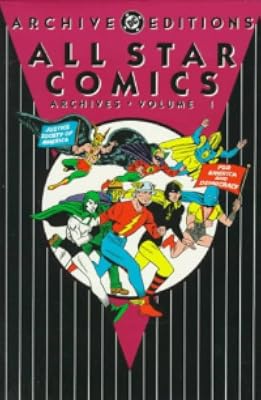
All Star Comics Archives, Volume 1
by Gardner Fox
All Star Comics Archives (1), All-Star Comics Vol 1 (1940-1978) (Collections and Selections — 3-6)
On This Page
Description
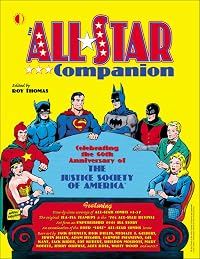
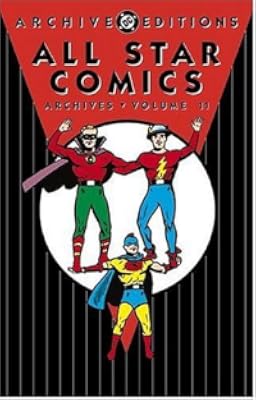
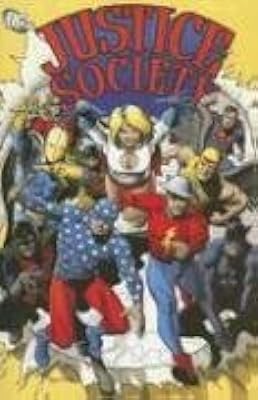
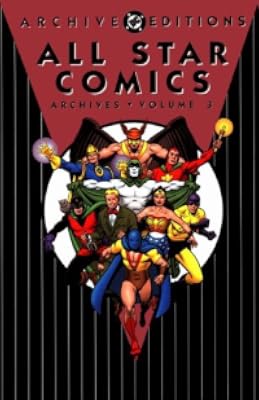
A collection of the adventures of the Justice Society of America, which at various times includes Wonder Woman, the Flash, the Green Lantern, Dr. Midnite, Wildcat, and Hawkman.Tags
Recommendations






Member Reviews
When you read a book with collected comics from the 40s, you need to be prepared for both the style and the cheesiness. After all - they were marketed and written for kids and this collections shows it.
Issue 3 which opens this collection is the issue that gives the world the Justice Society of America - the first (I believe?) superhero team. But if you expect a joint adventure, you will be very disappointed. In that first issue, the charter members of the Society (The Flash, The Green Lantern, The Spectre, The Hawkman, Dr. Fate, The Hour Man, The Sandman and The Atom) meet for the first time and decide to tell each other stories of their war against the criminals. The lack of Batman and Superman is obvious but at that time they have show more their own books - so no need to add them in yet another collected books (all other books that DC publishes at the time contain the separate adventures of a lot of different heroes). The stories are classic tales with heroes that you know (although everyone is introduced; each adventure drawn with the specific style and lettering usually used for that specific hero. In a way, it is a patched issue and at the time probably noone realized what it will end up being. And then there is Johnny Thunder - annoying, unknown (to me anyway) and added for some unknown reason - with his lack of control of his special talent, he is so different from anyone else.
And while issue 3 was readable enough, issue 4 summons the newly created society to Washington and they are sent to fight the Fifth column. Everyone has their own adventure, everyone does their own things. Calling the style old-fashioned will be an offense to the words. And even knowing that it was written for children, it feels didactic and forced. With Europe just getting in the throes of WWII, this is somewhat expected. But still...
Issue 5 sees a master criminal called X (ok, the early creators of comics are not even bothering to invent names) decides to obliterate the society because they are way too effective against his operations. Each of the heroes end up having their own adventure and it is as good of a story as you expect from the era - cheesy, full of plot holes and silly - but solid in its own way.
And then DC decided that the Flash is getting his one book as well so he is moved to a "honorary member" (as are Batman and Superman) and the annoying Johnny Thunder gets his chance to become a member. Of course he almost manages to bungle a very easy job and it requires every single one of the heroes to go and try to save him before he is saved. By the end of the story, he is a member. And he is still annoying.
If you have issues with women that live only for their men and stupid criminals and superheroes that are so cheeky that you wonder how anyone buys what they are saying, you should not be reading this book. But if you want to see how the things started, it is what it is.
I thought for a while how to rate this book. I loved it as a history of the comics team but it has flows. On the other hand, a book does not exist in vacuum so I am rating based on the collection itself and the comics in the context of the time. show less
Issue 3 which opens this collection is the issue that gives the world the Justice Society of America - the first (I believe?) superhero team. But if you expect a joint adventure, you will be very disappointed. In that first issue, the charter members of the Society (The Flash, The Green Lantern, The Spectre, The Hawkman, Dr. Fate, The Hour Man, The Sandman and The Atom) meet for the first time and decide to tell each other stories of their war against the criminals. The lack of Batman and Superman is obvious but at that time they have show more their own books - so no need to add them in yet another collected books (all other books that DC publishes at the time contain the separate adventures of a lot of different heroes). The stories are classic tales with heroes that you know (although everyone is introduced; each adventure drawn with the specific style and lettering usually used for that specific hero. In a way, it is a patched issue and at the time probably noone realized what it will end up being. And then there is Johnny Thunder - annoying, unknown (to me anyway) and added for some unknown reason - with his lack of control of his special talent, he is so different from anyone else.
And while issue 3 was readable enough, issue 4 summons the newly created society to Washington and they are sent to fight the Fifth column. Everyone has their own adventure, everyone does their own things. Calling the style old-fashioned will be an offense to the words. And even knowing that it was written for children, it feels didactic and forced. With Europe just getting in the throes of WWII, this is somewhat expected. But still...
Issue 5 sees a master criminal called X (ok, the early creators of comics are not even bothering to invent names) decides to obliterate the society because they are way too effective against his operations. Each of the heroes end up having their own adventure and it is as good of a story as you expect from the era - cheesy, full of plot holes and silly - but solid in its own way.
And then DC decided that the Flash is getting his one book as well so he is moved to a "honorary member" (as are Batman and Superman) and the annoying Johnny Thunder gets his chance to become a member. Of course he almost manages to bungle a very easy job and it requires every single one of the heroes to go and try to save him before he is saved. By the end of the story, he is a member. And he is still annoying.
If you have issues with women that live only for their men and stupid criminals and superheroes that are so cheeky that you wonder how anyone buys what they are saying, you should not be reading this book. But if you want to see how the things started, it is what it is.
I thought for a while how to rate this book. I loved it as a history of the comics team but it has flows. On the other hand, a book does not exist in vacuum so I am rating based on the collection itself and the comics in the context of the time. show less
I haven't gotten hooked back on my comic book habit (yet) but I have pulled a few off the shelf to enjoy over meals. (Comics are great to read when your hands are primarily occupied with the task of stuffing your face.) This is the first volume reprinting the Justice Society of America stories from All-Star Comics, issues three through six. According to modern standards, the art and stories are pretty crude, yet I have to admit I enjoyed them. Comics of the 1940s give a glimpse of an alien world--a world filled with gangsters, hidden civilizations, mad scientists and heroes who are unambiguously good and heroic. A fine place to escape for a half hour or so.
--J.
--J.
Ratings
Members
- Recently Added By
Author Information

All Editions
Some Editions
Series

All Star Comics Archives
12 works (1)

All-Star Comics Vol 1 (1940-1978)
39 works (Collections and Selections — 3-6)
Belongs to Publisher Series
Work Relationships
Common Knowledge
- Canonical title
- All Star Comics Archives, Volume 1
- Original title
- All Star Comics Archives, Volume 1
- People/Characters
- Justice Society of America; Green Lantern; Flash; Jay Garrick; Alan Scott; Johnny Thunder (show all 28); Doctor Fate; Sandman; Hawkman; Spectre; Atom; Shiera Hall; Oom; Hourman; Red Tornado; Dian Belmont; Inza Nelson; Irene Miller; Hawkgirl; Doctor Mid-Nite; Kent Nelson; Wesley Dodds; Carter Hall; Jim Corrigan; Al Pratt; Rex Tyler; Ma Hunkel; Charles McNider
- Important places
- Justice Society of America Headquarters; Toledo, Ohio, USA; El Paso, Texas, USA
- Important events
- World War II
Classifications
- Genre
- Graphic Novels & Comics
- DDC/MDS
- 741.5973 — Arts & recreation Drawing & decorative arts Drawing Comic books, graphic novels, fotonovelas, cartoons, caricatures, comic strips History, geographic treatment, biography North American United States (General)
- LCC
- PN6728 .A39 — Language and Literature Literature (General) Literature (General) Collections of general literature Comic books, strips, etc.
- BISAC
Statistics
- Members
- 82
- Popularity
- 389,561
- Reviews
- 2
- Rating
- (4.05)
- Languages
- English
- Media
- Paper
- ISBNs
- 1