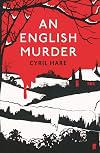
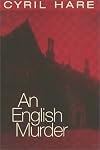
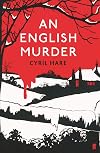
An English Murder
by Cyril Hare
On This Page
Description
A country house murder mystery classic, as a party find themselves snowed-in on Christmas Eve with a murderer among them . . . The snow is thick, the phone line is down, and no one is getting in or out of Warbeck Hall. All is set for a lovely Christmas, with friends and family gathered round the fire, except as the bells chime midnight, a murder is committed. But who is responsible? The scorned young lover? The lord's passed-over cousin? The social climbing politician's wife? The Czech show more history professor? The obsequious butler? And perhaps the real question is: Can they survive long enough to find out? show lessTags
Recommendations



















Member Recommendations
Member Reviews
'An English Murder' is a classic English Country House Christmas Murder Mystery that gently debunks 1950s English upper-class manners and beliefs..
The murder mystery works fairly well. Set in s splendid country house with a small group of closely connected guests snowed in over Christmas, it offers dramatic death scenes. a rich pool of suspects, damsels (of different classes) in distress, and triggers an almost over-mastering impulse to shout, 'the butler did it'.
Who did it, how they did it and why they did it slowly become clear as the plot unwinds like a skein of tangled wool pulled at by a cat. I enjoyed trying (and failing) to work the thing out.
Cyril Hare uses this mystery to display and gently debunk some of the beliefs and show more practices of the English upper-class in 1950. Much of this debunking assumes knowledge of recent events in British politics. I945-1950 saw the first full-term Labour government. They had been elected with a massive majority and saw themselves as having a mandate for fundamental change. At the end of their first full term, in 1950, the Labour Party stayed in power but with only a two seat majority, having lost seventy-eight seats. When the government called another election in 1951, the year 'An English Murder' was published, the Labour Party lost to the Conservatives. Hare manages to field characters from across the political spectrum in his small Christmas house party.
I liked that Hare chose to use a foreigner, Dr Botwink, a German Professor of history, who is studying the papers of the seventeenth century Lord Warbeck, to hold up a mirror to the twentieth century English. Dr Botwink speaks excellent engiish and has a better grasp of logic and more detailed knowledge of English history, including the history of the family hosting him, than the English upper-class around him do. Dr Botwink who, as well as studying and teaching in Heidelberg and Prague, has spent some time in a German concentration camp, has a very un-English view on politics and is constantly trying to understand the nuances of what the English think of as 'good form'.
At the beginning of the book set a few days before Christmas, Dr Botwink asks Briggs, the butler whether it is right for him to eat with the servants or with the guests who are coming for Christmas. He's happy when Briggs tells him that he should eat with the guests. Then he learns that the son and heir of the present Lord Warbeck will be present and he tells Briggs that he would rather eat with the servants. The exchange that follows is the start of taking a look at the English from the outside. Dr Botwink explains himself to Briggs by saying that the son is:
'...the president of this affair that calls itself the League of Liberty and Justice?’ ‘I understand that to be the fact, sir.’ ‘The League of Liberty and Justice, Briggs,’ said Dr Bottwink very clearly and deliberately, ‘is a Fascist organisation.’ ‘Is that so, sir?’ ‘You are not interested, Briggs?’ ‘I have never been greatly interested in politics, sir.’ ‘Oh, Briggs, Briggs,’ said the historian, shaking his head in regretful admiration, ‘if you only knew how fortunate you were to be able to say just that!’
I was amused to see that the current Lord Warbeck became a symbol for the plight of the aristocracy after World War II: passive, out of place and doomed. He is weak, bed-ridden and close to death. His decline mirrors that of the great houses who could no longer afford to staff or maintain their estates. His imminent demise raises the spectre of Death Duty which the Labour was using as a mechanism to redistribute wealth from the rich to the poor.
His brash and objectionable son and heir is used to show the flirtation of the English aristocracy with Fascism, although this case he seems to be driven less by political dogma and more from pique at his own loss of status. He's shown as leading a small, furtive group who dress-up in special jumpers in secret and play at being patriots.
His uncle, the present Lord Warbeck's brother, the Labour Chancellor of the Exchequer, also ends up being the butt of humour. This man, who has a key role in creating a new, more egalitarian, socialist Britain is shown to have no grasp of economics (he thinks he doesn't need it. He has chaps for that). We also learn that one of his dark, politically embarrassing, secrets is that while he often rode to hounds in his youth.
Then we have the women in the house party: the well-connected wife of a talented but Not-Our-Class-Darling Labour Junior Finance Minister who pushes her husband's career too hard and talks too much and a bright should-have-been-married-by-now-and-becoming-rather-desperate-about-it young gentlewoman who seems prone to passivity.
The servant classes are represented by the Butler and his daughter and the Personal Protection agent from Scotland Yard who is accompanying the Chancellor of the Exchequer. It was fascinating to watch these folks being torn between their old roles of unquestioning service and their awareness that that world was dying.
From the first death onwards, the Scotland Yard man is nominally in charge but clearly out of his depth. Meanwhile, Dr Botwink sets about solving the mystery as an act of self-preservation, reasoning that: 1. there is a murderer in the house and more murders may follow. 2. he is a foreigner and therefore the obvious person to take the blame.
I liked that the solution to the mystery required knowledge of an obscure piece of English law and a forgotten piece English history. I can imagine, that Cyril Hare, who was a County Court Judge when this book was published, saw this whole book as a sort of lawyerly joke. Still, it is a joke that is well told and which, eighty years later, still made me smile. show less
Originally published in 1951, An English Murder by Cyril Hare is a post-WWII murder mystery that uses many of the classic ingredients from the Golden Age of Murder Mysteries. He sets his mystery at an English country manor during the Christmas season and has the cast totally snowed in. The use of Christmas is really only an excuse to have a gathering as there is very little festivity involved in this story.
Be delving into English hereditary laws and customs, Cyril Hare came up with a unique murder mystery. The guests are a mixed bag and come with assorted tensions both personal and political. As this group of rather unlikable people are being cut down one by one, only one of the guests appears to be trying to solve the mystery. show more Historian Dr. Bettwink uses his research into old papers, his knowledge of human nature and a book about the life of William Pitt, to decipher the motive behind the three deaths.
I felt that An English Murder was the author’s clever homage to vintage English country house murder mysteries. He tweaked the ingredients just enough to come up with an original and interesting plot and added a more modern touch, well, 1950s modern, by including discussions revolving around class distinction and prejudices. I enjoyed this book and will look for more mysteries by this author. show less
Be delving into English hereditary laws and customs, Cyril Hare came up with a unique murder mystery. The guests are a mixed bag and come with assorted tensions both personal and political. As this group of rather unlikable people are being cut down one by one, only one of the guests appears to be trying to solve the mystery. show more Historian Dr. Bettwink uses his research into old papers, his knowledge of human nature and a book about the life of William Pitt, to decipher the motive behind the three deaths.
I felt that An English Murder was the author’s clever homage to vintage English country house murder mysteries. He tweaked the ingredients just enough to come up with an original and interesting plot and added a more modern touch, well, 1950s modern, by including discussions revolving around class distinction and prejudices. I enjoyed this book and will look for more mysteries by this author. show less
It’s a masterpiece! It has every staple of cozy mysteries—a reluctant Christmas guest, an English house party, a lord with a bad heart summoning his family around him, a suspicious butler, being snowed in with a murderer—but it is incredibly original. Published in 1951, it depicts post-war Britain still undergoing privations and everyone having strong feelings about the new Labor government. It also has a sympathetic portrayal of a Jewish Holocaust survivor, arguably the main character. I will say that as in the Francis Pettigrew mysteries, the solution involves a little-known fact about British law (of that time period, no less.) There was no way I could have figured it out but that didn’t trouble me!
PS. My brother said that show more readers of a specific Victorian novelist will know this point of British law and they will be able to solve the mystery. But I don’t want to give too much away! show less
PS. My brother said that show more readers of a specific Victorian novelist will know this point of British law and they will be able to solve the mystery. But I don’t want to give too much away! show less
An English Murder - Hare
Audio performance by Chris MacDonnell
3 stars
It’s Christmas. It’s snowing. It’s an English country house. There’s a murder.
Of course there’s a murder. Or two.
The setting is post WW2. There are political tensions within the gathered family. The son of the house heads a fascist organization. A visiting scholar is a refugee Jew. The very correct family butler is struggling to maintain the standards of a past generation. The lord of the manner is dying of old age. His cousin, a prominent member of parliament, arrives with his own security agent. So convenient, the agent can head the investigation as the snow comes down and the body count goes up.
This was a mildly entertaining, predictable mystery. It show more made me think, just a bit, of The Remains of the Day. The character interactions were designed to highlight the cultural, political and financial adjustments that occurred following the war. In other ways, the plot was a pale imitation of an Agatha Christie or Margery Allingham mystery. show less
Audio performance by Chris MacDonnell
3 stars
It’s Christmas. It’s snowing. It’s an English country house. There’s a murder.
Of course there’s a murder. Or two.
The setting is post WW2. There are political tensions within the gathered family. The son of the house heads a fascist organization. A visiting scholar is a refugee Jew. The very correct family butler is struggling to maintain the standards of a past generation. The lord of the manner is dying of old age. His cousin, a prominent member of parliament, arrives with his own security agent. So convenient, the agent can head the investigation as the snow comes down and the body count goes up.
This was a mildly entertaining, predictable mystery. It show more made me think, just a bit, of The Remains of the Day. The character interactions were designed to highlight the cultural, political and financial adjustments that occurred following the war. In other ways, the plot was a pale imitation of an Agatha Christie or Margery Allingham mystery. show less
A satisfying murder mystery which feels deeply classic but also oddly modern. Classic, because it is set in a snowed-in country house over a 36-hour period, with the suspects restricted to our main cast - everyone of them noble on the surface but deeply shabby within - and a bunch of unseen servants, of course. Modern, because this is a novel in which a socialist Chancellor and a neo-Fascist make up two members of the family, whose guests include a variety of upper-class types realising their day is nearly done, lower-class types on the make, and a refugee from Hitler's Europe who sees through all of this nonsense. (More than once, I had to remind myself this was an authentic novel of the 1950s, and not an Anthony Horowitz pastiche.) show more
Like most crime fiction novels, the second half is less exciting than the setup, although the plot holds together quite well. I would like to adapt this for the screen, I think. It could make an enjoyable - and timely - TV film. show less
Like most crime fiction novels, the second half is less exciting than the setup, although the plot holds together quite well. I would like to adapt this for the screen, I think. It could make an enjoyable - and timely - TV film. show less
I had trouble locating this book, finally finding it through an interlibrary transfer. I 'm glad I pursued it. The characters were distinct, the mystery was satisfying - right down to the last few pages, I kept trying to figure it out. The setting was engrossing. When he talked about the muniment room, I felt the cold.
This is a book I will read again.
This is a book I will read again.
If you're looking for a traditional crime novel to read over Christmas, this is just about ideal. A whodunnit set in a declining country house, with all of the suspects (and potential victims) kept indoors by the snow, An English Murder is like a literary game of 'murder in the dark'. The post-war setting gives the author the opportunity of poking fun at the various political factions of the day, as does his device of featuring social commentary by an 'outsider'. Unfortunately this latter mechanism – an ingenious continental European seeking to 'understand' the English – betrays the novel's greatest flaw: its debt to the character and routine of Monsieur Hercule Poirot. Still well worth reading.
Members
- Recently Added By
Lists

Anthony Boucher's Best Crime Fiction of the Year
115 works; 5 members

British Mystery
469 works; 14 members

Christmas Reading
142 works; 5 members

Books Read in 2011
684 works; 19 members

Books Read in 2022
5,226 works; 115 members

Books Read in 2023
5,638 works; 147 members

Best Christmas Mysteries
114 works; 2 members
Must Read Detective Stories (Nick Fuller)
278 works; 2 members

Top Ten Escapist Crime Reads (Martin Edwards)
10 works; 1 member
Christmas Books
370 works; 40 members
Author Information

21+ Works 2,741 Members
Some Editions
Awards and Honors
Series
Belongs to Publisher Series
Perennial Library (P455)
detebe (22604)
Work Relationships
Has the adaptation
Common Knowledge
- Canonical title*
- Mord-- made in England
- Original title
- An English Murder
- Alternate titles
- The Christmas Murder
- Original publication date
- 1951
- People/Characters
- Thomas Warbeck, Viscount Warbeck; Hon. Robert Warbeck; Lady Camilla Prendergast; Sir Julius Warbeck; Mrs. Carstairs; Briggs, the butler (show all 9); Susan Briggs; Sgt. James Rogers; Wenceslaus Bottwink (Dr., Ph.D)
- Important places
- Warbeck Hall, Markshire, England, UK; London, England, UK
- First words
- Warbeck Hall is reputed to be the oldest inhabited house in Markshire.
- Quotations*
- The muniment room in the north-eastern angle is probably the oldest part; it is certainly the coldest. Dr Wenceslaus Bottwink, Ph.D. of Heidelberg, Hon.D.Litt. of Oxford, sometime Professor of Modern History in the University... (show all) of Prague, corresponding member of half a dozen learned societies from Leyden to Chicago, felt the cold sink into his bones as he sat bowed over the pages of a pile of faded manuscripts, pausing now and then in his reading to transcribe passages from them in his angular foreign script. He was accustomed to cold. It had been cold in his student's lodgings in Heidelberg, colder yet in Prague in the winter of 1917, coldest of all in the concentration camps of the Third Reich.
- Last words
- (Click to show. Warning: May contain spoilers.)'I shall speak to the Prime Minister about it,' said Sir Julius Warbeck.
- Blurbers*
- Lawson, Mark
- Original language
- English
- Disambiguation notice
- An English Murder is sometimes known as The Christmas Murder.
*Some information comes from Common Knowledge in other languages. Click "Edit" for more information.
Classifications
Statistics
- Members
- 563
- Popularity
- 52,633
- Reviews
- 31
- Rating
- (3.86)
- Languages
- 10 — Danish, English, French, German, Italian, Japanese, Korean, Russian, Spanish, Swedish
- Media
- Paper, Audiobook, Ebook
- ISBNs
- 26
- ASINs
- 17