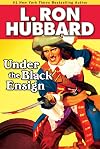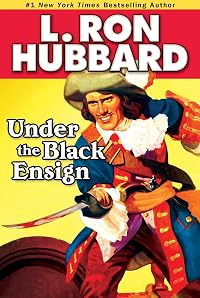
Under the Black Ensign (Stories from the Golden Age)
by L. Ron Hubbard
Stories from the Golden Age - Galaxy Press, Stories From the Golden Age
On This Page
Description
Long before Captain Jack Sparrow raised hell with the Pirates of the Caribbean, Tom Bristol sailed to hell and back Under the Black Ensign. That's where the real adventure begins. Bristol's had plenty of bad luck in his life. Press-ganged into serving aboard a British vessel, he's felt the cruel captain's lash on his back. Then, freed from his servitude by pirates, his good fortune immediately takes a bad turn . . . as the pirates accuse him of murder-and leave him to die on a deserted show more island. Now all he has left are a few drops of water, a gun, and just enough bullets to put himself out of his misery. But Bristol's luck is about to change. Finding himself in the unexpected company of a fiery woman and a crafty crew, he unsheathes his sword, raises a pirate flag of his own, and sets off to make love and war on the open seas. In his early twenties, Hubbard led the two-and-a-half-month, five-thousand-mile Caribbean Motion Picture Expedition. He followed that with the West Indies Mineralogical Expedition near San Juan, Puerto Rico, in which he completed the island's first mineralogical survey as an American territory. It was during these two journeys that Hubbard became an expert on the Caribbean's colorful history-an expertise he drew on to write stories like Under the Black Ensign. show lessTags
Recommendations























Member Reviews
Another rapidly moving tale from L. Ron Hubbard, Under the Black Ensign is quite the enjoyable read. Heroes (Pirates!), Villains, Damsel in a dress, everything an adventure tale from the ‘30s should be.
And some things that it should not be. There is a small glossary at the end to explain certain terms. One such was “pieces of seven.” This is defined as a small cannon with a bore diameter of seven centimeters. Since the story is set in 1680, more than one hundred years before the introduction of the metric system, there is a serious anachronism here. There is also a reference to a fortress armed with “Thirty eight-thousand pound cannon”. Since cannon at the time were defined by the weight of their shot (not cannon weight or show more bore size) this is also wrong. There are many such errors. It seems no self respecting pirate would have a ship of less than 50 guns, and regularly went looking for warships beat up on. All silliness.
None of my criticisms should be taken as detracting from the basic entertainment of the story itself. But of more concern is the fact that this very small story (80 pages) goes for $9.95. That seems way more than it is worth. Any book by C.S. Forester or Patrick O’Brian seems a much better value. show less
And some things that it should not be. There is a small glossary at the end to explain certain terms. One such was “pieces of seven.” This is defined as a small cannon with a bore diameter of seven centimeters. Since the story is set in 1680, more than one hundred years before the introduction of the metric system, there is a serious anachronism here. There is also a reference to a fortress armed with “Thirty eight-thousand pound cannon”. Since cannon at the time were defined by the weight of their shot (not cannon weight or show more bore size) this is also wrong. There are many such errors. It seems no self respecting pirate would have a ship of less than 50 guns, and regularly went looking for warships beat up on. All silliness.
None of my criticisms should be taken as detracting from the basic entertainment of the story itself. But of more concern is the fact that this very small story (80 pages) goes for $9.95. That seems way more than it is worth. Any book by C.S. Forester or Patrick O’Brian seems a much better value. show less
 This review was written for LibraryThing Early Reviewers.
I have won several of these L. Ron Hubbard dramatizations through librarything.com and they are great. Excellent production values, sound effects and music.
Under the Black Ensign is set in the Caribbean. Tom Bristol was a junior officer on a US ship before he was shanghaied into the British navy. Now, as a simple sailor, he accidentally endangers the governor of Nevis and is unfairly sentenced to death for attempted murder. When the ship is taken by pirates, he gladly switches sides, as does Midshipman Jim, a teenager on the naval boat. Tom's time with the pirates does not go very well and he is soon cast ashore on a small island. Jim comes to rescue him and they begin a series of adventures together.
We can imagine that Galaxy Press, show more publishers of these dramatizations, is a Scientologist outfit, but there is nothing that points directly to a link.
I received the Galaxy Press audio dramatization of Under the Black Ensign (Stories from the Golden Age) by L. Ron Hubbard through Librarything.com. show less
Under the Black Ensign is set in the Caribbean. Tom Bristol was a junior officer on a US ship before he was shanghaied into the British navy. Now, as a simple sailor, he accidentally endangers the governor of Nevis and is unfairly sentenced to death for attempted murder. When the ship is taken by pirates, he gladly switches sides, as does Midshipman Jim, a teenager on the naval boat. Tom's time with the pirates does not go very well and he is soon cast ashore on a small island. Jim comes to rescue him and they begin a series of adventures together.
We can imagine that Galaxy Press, show more publishers of these dramatizations, is a Scientologist outfit, but there is nothing that points directly to a link.
I received the Galaxy Press audio dramatization of Under the Black Ensign (Stories from the Golden Age) by L. Ron Hubbard through Librarything.com. show less
This review was written for LibraryThing Early Reviewers.Another 80-year-old pulp yarn from L. Ron Hubbard—this one not much more than a mildly pleasurable diversion featuring the usual cast of flat characters going through their standard paces. Even so, I was actually enjoying the fast-paced seventeenth-century pirate action right up until the too-perfect-to-be-believable ending rolled up in the last few pages with a loud clunk.
This review was written for LibraryThing Early Reviewers.Thanks to LibraryThing for awarding this book to me through their giveaway!
The Story.
Tom Bristol didn’t volunteer to serve on the HMS Terror. He was first mate on the Randolph when he was gang-pressed into the service of Captain Manville. But his resentment didn’t compel him to hurl a belaying pin at the Lord High Governor of Nevis, passenger aboard the Terror. Oh, no. That was an accident…
Neither Sir Charles Stukely nor Captain Manville are convinced by Bristol’s protestations of innocence. He attempted to assassinate the governor – he must be punished! One hundred lashes with the whip is too good for him!
But Bristol is saved, strangely enough, by the attack of a pirate ship which overwhelms the Terror. Finding Bristol bound, show more they free him and install him as part of the Terror’s new, piratical crew. Has Bristol turned outlaw, or will he still fight for honor and justice?
Discussion.
I have read two other works by L. Ron Hubbard – The Iron Duke and The Phantom Patrol. All three stories are what is known as “pulp fiction” - cheap, stereotypical adventures replete with daring heroes and leering villains. When judged as literature, pulp fiction is unimpressive. But when viewed as a separate cultural phenomena with a different purpose, pulp fiction can be appreciated on a different level.
As pulp fiction, The Phantom Patrol was okay. The Iron Duke was good. And Under the Black Ensign was very good. True, it has none of the depth or complexities of the four hundred page novel; but it’s not supposed to. It’s supposed to be a quick, zip-in-and-zip-out-adventure with no character development and lots of swordplay. And Under the Black Ensign acquits itself well by these standards.
Of course, Under the Black Ensign’s ending bore a remarkable resemblance to the ending of Captain Blood. (The movie version; I haven’t read the book.) In fact, having read Under the Black Ensign and watched Captain Blood within a week of each other, I rather got the two muddled in my mind. There are differences, to be sure, but enough of a resemblance to connect the two.
Conclusion. Fun fiction from the Golden Era of Pulp Fiction. The best I’ve read by L. Ron Hubbard thus far.
Note: I know next to nothing about maritime history, and therefore am unable to report whether the terms used and attitudes reflected in Under the Black Ensign are accurate.
Visit The Blithering Bookster to read more reviews!
www.blitheringbookster.com show less
The Story.
Tom Bristol didn’t volunteer to serve on the HMS Terror. He was first mate on the Randolph when he was gang-pressed into the service of Captain Manville. But his resentment didn’t compel him to hurl a belaying pin at the Lord High Governor of Nevis, passenger aboard the Terror. Oh, no. That was an accident…
Neither Sir Charles Stukely nor Captain Manville are convinced by Bristol’s protestations of innocence. He attempted to assassinate the governor – he must be punished! One hundred lashes with the whip is too good for him!
But Bristol is saved, strangely enough, by the attack of a pirate ship which overwhelms the Terror. Finding Bristol bound, show more they free him and install him as part of the Terror’s new, piratical crew. Has Bristol turned outlaw, or will he still fight for honor and justice?
Discussion.
I have read two other works by L. Ron Hubbard – The Iron Duke and The Phantom Patrol. All three stories are what is known as “pulp fiction” - cheap, stereotypical adventures replete with daring heroes and leering villains. When judged as literature, pulp fiction is unimpressive. But when viewed as a separate cultural phenomena with a different purpose, pulp fiction can be appreciated on a different level.
As pulp fiction, The Phantom Patrol was okay. The Iron Duke was good. And Under the Black Ensign was very good. True, it has none of the depth or complexities of the four hundred page novel; but it’s not supposed to. It’s supposed to be a quick, zip-in-and-zip-out-adventure with no character development and lots of swordplay. And Under the Black Ensign acquits itself well by these standards.
Of course, Under the Black Ensign’s ending bore a remarkable resemblance to the ending of Captain Blood. (The movie version; I haven’t read the book.) In fact, having read Under the Black Ensign and watched Captain Blood within a week of each other, I rather got the two muddled in my mind. There are differences, to be sure, but enough of a resemblance to connect the two.
Conclusion. Fun fiction from the Golden Era of Pulp Fiction. The best I’ve read by L. Ron Hubbard thus far.
Note: I know next to nothing about maritime history, and therefore am unable to report whether the terms used and attitudes reflected in Under the Black Ensign are accurate.
Visit The Blithering Bookster to read more reviews!
www.blitheringbookster.com show less
This review was written for LibraryThing Early Reviewers.This is one of a number of books that appear in the Golden Age series. For those of you who may be worried that the book may contain references to scientology or dianetics, for which this Author appears to be well-known, you need not worry. At no point in my reading of this did I find any references to either of these.
If you are a reader that is looking for a no frills, straight to the action kind of book, this one will be right up your alley. Like most books written in this era and classified as pulp fiction, there is no thought at all given to any character development, and when every page is packed with action and adventure, why waste time with all the frills and fancy that developing a back story brings with it. As with most of this show more Authors Golden Age books, the characters portrayed within its pages are not the usual stereotypical fodder one would except from this kind of book; instead they are more archetypical which makes the book more palatable for the reader.
At only 121 pages, this little novella is full of pirates, adventure, mishap, exploits and did I mention pirates? Every kind of piratical adventure imaginable is packed into these pages, and the reader can find themselves turning the last page before they realise it. It’s a high-octane and great uncomplicated read for all ages, especially children who are caught up in the pirate craze, and adults looking for some good old-fashioned escapism. I also feel this book would be suitable as bedtime reading to your children and grandchildren, and would definitely read it to mine.
I thoroughly enjoyed this book, and will definitely be hunting down some more of the Golden Age books for those nasty winter afternoons that lay ahead. I highly recommend you do the same.
Originally reviewed on: http://catesbooknuthut.com/2013/11/19/review-under-the-black-ensign-l-ron-hubbar...
This work is licensed under a Creative Commons Attribution-NonCommercial-NoDerivs 3.0 Unported License. show less
If you are a reader that is looking for a no frills, straight to the action kind of book, this one will be right up your alley. Like most books written in this era and classified as pulp fiction, there is no thought at all given to any character development, and when every page is packed with action and adventure, why waste time with all the frills and fancy that developing a back story brings with it. As with most of this show more Authors Golden Age books, the characters portrayed within its pages are not the usual stereotypical fodder one would except from this kind of book; instead they are more archetypical which makes the book more palatable for the reader.
At only 121 pages, this little novella is full of pirates, adventure, mishap, exploits and did I mention pirates? Every kind of piratical adventure imaginable is packed into these pages, and the reader can find themselves turning the last page before they realise it. It’s a high-octane and great uncomplicated read for all ages, especially children who are caught up in the pirate craze, and adults looking for some good old-fashioned escapism. I also feel this book would be suitable as bedtime reading to your children and grandchildren, and would definitely read it to mine.
I thoroughly enjoyed this book, and will definitely be hunting down some more of the Golden Age books for those nasty winter afternoons that lay ahead. I highly recommend you do the same.
Originally reviewed on: http://catesbooknuthut.com/2013/11/19/review-under-the-black-ensign-l-ron-hubbar...
This work is licensed under a Creative Commons Attribution-NonCommercial-NoDerivs 3.0 Unported License. show less
As usual I received this title for free in exchange for a review. This time from LibraryThing and in AudioBook format. Despite that kindness I will give my scrupulously honest review below.
First and foremost, it should be realized that my review is predicated entirely on the understanding that this is pulp action fiction pure and simple. Is there a grand and complex plotline to keep you guessing? no. Is there Dickensian detail and character development? no. Is there a grand social commentary buried in these pages? Not really... but sorta. This is just action, action and more action and that's all it tries to be. And at that, it does pretty well. OK, so that understood, lets get down to it.
So, on the positive side (and remember I have show more the audio book version of this) the book isn't really a book so much as a radio play. The narrator's voice is strong and steady and flawless throughout and the sound effects are comparable to what you would have heard in one of the radio broadcasts back in the 40s-50s. I'm a fan of such rot so that's a positive for me. It may well be a negative for you.
To the negative, while the narrator is steady his supporting cast is sometimes a bit off their game. The only other real negative is, possibly, everything I said in the first and foremost category. If you want depth or complexity look elsewhere. If you want sword battles and cannon fire, then stay right here.
In summary, it's pretty good at what it tries to be. I cannot fathom actually reading this text as it is pretty pulpy but as an audio book is does pretty well. show less
First and foremost, it should be realized that my review is predicated entirely on the understanding that this is pulp action fiction pure and simple. Is there a grand and complex plotline to keep you guessing? no. Is there Dickensian detail and character development? no. Is there a grand social commentary buried in these pages? Not really... but sorta. This is just action, action and more action and that's all it tries to be. And at that, it does pretty well. OK, so that understood, lets get down to it.
So, on the positive side (and remember I have show more the audio book version of this) the book isn't really a book so much as a radio play. The narrator's voice is strong and steady and flawless throughout and the sound effects are comparable to what you would have heard in one of the radio broadcasts back in the 40s-50s. I'm a fan of such rot so that's a positive for me. It may well be a negative for you.
To the negative, while the narrator is steady his supporting cast is sometimes a bit off their game. The only other real negative is, possibly, everything I said in the first and foremost category. If you want depth or complexity look elsewhere. If you want sword battles and cannon fire, then stay right here.
In summary, it's pretty good at what it tries to be. I cannot fathom actually reading this text as it is pretty pulpy but as an audio book is does pretty well. show less
This review was written for LibraryThing Early Reviewers.This is one of a number of books that appear in the Golden Age series. For those of you who may be worried that the book may contain references to scientology or dianetics, for which this Author appears to be well-known, you need not worry. At no point in my reading of this did I find any references to either of these.
If you are a reader that is looking for a no frills, straight to the action kind of book, this one will be right up your alley. Like most books written in this era and classified as pulp fiction, there is no thought at all given to any character development, and when every page is packed with action and adventure, why waste time with all the frills and fancy that developing a back story brings with it. As with most of this show more Authors Golden Age books, the characters portrayed within its pages are not the usual stereotypical fodder one would except from this kind of book; instead they are more archetypical which makes the book more palatable for the reader.
At only 121 pages, this little novella is full of pirates, adventure, mishap, exploits and did I mention pirates? Every kind of piratical adventure imaginable is packed into these pages, and the reader can find themselves turning the last page before they realise it. It’s a high-octane and great uncomplicated read for all ages, especially children who are caught up in the pirate craze, and adults looking for some good old-fashioned escapism. I also feel this book would be suitable as bedtime reading to your children and grandchildren, and would definitely read it to mine.
I thoroughly enjoyed this book, and will definitely be hunting down some more of the Golden Age books for those nasty winter afternoons that lay ahead. I highly recommend you do the same.
Originally reviewed on: http://catesbooknuthut.com/2013/11/19/review-under-the-black-ensign-l-ron-hubbar...
This work is licensed under a Creative Commons Attribution-NonCommercial-NoDerivs 3.0 Unported License. show less
If you are a reader that is looking for a no frills, straight to the action kind of book, this one will be right up your alley. Like most books written in this era and classified as pulp fiction, there is no thought at all given to any character development, and when every page is packed with action and adventure, why waste time with all the frills and fancy that developing a back story brings with it. As with most of this show more Authors Golden Age books, the characters portrayed within its pages are not the usual stereotypical fodder one would except from this kind of book; instead they are more archetypical which makes the book more palatable for the reader.
At only 121 pages, this little novella is full of pirates, adventure, mishap, exploits and did I mention pirates? Every kind of piratical adventure imaginable is packed into these pages, and the reader can find themselves turning the last page before they realise it. It’s a high-octane and great uncomplicated read for all ages, especially children who are caught up in the pirate craze, and adults looking for some good old-fashioned escapism. I also feel this book would be suitable as bedtime reading to your children and grandchildren, and would definitely read it to mine.
I thoroughly enjoyed this book, and will definitely be hunting down some more of the Golden Age books for those nasty winter afternoons that lay ahead. I highly recommend you do the same.
Originally reviewed on: http://catesbooknuthut.com/2013/11/19/review-under-the-black-ensign-l-ron-hubbar...
This work is licensed under a Creative Commons Attribution-NonCommercial-NoDerivs 3.0 Unported License. show less
Members
- Recently Added By
Author Information

909+ Works 19,829 Members
L. Ron Hubbard was born in Tilden, Nebraska on March 13, 1911. He attended George Washington University and Princeton University. He began his career as a writer for pulp magazines and later as a science fiction writer. His science fiction works include the Buckskin Brigades, Final Blackout, Fear, The Kingslayer, and Black Towers to Danger. His show more book, Dianetics, was published in 1950. He spent the next 30 years devoting himself to the development of Dianetics and Scientology. In 1954, he founded the Church of Scientology. In the 1980s, he published his final fiction works Battlefield Earth and the Mission Earth series, which won the Cosmos 2000 Award from French readers and the Nova Science Fiction Award from Italy's Perseo Libri. He died on January 24, 1986. (Bowker Author Biography) show less
Some Editions
Awards and Honors
Awards
Series


Common Knowledge
- Original publication date
- 1935
- People/Characters
- Tom Bristol; Lady Jane Campbell
- First words
- The marlinespike was inoffensive enough.
- Blurbers
- Anderson, Kevin J.
Classifications
Statistics
- Members
- 204
- Popularity
- 160,938
- Reviews
- 33
- Rating
- (3.73)
- Languages
- English
- Media
- Paper, Audiobook, Ebook
- ISBNs
- 11
- ASINs
- 4